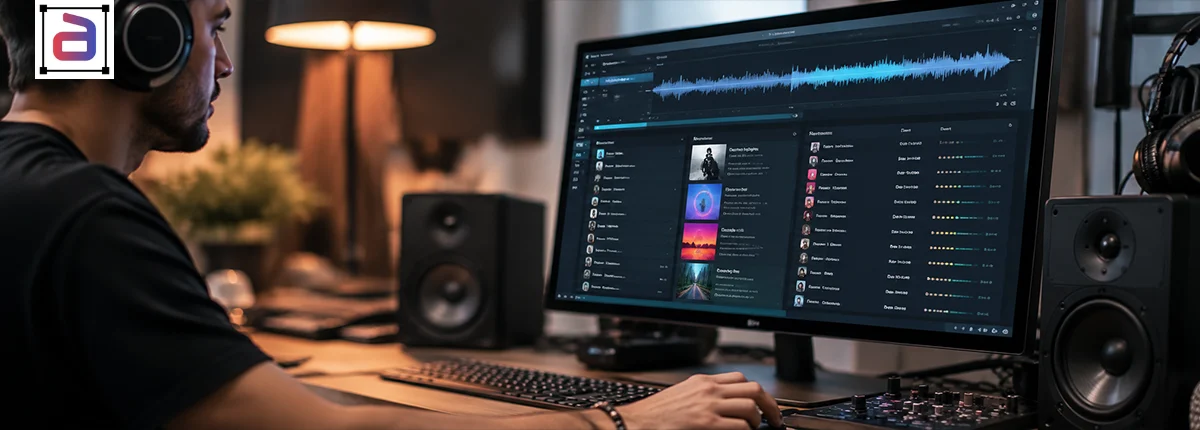
Imagine opening your favorite music streaming app after a long day. Within seconds, you’re greeted with a playlist that perfectly matches your mood—perhaps mellow acoustic tracks for unwinding or energetic electronic beats for your workout. It feels effortless, almost intuitive. But behind every personalized recommendation lies something far less glamorous yet absolutely essential: high-quality metadata annotation. Streaming platforms today are powered by artificial intelligence that doesn’t simply recognize songs—it understands genres, moods, instruments, language, explicit content, emotions, and contextual audio cues. None of this is possible without expertly annotated datasets. As AI-driven recommendation engines continue to evolve, organizations are increasingly partnering with a trusted data annotation company like Annotera to build reliable metadata that enhances discovery, engagement, and user satisfaction.
Key Points
- High-quality metadata annotation is the foundation of AI-powered music streaming and recommendation engines, enabling accurate content discovery through labels such as genre, mood, instruments, language, speaker identity, and acoustic events.
- Human-in-the-loop audio annotation significantly improves recommendation accuracy by capturing nuanced context, emotional tone, genre fusion, and cultural references that automated tagging systems often miss.
- Professional audio annotation services help streaming platforms build scalable, production-ready AI datasets, improving search relevance, playlist personalization, podcast discovery, and overall listener engagement.
- Partnering with an experienced data annotation company like Annotera enables organizations to accelerate AI development through expert-led data annotation outsourcing, robust quality assurance, and scalable metadata annotation workflows for music, podcasts, and speech applications.
The Streaming Revolution Runs on Data
The digital entertainment industry has experienced unprecedented growth over the past decade. According to the International Federation of the Phonographic Industry (IFPI), global recorded music revenues surpassed $29 billion in 2024, with streaming contributing nearly 70% of total revenue. Subscription streaming alone now serves hundreds of millions of paid users worldwide. Meanwhile, podcasts, audiobooks, and user-generated audio continue to expand at remarkable speed, creating enormous volumes of unstructured audio content every day. The challenge is no longer collecting audio—it’s organizing and understanding it. Every uploaded song, podcast episode, audiobook chapter, or live recording needs meaningful metadata before AI can accurately recommend it to listeners.
Why Metadata Annotation Matters More Than Ever
Basic metadata—such as song title, artist, and album—is no longer enough. Today’s recommendation engines rely on rich semantic metadata that helps AI understand the content itself. Professional audio annotation services generate metadata including:
- Genre and subgenre
- Mood and emotion
- Tempo and rhythm
- Musical instruments
- Vocal style
- Language identification
- Speaker recognition
- Environmental sounds
- Audio quality
- Explicit content
- Podcast topics
- Timestamped sound events
AI Learns Only From the Data It Receives
Artificial intelligence has transformed recommendation engines, but even the most advanced models remain dependent on training data. As Andrew Ng famously observed:
“AI is the new electricity.”
Much like electricity transformed every industry, AI is transforming digital media. Yet electricity is only useful when the infrastructure behind it is reliable. Likewise, AI performs only as well as the data that powers it. Poor metadata leads to:
- Irrelevant recommendations
- Weak search accuracy
- Playlist inconsistencies
- Lower listener engagement
- Reduced user retention
High-quality annotation produces the opposite: intelligent discovery experiences that keep users listening longer.
Metadata Annotation Beyond Genre Classification
Modern recommendation systems analyze audio from multiple perspectives simultaneously.
Genre & Subgenre Classification
Music rarely belongs to a single category. Annotators often assign multiple labels, such as:
- Indie Pop
- Alternative Rock
- Neo Soul
- Lo-fi Hip Hop
- Progressive House
- Contemporary Jazz
This multi-label approach gives recommendation models much richer contextual understanding.
Emotion & Mood Annotation
Emotion plays a major role in music consumption. Human annotators identify nuanced moods such as:
- Hopeful
- Nostalgic
- Romantic
- Aggressive
- Peaceful
- Melancholic
- Empowering
- Energetic
These emotional labels drive personalized playlists like:
- Focus Music
- Sleep Sounds
- Workout Mixes
- Sunday Relaxation
- Feel-Good Hits
Instrument Recognition
AI can also learn to recognize musical composition through timestamped annotations. Examples include:
- Acoustic guitar
- Piano
- Strings
- Saxophone
- Synthesizer
- Drum solos
- Brass sections
These detailed annotations improve similarity matching between songs.
Podcast & Speech Metadata
Streaming platforms increasingly host spoken-word content. Annotation teams label:
- Speaker diarization
- Topic segmentation
- Language detection
- Named entities
- Emotion
- Intent
- Transcript validation
This makes podcasts searchable and dramatically improves content recommendations.
Environmental Sound Detection
Not every audio file is music. Professional annotation also identifies sounds like:
- Rain
- Ocean waves
- Birdsong
- Traffic
- Applause
- Crowd noise
- Footsteps
- Sirens
- Doorbells
These datasets are valuable for multimedia search, smart assistants, autonomous systems, and accessibility applications.
Human Expertise Makes Recommendation Engines Smarter
Music is emotional. Context matters. Two songs with identical tempos may evoke entirely different feelings. Humans recognize subtle characteristics that AI still struggles to understand:
- Sarcasm in spoken audio
- Emotional transitions
- Genre fusion
- Cultural references
- Instrument overlap
- Background ambience
This is why Human-in-the-Loop (HITL) annotation remains essential. As computer scientist Fei-Fei Li has stated:
“The current AI revolution is not about algorithms alone; it is about data.”
Human expertise transforms raw audio into structured intelligence that AI can learn from confidently.
Why Streaming Platforms Choose Data Annotation Outsourcing
Building an internal annotation team is both expensive and difficult to scale. Organizations must recruit specialists, establish annotation standards, implement quality assurance workflows, and continuously manage evolving datasets. For this reason, many leading AI companies rely on data annotation outsourcing. Partnering with an experienced annotation provider offers significant advantages:
- Faster dataset creation
- Access to trained domain experts
- Consistent quality assurance
- Flexible project scaling
- Reduced operational costs
- Faster AI deployment
- Improved annotation consistency
Rather than managing annotation operations internally, engineering teams can stay focused on developing better AI products.
Why Annotera Is the Right Annotation Partner
At Annotera, we understand that metadata is far more than descriptive information—it’s the foundation of intelligent AI. As an experienced data annotation company, we help organizations build high-quality datasets that improve search, recommendation engines, speech AI, and multimedia analytics. Our comprehensive audio annotation services include:
- Music metadata annotation
- Genre classification
- Mood and sentiment tagging
- Podcast annotation
- Speaker identification
- Audio segmentation
- Timestamp annotation
- Environmental sound labeling
- Emotion recognition
- Multilingual speech annotation
- Audio quality assessment
Every project is supported by expert annotators, rigorous quality control, scalable workflows, and secure data management. Whether you’re training recommendation engines, voice assistants, music discovery platforms, or conversational AI, Annotera delivers annotation accuracy that directly translates into better model performance.
The Future of Audio AI Starts with Better Metadata
Recommendation engines have become one of the defining competitive advantages of modern streaming platforms. Yet even the most sophisticated algorithms cannot compensate for incomplete, inconsistent, or poorly labeled data. As streaming libraries grow into the hundreds of millions of tracks and spoken-audio assets, metadata annotation will become even more critical for delivering personalized, engaging user experiences. Organizations that invest in professionally annotated audio datasets today will build the recommendation engines that define tomorrow’s digital entertainment landscape.
Ready to Build Smarter Audio AI? Whether you’re developing a music streaming platform, podcast recommendation engine, speech recognition system, or next-generation conversational AI, Annotera is your trusted partner for high-quality audio data. Our expert team combines human intelligence with scalable annotation workflows to deliver accurate, consistent, and production-ready datasets tailored to your AI objectives. Partner with Annotera today to transform raw audio into actionable intelligence—and power recommendation engines that truly understand what your users want to hear.
A closely related read: Audio & Speech Annotation.
Read here : Recognizing Acoustic Events for Real-Time Safety