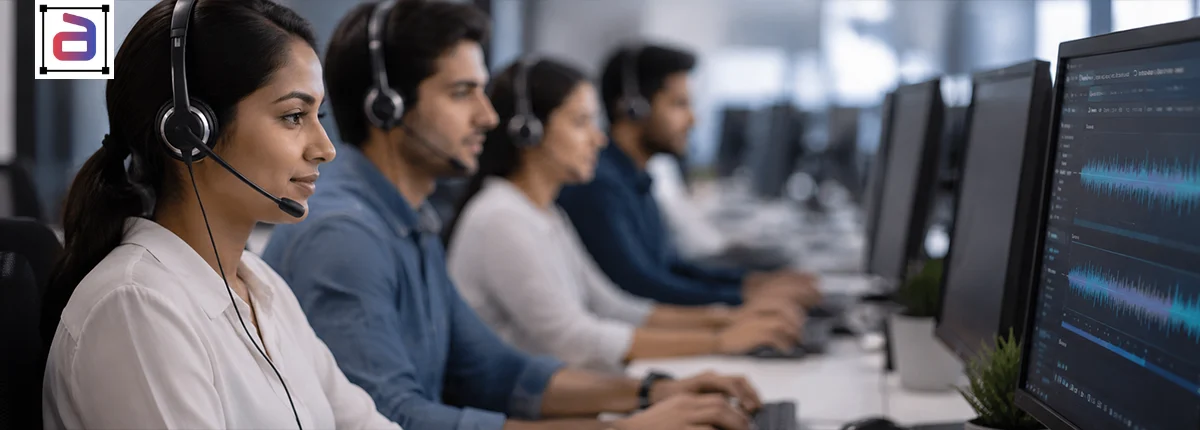
Every customer conversation tells a story—but AI only understands it when that story is structured. Millions of customer support calls take place every day, capturing everything from product feedback and billing disputes to technical issues and purchasing intent. Hidden within these conversations are insights that can improve customer experience, train conversational AI, enhance speech recognition, and automate quality assurance. Yet raw audio recordings are just that—raw. Without structured labeling, they remain unusable for machine learning. This is where audio annotation services become indispensable. By converting unstructured conversations into rich, machine-readable datasets, businesses can train AI systems to understand not only what customers say, but also how they say it—their intent, sentiment, urgency, and emotions. At Annotera, we help enterprises transform massive volumes of customer conversations into high-quality training data that powers next-generation conversational AI, intelligent speech analytics, and automated customer support.
Key Points
- Call center audio annotation transforms unstructured customer conversations into structured AI training data by labeling speakers, intent, sentiment, entities, timestamps, and acoustic events, enabling more accurate conversational AI and speech analytics.
- Human-in-the-loop annotation remains essential for handling overlapping speech, diverse accents, emotional context, and industry-specific terminology, delivering the high-quality datasets that automated transcription alone cannot achieve.
- As conversational AI adoption accelerates, businesses increasingly rely on data annotation outsourcing to access scalable, secure, and cost-effective audio annotation services without compromising annotation quality or turnaround times.
- Partnering with an experienced audio annotation company like Annotera helps organizations build reliable speech recognition, sentiment analysis, and contact center AI solutions using enterprise-grade quality assurance and expertly annotated training data.
Why Customer Conversations Have Become AI’s Most Valuable Dataset
The modern contact center has evolved far beyond answering customer calls. Today, it serves as one of the richest sources of real-world data for developing:
- Automatic Speech Recognition (ASR)
- Conversational AI
- Voice Assistants
- Customer Sentiment Analysis
- Agent Quality Monitoring
- Intelligent Call Routing
- Large Language Models (LLMs)
- Customer Experience Analytics
However, AI models cannot learn directly from thousands of hours of recorded conversations. Every interaction must first be carefully labeled, categorized, timestamped, and quality checked before it becomes valuable training data. As Andrew Ng, Founder of DeepLearning.AI, famously said:
“The data-centric approach to AI is the discipline of systematically engineering the data used to build an AI system.”
For conversational AI, that engineering begins with expert audio annotation.
The Growing Demand for High-Quality Audio Annotation
The rapid growth of conversational AI has dramatically increased demand for structured speech datasets. According to Grand View Research, the global speech and voice recognition market was valued at over USD 20 billion and is projected to grow at a CAGR exceeding 14% through 2030, driven by virtual assistants, contact center automation, healthcare AI, and enterprise speech analytics. Meanwhile, McKinsey & Company estimates that Generative AI could unlock between $400 billion and $660 billion annually in customer care functions, primarily by improving agent productivity and automating customer interactions. These technologies all rely on one common foundation: High-quality human-labeled conversational data. Regional audio annotation captures accents, dialects, pronunciation patterns, and culturally specific speech across different locations. It helps AI systems understand regional language variations more accurately, improving speech recognition, voice assistants, transcription, and conversational AI performance for diverse audiences.
What Exactly Gets Annotated in Customer Calls?
Many assume audio annotation simply means transcription. In reality, professional audio annotation services create multi-layered datasets that capture both linguistic and acoustic information.
Speaker Diarization
Every spoken segment is assigned to the correct participant:
- Customer
- Support Agent
- Supervisor
- IVR System
This enables AI to distinguish speakers accurately throughout the conversation.
Accurate Speech Transcription
Human annotators capture:
- Hesitations
- Filler words
- Repeated phrases
- Partial sentences
- Industry terminology
- Product names
Unlike automated transcription alone, human review preserves context and minimizes recognition errors.
Intent Annotation
Every customer interaction is labeled according to its objective, such as:
- Billing issue
- Refund request
- Product inquiry
- Technical support
- Order tracking
- Cancellation request
Intent labeling forms the backbone of conversational AI and intelligent call routing systems.
Emotion & Sentiment Annotation
One of the most valuable aspects of customer conversations is emotion. Annotators identify nuanced emotional states including:
- Satisfaction
- Frustration
- Confusion
- Urgency
- Anger
- Delight
These annotations help organizations build AI that understands customers—not just their words.
Entity & Keyword Tagging
Critical business entities are labeled throughout conversations, including:
- Customer names
- Product references
- Order IDs
- Account numbers
- Locations
- Competitor mentions
This enables downstream analytics and intelligent information extraction.
Acoustic Event Annotation
Not every valuable signal comes from speech. Professional annotation also captures:
- Silence
- Background conversations
- Hold music
- Keyboard sounds
- Crosstalk
- Laughter
- Environmental noise
These labels make speech AI significantly more robust in real-world environments.
Why Human Annotation Still Matters
Despite rapid advances in speech recognition models, automation alone cannot fully understand natural conversations. AI continues to struggle with:
- Multiple speakers talking simultaneously
- Regional accents
- Emotional context
- Sarcasm
- Domain-specific terminology
- Poor audio quality
- Code-switching between languages
As Fei-Fei Li, Professor at Stanford University, notes:
“AI is not a substitute for human intelligence; it is a tool to amplify human creativity and ingenuity.”
The same principle applies to training data. Human expertise remains essential for producing consistent, context-aware annotations that machines simply cannot replicate. This is why leading AI companies continue to rely on human-in-the-loop annotation workflows.
Why Businesses Choose Data Annotation Outsourcing
Building an in-house annotation team requires significant investments in hiring, training, infrastructure, quality assurance, and data security. Instead, organizations increasingly partner with a trusted data annotation company that already possesses the people, processes, and expertise needed to deliver production-ready datasets. The benefits of data annotation outsourcing include:
- Faster project delivery
- Lower operational costs
- Dedicated annotation specialists
- Scalable global workforce
- Consistent quality assurance
- Multilingual annotation capabilities
- Enterprise-grade security and confidentiality
Rather than managing annotation operations internally, AI teams can focus on what matters most—developing better models and bringing products to market faster.
Why Leading AI Teams Choose Annotera
At Annotera, we understand that exceptional AI begins with exceptional data. As a specialized audio annotation company, we combine skilled human annotators, AI-assisted workflows, and rigorous quality assurance to produce reliable datasets for enterprise AI applications. Our audio annotation services include:
- Speech transcription
- Speaker diarization
- Intent classification
- Sentiment and emotion annotation
- Timestamp labeling
- Acoustic event detection
- Named entity annotation
- Keyword tagging
- Multilingual speech annotation
- Multi-stage quality validation
Every project follows detailed annotation guidelines, secure handling protocols, and comprehensive quality reviews to ensure consistency—even across millions of customer conversations. Whether you’re building a conversational AI platform, improving speech recognition, automating call center quality assurance, or training next-generation LLMs, Annotera delivers structured datasets that help your AI perform with confidence.
Conclusion
Customer conversations are no longer just support records—they are strategic assets for building intelligent AI systems. The difference between an average conversational model and an exceptional one often comes down to the quality of its training data. High-quality annotation transforms ordinary call recordings into structured datasets that enable AI to recognize speech accurately, understand customer intent, detect emotion, and deliver more meaningful interactions. As organizations continue investing in conversational AI, partnering with an experienced data annotation company becomes a competitive advantage rather than an operational choice. With deep domain expertise, scalable workflows, and industry-leading audio annotation services, Annotera helps organizations unlock the full value of their customer conversations—turning every call into an opportunity to build smarter, more reliable AI.
Ready to Build Smarter Conversational AI? Whether you’re developing speech recognition systems, contact center analytics, AI-powered virtual agents, or customer sentiment models, Annotera provides the expertise and scalability to create high-quality annotated datasets that accelerate AI performance. Contact Annotera today to discover how our expert audio annotation services can transform your customer conversations into structured, AI-ready training data—delivered with precision, security, and enterprise-scale quality.
A closely related read: Why High-Fidelity Audio Annotation is Essential for Next-Gen Predictive Security & Surveillance.
Read also : Audio Intent Recognition Services for Virtual Assistants