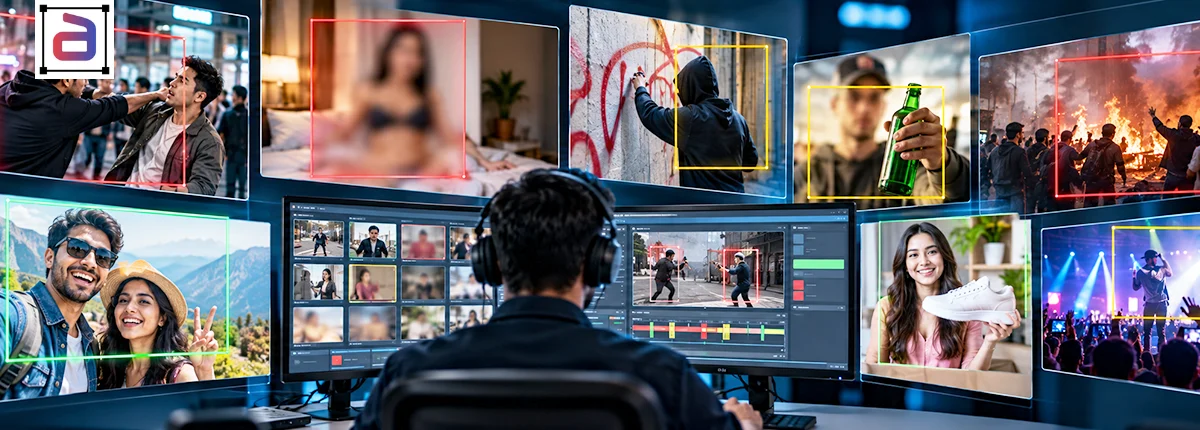
Every second, users upload videos, join live streams, and share experiences across digital platforms. While this constant flow of content drives engagement, it also introduces significant risks, including violent imagery, sexually explicit material, hate-related visuals, and content that threatens brand safety. For social media platforms, streaming services, and digital publishers, identifying these risks at scale is no longer optional. Yet, automated moderation systems cannot reliably distinguish every policy violation without high-quality training data and sufficient contextual understanding. This is where video content moderation annotation becomes essential. By labeling sensitive scenes, identifying harmful actions, and marking the precise timing of policy violations, annotation helps AI models learn to recognize potentially unsafe content more effectively. As a data annotation partner, Annotera helps organizations build structured video datasets that support content moderation, platform safety, and responsible AI development.
“Effective content moderation begins with accurate labels, clear policies, and the ability to understand what happens across an entire video—not just in a single frame.”
Key Points
- Violence and NSFW Detection: Accurate video annotation helps AI identify violent acts, graphic imagery, and explicit content while considering contextual factors.
- Brand-Safety Risk Classification: Structured labels help platforms distinguish policy violations from content that may be unsuitable for specific advertisers.
- Temporal Annotation and Multi-Object Tracking: Frame-level labels, event timestamps, and multi-object tracking improve the identification of risky actions across video sequences and live streams.
- Scalable Moderation AI with Annotera: Professional video annotation outsourcing services support consistent labeling, quality assurance, and the development of reliable AI-powered content moderation systems.
What Is Video Content Moderation Annotation?
Video content moderation annotation is the process of labeling video frames, objects, actions, and sequences according to predefined content safety categories. These labels help train and evaluate AI models designed to identify content that may violate platform guidelines or advertiser requirements. Unlike image classification, video moderation requires temporal and contextual understanding. A single frame showing a person holding a weapon may not indicate a policy violation. However, a sequence depicting an explicit threat or physical assault provides substantially different evidence. Annotation teams can identify individual frames, mark event timestamps, classify content severity, and distinguish between harmful material and legitimate contexts such as journalism, education, or entertainment. For businesses developing AI-powered moderation systems, Annotera supports structured video annotation workflows tailored to specific dataset requirements and moderation taxonomies.
Key Categories in Video Content Moderation Annotation
1. Violence and Graphic Content Detection
Violent content presents one of the most challenging moderation scenarios. Videos may contain physical fights, threatening gestures, weapons, visible injuries, or graphic depictions of harm. Annotation teams can label:
- Physical aggression, assault, and threatening behavior.
- Weapons and their contextual use.
- Blood, visible injuries, and graphic imagery.
- Violent incidents involving people or animals.
- The start, duration, and end of potentially harmful events.
Temporal precision is particularly important when an incident lasts only a few seconds within a longer video. By marking relevant timestamps, annotators help models learn to identify specific events instead of treating every frame as equally risky. Context must also be preserved. News reporting, fictional violence, and educational footage may require different classifications depending on platform policy.
2. NSFW Content and Explicit Visual Classification
Not-safe-for-work (NSFW) annotation helps identify content that may be inappropriate for certain audiences or restricted under platform guidelines. Depending on the project, categories may include nudity, sexually explicit imagery, suggestive behavior, and other sensitive visual material. However, accurate classification requires more than detecting exposed skin. Medical demonstrations, breastfeeding, artistic imagery, and ordinary fashion content can be incorrectly flagged when annotation guidelines lack contextual distinctions. Annotera’s video annotation workflows can support clearly defined NSFW categories, consistent labeling criteria, and quality review procedures. These measures help reduce ambiguous labels and provide more useful training examples for moderation models.
3. Brand-Safety Risks in User-Generated Content
Brand safety is especially important for platforms that monetize videos through advertising and sponsorships. Advertisers want to avoid placements alongside content that conflicts with their values, campaign objectives, or suitability requirements. Brand-safety annotation may cover:
- Hate symbols and discriminatory imagery.
- Offensive gestures and other policy-defined visual risks.
- Dangerous acts and the promotion of harmful behavior.
- Drug-related imagery and other restricted categories.
- Sensitive or controversial scenes requiring additional review.
Importantly, brand safety and platform policy enforcement are not identical. A video may comply with community guidelines but still be unsuitable for a particular advertiser. Annotation taxonomies should therefore distinguish prohibited content from content that requires age restrictions, limited monetization, or additional contextual review.
4. Multi-Object Tracking for Contextual Moderation
Some moderation tasks require tracking people and objects across consecutive video frames. Multi-object tracking helps maintain consistent labels for visible entities as they move, overlap, or temporarily disappear from view. For example, in a crowded live stream, tracking can help associate a visible object with a sequence of actions. Combined with action labels and event timestamps, this information provides a richer representation of what happened during a potentially harmful incident. Annotators may also label object visibility, movement, occlusion, and interactions between entities. However, tracking establishes visual continuity, not a person’s identity, intent, or guilt. These distinctions are important when designing responsible moderation datasets.
Why Live Streams Require Specialized Annotation
Pre-recorded videos can often be reviewed before publication. Live streams, by contrast, introduce content continuously, leaving moderation systems limited time to detect and respond to emerging risks. UGC also varies in resolution, lighting, camera movement, background activity, and recording quality. Effective live-stream moderation datasets should account for:
- Temporal accuracy: Marking the precise boundaries of harmful events.
- Contextual interpretation: Distinguishing genuine policy violations from harmless or legitimate scenarios.
- Visual ambiguity: Applying consistent rules to blurry footage, partially visible objects, and overlapping actions.
- Scalable workflows: Preparing representative training data across diverse content types and risk categories.
- Human oversight: Identifying ambiguous cases that require specialist review rather than forcing uncertain classifications.
How Video Annotation Outsourcing Services Strengthen Moderation AI
Building high-quality moderation datasets internally can demand substantial time, specialist expertise, and ongoing quality control. Professional video annotation outsourcing services can help organizations scale dataset preparation while establishing consistent labeling standards. Working with an experienced video annotation company such as Annotera can support:
- Scalable data preparation: Handle growing volumes of video frames and sequences.
- Structured annotation guidelines: Apply consistent category definitions and severity criteria.
- Temporal and object-level labeling: Capture event boundaries, actions, and object movement.
- Quality assurance: Use reviewer checks, sampling, and disagreement resolution to identify inconsistencies.
- Project-specific customization: Align annotation categories with platform policies and advertiser suitability requirements.
Outsourcing does not automatically guarantee better model performance. Results depend on annotation accuracy, guideline clarity, representative data, and the effectiveness of subsequent model evaluation.
Annotera: Building Better Training Data for Content Safety
Annotera helps organizations prepare structured video datasets for AI applications through specialized video annotation capabilities. For content moderation projects, workflows can be tailored to violence detection, NSFW classification, brand-safety labeling, temporal event annotation, and multi-object tracking. The process begins with defining the project’s taxonomy and documenting edge cases. Annotators then label relevant frames and sequences, while quality reviewers assess consistency and resolve disagreements. Appropriate access controls and confidentiality procedures should also be established when handling sensitive material. This structured approach helps create training datasets that better reflect real-world moderation requirements.
“Safer digital experiences require more than detecting harmful content. They require reliable data that helps AI understand context, distinguish risk levels, and support consistent decisions.”
Conclusion: Strengthen Your Content Moderation Strategy with Annotera
As UGC and live streaming continue to expand, accurate video content moderation annotation will remain essential for protecting users, supporting advertiser confidence, and improving AI-powered safety systems. From violence and NSFW detection to brand-safety classification and multi-object tracking, high-quality annotation gives moderation models the structured information needed to recognize relevant visual patterns and events. Ready to build more reliable content moderation AI? Partner with Annotera for tailored video annotation solutions designed around your content categories, quality requirements, and AI development goals. Contact Annotera today to discuss your project and discover how high-quality training data can support a safer, more responsible digital content ecosystem.
A closely related read: Scaling Platform Safety with Content Moderation Labeling.