As wearable technologies and immersive AR/VR experiences become increasingly mainstream, the demand for intelligent systems that can understand the world from a human perspective is rapidly growing. From smart glasses and mixed-reality headsets to body-worn cameras and industrial wearables, organizations are generating massive volumes of first-person (egocentric) video data that hold immense value for AI development. However, raw video alone is not enough. To train AI models that can recognize objects, understand actions, track hand movements, and interpret contextual interactions, organizations need accurately annotated datasets. This is where expert annotation becomes a critical enabler of innovation. At Annotera, we help organizations transform complex visual data into high-quality, AI-ready datasets through specialized video and image annotation services. As a trusted data annotation company, we understand the unique challenges associated with first-person video annotation and the advanced techniques required to support next-generation wearable and AR/VR applications.
Key Points
- Egocentric video annotation labels objects and actions from the wearer’s point of view.
- AR and VR applications require precise gaze, gesture, and interaction annotations.
- First-person video introduces unique challenges like motion blur and limited field of view.
- Expert annotators trained on egocentric datasets deliver more consistent labels.
Table of Contents
Why Egocentric Video Matters in the Age of AR/VR
Unlike traditional videos captured from a fixed viewpoint, egocentric videos are recorded from the user’s perspective. These videos provide a rich understanding of how people interact with objects, environments, and digital interfaces in real-world settings. The growth of this technology is undeniable. According to Grand View Research, the global augmented reality market size was estimated at USD 120.21 billion in 2025 and is projected to reach USD 1,050.56 billion by 2033, growing at a CAGR of 29.7% from 2026 to 2033. . As AR and VR systems become more intelligent, they must learn to interpret human behavior with greater precision. This requires vast amounts of annotated first-person video data that accurately capture human-object interactions, gestures, actions, and environmental context.
“Data is the food for AI.” – Andrew Ng
For wearable and immersive technologies, high-quality annotated egocentric video data is the fuel that powers intelligent user experiences.
Unique Challenges of First-Person Video Annotation
While first-person video provides valuable contextual information, it also introduces annotation complexities that are rarely encountered in conventional video datasets. While egocentric video data offers rich contextual insights, it also presents unique annotation challenges. Moreover, constant camera movement, frequent occlusions, and complex human-object interactions make accurate labeling difficult. Therefore, specialized annotation techniques are essential for developing reliable AR/VR and wearable AI systems. Egocentric video annotation requires understanding scenes from a first-person perspective, where camera movement, occlusions, hand interactions, and changing viewpoints complicate labeling. Accurate annotation helps AI models interpret human actions, objects, environments, and interactions more effectively.
Continuous Camera Movement
Since wearable cameras move with the user, footage often contains abrupt viewpoint changes, motion blur, and unstable scenes. Objects may quickly enter and leave the frame, making consistent tracking significantly more difficult.
Frequent Occlusions
Hands, tools, and surrounding objects often obscure one another during interactions. Annotators must accurately identify partially visible objects and maintain continuity across frames.
Complex Human-Object Interactions
Egocentric datasets frequently involve intricate activities such as assembling products, performing medical procedures, operating machinery, or interacting with virtual interfaces. Understanding these interactions requires detailed and context-aware annotation.
Massive Data Volumes
A single wearable device can generate hours of continuous footage daily. Processing such large-scale datasets demands scalable annotation workflows, stringent quality assurance protocols, and specialized expertise. These challenges underscore why many organizations choose data annotation outsourcing to accelerate project timelines while maintaining annotation quality.
Key Annotation Techniques for Wearable and AR/VR Applications
Creating robust AI systems for first-person video analysis requires multiple annotation methodologies working together. To overcome these challenges, organizations rely on advanced annotation methodologies tailored for wearable and AR/VR datasets. Furthermore, techniques such as object tracking, action recognition, and gesture annotation enable AI models to better understand user behavior, interactions, and real-world environments.
Object Detection and Tracking
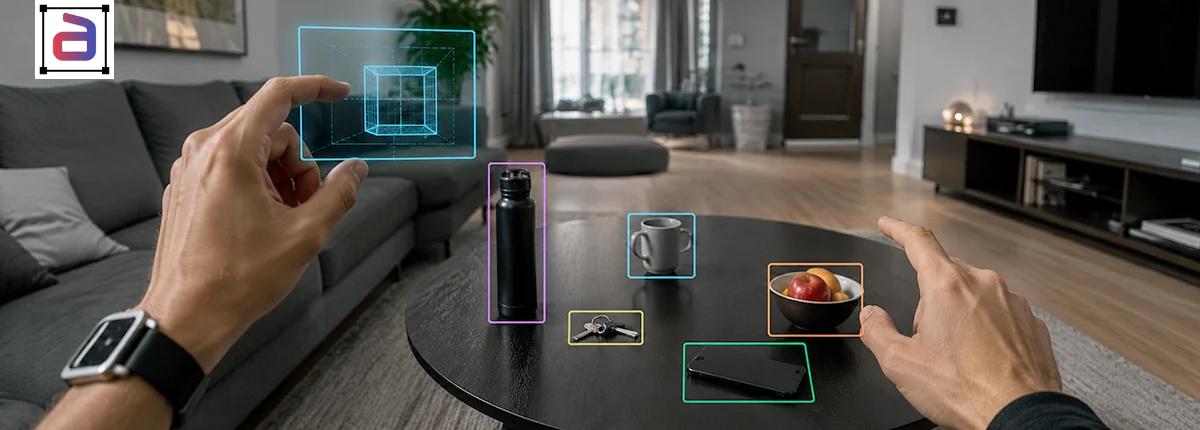
Object detection remains a foundational annotation technique for wearable AI applications. Annotators label and track objects such as:
- Tools and equipment
- Consumer products
- Medical instruments
- Industrial components
- Household items
- Human hands
Using bounding boxes, polygons, or segmentation masks, annotation teams enable AI systems to identify and track objects throughout dynamic video sequences. For AR-powered navigation, workplace assistance, and robotics applications, accurate object tracking is essential for real-time decision-making.
Action Recognition Annotation
Understanding what a user is doing is often just as important as recognizing what they are looking at. Action recognition annotation involves labeling activities such as:
- Picking up an object
- Operating machinery
- Opening containers
- Assembling components
- Performing medical procedures
- Navigating environments
These annotations help AI models understand behavioral patterns and predict user intent.
“The best way to understand intelligence is to understand vision.” – Fei-Fei Li
For AI systems, understanding human actions through vision is a crucial step toward building more intuitive AR and wearable experiences.
Hand and Gesture Annotation
In AR/VR environments, hands frequently serve as the primary interface between users and digital content. Hand annotation typically includes:
- Hand detection
- Finger keypoint labeling
- Gesture classification
- Hand-object interaction tracking
Whether users are manipulating virtual objects, issuing commands, or interacting with physical tools, precise hand annotations help create more responsive and immersive experiences.
Semantic and Instance Segmentation
Segmentation provides pixel-level understanding of visual scenes. Semantic segmentation assigns category labels to every pixel, while instance segmentation distinguishes individual objects belonging to the same class. For example, in a manufacturing setting, segmentation can differentiate multiple workers, tools, and machine components operating simultaneously. This level of granularity is especially valuable for AR overlays, industrial automation, and digital twin applications.
Temporal Event Annotation
Many first-person video applications require understanding events over time rather than analyzing isolated frames. Temporal annotation involves identifying:
- Activity start and end points
- Task sequences
- Workflow stages
- User attention shifts
- Process completion events
These annotations allow AI systems to understand context, monitor performance, and provide real-time assistance during complex tasks.
Real-World Applications of Egocentric Video Annotation
As wearable and immersive technologies continue to evolve, egocentric video annotation is driving innovation across multiple industries. Consequently, organizations are leveraging annotated first-person video data to enhance AI-powered decision-making, improve user experiences, and optimize operational efficiency in real-world environments.
Healthcare
Medical professionals use wearable cameras for training, documentation, and procedural analysis. Annotated datasets support AI-assisted diagnostics, surgical guidance systems, and medical education platforms.
Manufacturing and Industrial Operations
Smart glasses are increasingly being deployed on factory floors to enhance productivity and safety. Annotated video data enables AI systems to provide contextual instructions, detect operational errors, and improve workforce efficiency.
Retail and Customer Experience
Retailers leverage AR technologies to create interactive shopping experiences. Accurate annotation improves object recognition and contextual understanding, allowing virtual experiences to feel more natural and personalized.
Robotics and Human-AI Collaboration
Robots trained using egocentric video data can better understand human workflows and replicate complex manipulation tasks. This accelerates advancements in collaborative robotics and automation.
Gaming and Immersive Experiences
From gesture-based controls to real-time environment mapping, AR/VR gaming platforms rely heavily on annotated first-person video datasets to create seamless user experiences.
Why Partner with Annotera?
As wearable technology adoption accelerates, annotation quality has become a decisive factor in AI performance. At Annotera, we combine domain expertise, scalable annotation workflows, and rigorous quality control processes to deliver high-precision datasets for complex computer vision projects. Whether organizations require object tracking, action recognition, gesture annotation, segmentation, or temporal event labeling, our team ensures data consistency and accuracy at scale. As a leading video annotation company, we support organizations developing cutting-edge AI solutions across AR/VR, healthcare, manufacturing, robotics, and retail sectors. Through strategic video annotation outsourcing services, we help businesses reduce operational complexity while accelerating AI deployment.
The Future of Egocentric AI Starts with Better Data
First-person video is redefining how machines understand human behavior and interact with the world. As wearable devices, smart glasses, and immersive technologies continue to evolve, the demand for accurately annotated egocentric datasets will only increase. Organizations that invest in high-quality annotation today will be better positioned to build intelligent, context-aware systems that drive tomorrow’s innovations.
Ready to Power Your AR/VR and Wearable AI Projects?
Annotera delivers high-quality annotation solutions tailored to the unique demands of egocentric video datasets. Whether you’re developing smart wearables, immersive AR experiences, robotics systems, or industrial AI applications, our expert annotation teams can help you build reliable and scalable training datasets. Connect with Annotera today to discover how our expertise as a data annotation company and video annotation company can accelerate your AI initiatives and bring your vision to life.
A closely related read: Video Annotation for Retail Analytics: Transforming Customer Behavior Insights.