Artificial Intelligence has transformed how businesses interpret visual data. From autonomous vehicles navigating crowded streets to healthcare systems identifying abnormalities in medical scans, computer vision is driving innovation across industries. Yet, behind every high-performing AI model lies one critical foundation: high-quality image annotation. Instance vs Semantic Segmentation is a critical consideration in computer vision projects. For teams focused specifically on scene understanding and spatial context annotation, see image segmentation services for scene parsing. While semantic segmentation classifies every pixel by category, instance segmentation identifies individual objects separately, making the choice of annotation strategy essential for achieving optimal AI model accuracy and performance.
Among the most powerful annotation techniques used in computer vision are semantic segmentation and instance segmentation. Both rely heavily on polygon annotation to define object boundaries with precision, but they serve very different purposes. Choosing the right segmentation strategy can significantly influence model accuracy, project costs, and overall AI success. At Annotera, we help organizations navigate these decisions with expert annotation services designed to deliver scalable, high-quality datasets for real-world AI applications. Choosing the right strategy matters most in high-stakes domains, as our guide to polygon annotation services for medical imaging explains. Segmentation is one of several techniques compared in our complete image annotation guide. This choice matters directly for e-commerce product video segmentation.
Just as electricity required reliable infrastructure to power industries, AI requires reliable training data to power intelligent systems. That journey starts with selecting the right annotation approach.
Key Points
- Semantic segmentation classifies every pixel by category; instance segmentation goes further by separating individual objects of the same class.
- Use case determines the right choice: semantic segmentation suits background classification while instance segmentation is required for counting or tracking.
- Instance segmentation annotation is significantly more labor-intensive per image, making task scoping decisions critical to project budget.
- Mismatching segmentation method to model architecture wastes annotation budget and produces training data that cannot serve its intended purpose.
Table of Contents
Why Polygon Annotation Matters in Computer Vision
Traditional bounding boxes are often insufficient for complex computer vision tasks. Objects rarely fit neatly into rectangular shapes, especially in crowded or highly detailed environments. When evaluating Instance vs Semantic Segmentation, the primary difference lies in object identification. Semantic segmentation labels pixels by class, while instance segmentation distinguishes each object individually, enabling more detailed analysis and decision-making in computer vision systems.
Polygon annotation solves this challenge by allowing annotators to trace the exact contours of an object. The result is a much richer dataset that helps AI models understand object boundaries with greater precision. This level of detail has become increasingly important as enterprises invest more heavily in AI. According to Grand View Research, the global data annotation tools market size was estimated at USD 1.02 billion in 2023 and is projected to reach USD 5.33 billion by 2030, growing at a CAGR of 26.5% from 2024 to 2030.. For businesses investing in AI, the question is no longer whether annotation matters—but which annotation strategy will generate the best results.
Understanding Semantic Segmentation
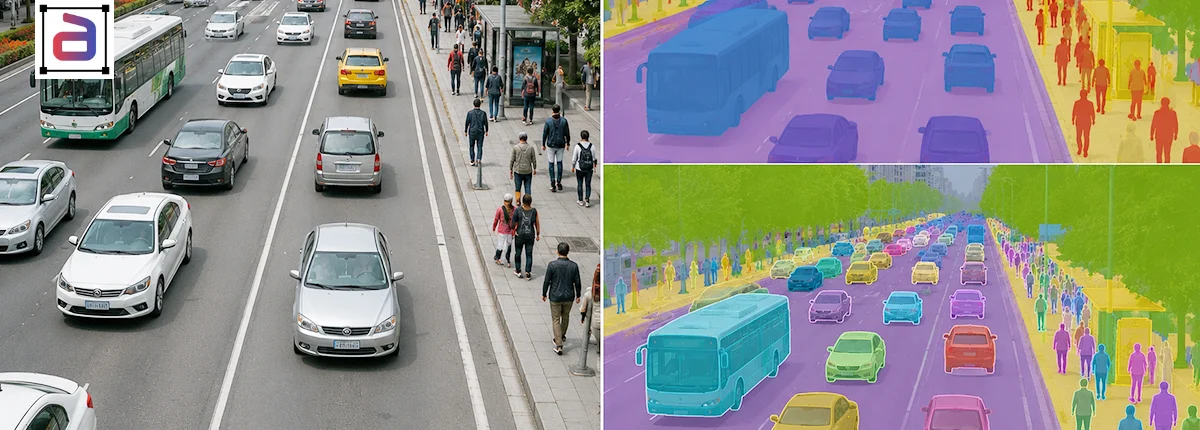
Semantic segmentation classifies every pixel within an image according to a predefined category. For example, in a city street image:
- Every vehicle is labeled as “car”
- Every pedestrian is labeled as “person”
- Every tree is labeled as “vegetation”
The AI model learns what each pixel represents but does not distinguish between separate objects belonging to the same category. Think of semantic segmentation as teaching a model to understand the composition of an entire scene. For eg , semantic segmentation enables AI models to classify every pixel within an image, creating highly detailed maps of disaster-affected areas. For flood and disaster zone mapping, it helps accurately identify water, infrastructure, debris, and safe access routes for emergency responders.
Where Semantic Segmentation Excels
Semantic segmentation is ideal when understanding regions or environments is more important than identifying individual objects. Common use cases include:
- Autonomous driving road mapping
- Agricultural field monitoring
- Satellite imagery analysis
- Environmental monitoring
- Medical image segmentation
For example, a satellite imaging company may need to determine how much land is covered by vegetation versus urban development. In this scenario, distinguishing individual buildings is less important than accurately classifying land categories.
Benefits of Semantic Segmentation
- Comprehensive scene understanding
- Faster annotation workflows
- Lower annotation costs
- Efficient training for large-scale datasets
- Strong performance in environmental classification tasks
Many organizations pursuing image annotation outsourcing for geospatial and medical AI projects find semantic segmentation to be a cost-effective and highly scalable solution.
Understanding Instance Segmentation
Instance segmentation takes image understanding one step further. The debate around Instance vs Semantic Segmentation often comes down to application requirements. Projects requiring scene understanding may benefit from semantic segmentation, whereas tasks involving object tracking, counting, or monitoring typically require instance segmentation. Instead of grouping all objects within a category together, it identifies and labels each object individually. Using the same street image example:
- Car #1 receives its own annotation mask
- Car #2 receives a separate mask
- Car #3 is identified independently
The model understands not only what an object is but also where one object ends and another begins. This distinction becomes critical in applications where object counting, tracking, and interaction analysis are required.
Where Instance Segmentation Excels
Instance segmentation is particularly valuable in complex environments where objects overlap or appear in large numbers. Key applications include:
- Autonomous vehicles
- Robotics and automation
- Retail inventory management
- Manufacturing quality inspection
- Construction site monitoring
For example, an autonomous vehicle must recognize every pedestrian, cyclist, and vehicle independently to make safe navigation decisions. Likewise, warehouse robots need to identify individual products on shelves rather than viewing them as a single category.
Benefits of Instance Segmentation
Understanding Instance vs Semantic Segmentation is essential for building effective AI models. The right segmentation approach influences annotation complexity, dataset quality, model accuracy, and ultimately the success of computer vision applications across industries. Below are the following benefits :
- Object-level intelligence
- Accurate counting capabilities
- Improved tracking and monitoring
- Better handling of overlapping objects
- Enhanced operational automation
Although annotation requirements are more complex, the resulting data often unlocks significantly higher business value.
Semantic Segmentation vs. Instance Segmentation: Key Differences
| Feature | Semantic Segmentation | Instance Segmentation |
|---|---|---|
| Pixel-Level Classification | Yes | Yes |
| Individual Object Recognition | No | Yes |
| Object Counting | Limited | Excellent |
| Annotation Complexity | Moderate | High |
| Dataset Creation Cost | Lower | Higher |
| Overlapping Object Handling | Limited | Strong |
| Advanced Automation Support | Moderate | Excellent |
The right choice depends entirely on the business objective. If the goal is understanding an environment, semantic segmentation is often sufficient. If the objective is tracking, counting, or analyzing individual objects, instance segmentation becomes essential.
The Hidden Cost of Choosing the Wrong Strategy
Many organizations focus primarily on model architecture while underestimating the importance of annotation strategy. The reality is that even the most sophisticated AI models cannot compensate for poorly structured training data.
“The quality of data is more important than the quantity of data.”— Fei-Fei Li
Selecting semantic segmentation when object-level detail is required can limit model capabilities. Conversely, using instance segmentation when scene-level understanding is sufficient may increase costs unnecessarily. This is why businesses increasingly partner with a specialized data annotation company to evaluate project requirements before dataset creation begins. At Annotera, we work closely with clients to align annotation methodologies with intended AI outcomes, ensuring every annotation dollar contributes directly to model performance.
Why Businesses Choose Data Annotation Outsourcing
Building segmentation datasets internally requires substantial resources, including recruiting annotators, establishing quality control processes, and managing scalability challenges. As AI initiatives grow, many enterprises turn to data annotation outsourcing to accelerate development while maintaining quality. The advantages include:
- Faster project delivery
- Access to trained annotation specialists
- Consistent quality assurance
- Scalability for large datasets
- Reduced operational costs
Similarly, image annotation outsourcing enables AI teams to focus on innovation rather than annotation management. At Annotera, our dedicated teams combine domain expertise, advanced quality control workflows, and scalable production capabilities to support complex segmentation projects across healthcare, automotive, retail, agriculture, manufacturing, and geospatial intelligence.
Why Annotera Is the Right Annotation Partner
Successful computer vision projects depend on more than annotation volume—they depend on annotation precision. As a trusted image annotation company, Annotera delivers:
- High-precision polygon annotation
- Semantic segmentation expertise
- Instance segmentation expertise
- Multi-layer quality assurance
- Rapid project scalability
- Customized workflows for industry-specific use cases
Whether you’re building AI for autonomous systems, medical imaging, retail analytics, or industrial automation, our team ensures your training data is accurate, consistent, and production-ready.
Conclusion
There is no universal winner in the debate between semantic segmentation and instance segmentation. The right choice depends on what your AI model needs to learn. Semantic segmentation provides powerful scene-level understanding, while instance segmentation delivers detailed object-level intelligence. Both approaches can drive exceptional model performance when paired with high-quality polygon annotation. The key is selecting the strategy that aligns with your business objectives and ensuring annotation quality remains uncompromised throughout the process.
Ready to Build Better Computer Vision Models?
Annotera helps organizations transform raw visual data into high-quality training datasets that power accurate, scalable AI solutions. Whether you need semantic segmentation, instance segmentation, or end-to-end image annotation services, our experts are ready to support your next AI initiative. Contact Annotera today and discover how precision annotation can accelerate your path to AI success.It is worth also looking at why panoptic segmentation combines both approaches.
A closely related read: Semantic Segmentation for Self-Driving AI.