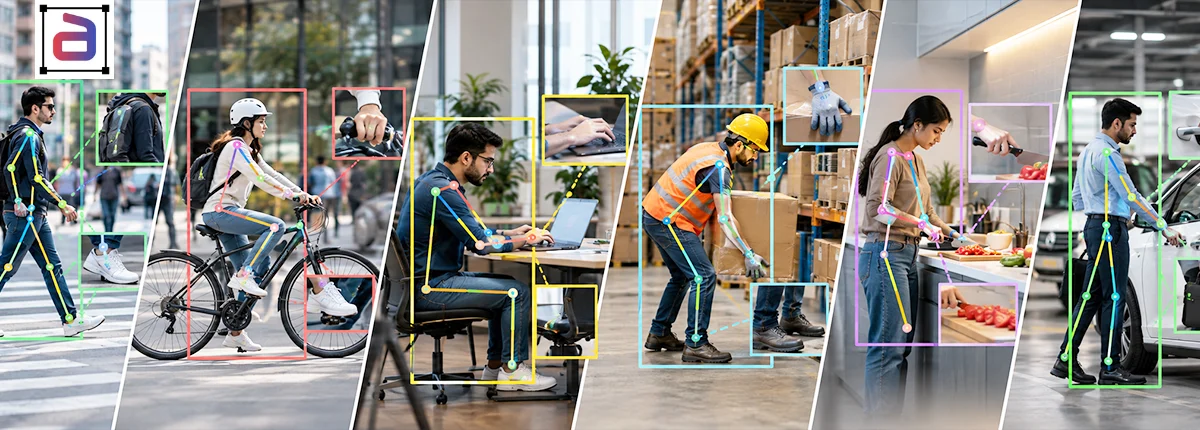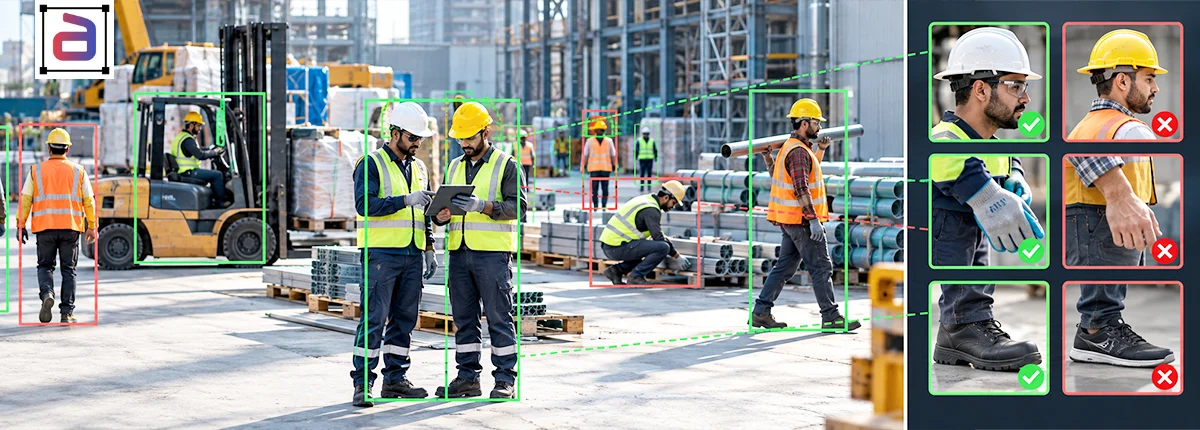
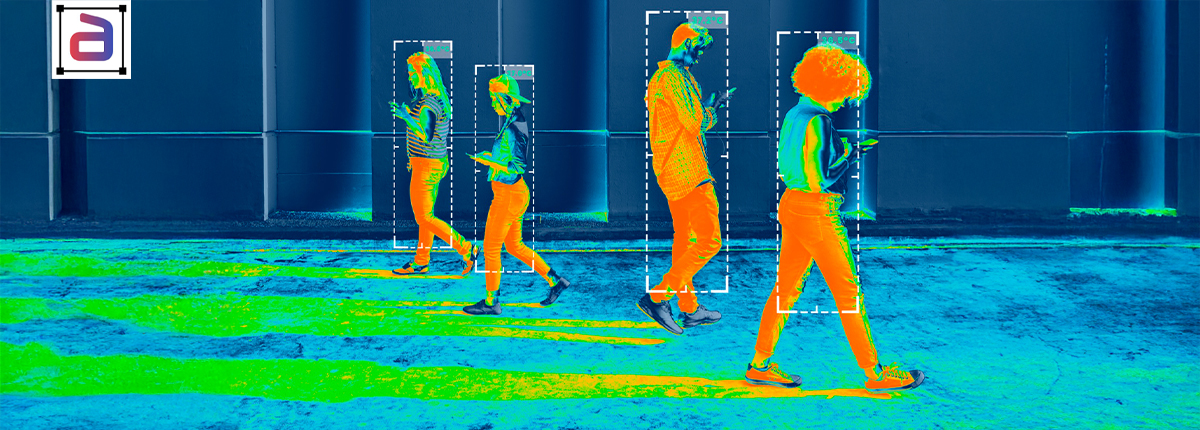
Object detection tells an AI model what is in an image. Scene parsing tells it how everything in that image relates to everything else. A pedestrian standing on a kerb is a different situation from a pedestrian stepping into traffic. Both involve the same object class, but the spatial context carries the meaning. That distinction is what image segmentation services for scene parsing are built to teach.
Key Points
- Scene parsing requires annotation that labels spatial relationships and relative positions, not just the presence of objects, enabling AI to understand scene structure rather than object inventories.
- Image segmentation for scene parsing must cover the full range of spatial configurations each object class can occupy, not just the canonical positions found in curated benchmark datasets.
- Semantic scene understanding enables AI systems to make contextually appropriate decisions — a pedestrian at a kerb means something different from a pedestrian mid-crossing, and segmentation labels must capture this.
- Scene parsing annotation programs need to define and consistently enforce spatial relationship labels across annotation teams to prevent models from learning annotator-specific scene interpretations.
Table of Contents
What Scene Parsing Is and How It Differs from Object Detection
Object detection draws a box around a car. Scene parsing assigns a semantic label to every pixel in the image. The car, the road beneath it, the pavement to the left, the sky above, the building in the background. The output is a complete spatial map of the visual environment, not a list of detected objects.
That density of information is what makes scene parsing the foundation for context-aware AI. Autonomous vehicles need to know where the driveable surface ends and the pavement begins. Robots need to know whether the space ahead is floor, wall, or an occupied obstacle. Agricultural drones need to distinguish crop canopy from bare soil from pooled water. None of those distinctions come from bounding boxes. They require pixel-level labels organized into a coherent scene structure.
The Annotation Tasks That Build Scene Parsing Datasets
Semantic Segmentation
Semantic segmentation assigns a single class label to every pixel. Road, vehicle, person, building, vegetation, sky. Every pixel belongs to exactly one class, and annotators draw boundaries precisely enough that the model learns where one class ends and another begins. The quality of those boundaries directly determines how well the model handles edge cases.
Instance Segmentation
Where semantic segmentation treats all vehicles as a single class, instance segmentation gives each individual vehicle a unique label. This distinction matters for tracking and interaction modeling. A model that cannot distinguish between two adjacent vehicles cannot reason about the gap between them. Instance segmentation is more annotation-intensive, but it enables a level of scene understanding that semantic labels alone cannot provide.
Spatial Relationship Labeling
The third layer is the one that gets least attention: spatial relationship labels that encode how elements relate to one another. A person to the left of a vehicle is different from a person behind a vehicle, and both differ from a person occluded by a vehicle. These relative position annotations allow models to move from recognizing what exists in a scene to understanding how elements interact within it.
Where Scene Parsing AI Is Applied
Autonomous vehicles depend on scene parsing to distinguish driveable surface from pavements, kerbs, lane markings, and obstructions. A model that only detects objects cannot plan a path through a complex intersection. It needs a pixel-level scene map to determine where it can and cannot go.
Industrial and warehouse robotics use scene parsing to navigate shared spaces with human workers. The robot needs to know not just that a person is present, but where the clear floor space is and what the traversable path looks like around a dynamic obstacle. See how 3D annotation for robotic navigation extends this spatial understanding into three dimensions.
Remote sensing and aerial analysis use segmentation-based scene parsing to map land cover, track agricultural conditions, assess disaster zones, and monitor infrastructure at scale. Each satellite or drone frame covers a vastly more complex scene than a street-level camera, which makes consistent pixel-level annotation even more critical.
Medical imaging applies scene parsing to organ segmentation, lesion boundary mapping, and surgical planning. In this domain, pixel boundary precision is not a quality standard. It is a safety requirement. A segmentation boundary that drifts by a few pixels in a radiology context carries clinical consequences that do not exist in most other applications.
What Makes Scene Parsing Annotation Hard to Do Well
Boundary precision is the most technically demanding requirement. Where two classes meet, the annotator must place the boundary at the exact pixel where one class ends and the other begins. Systematic boundary errors across thousands of frames teach the model a distorted spatial map of reality.
Class imbalance is a structural problem in most real-world scenes. Sky and road occupy far more pixels than pedestrians or cyclists, yet model performance on rare classes is often what determines safety. Annotation programs for scene parsing need active sampling of scenes where minority classes are well represented, not just scenes where they appear at the edge of a frame.
Consistency across annotators is harder to maintain in segmentation than in bounding box annotation. Two annotators drawing a box around a car will produce similar results. Two annotators drawing the boundary between a building and the sky on a partly cloudy day may produce substantially different pixel maps. Inter-annotator agreement must be measured on boundary placement specifically, and recalibration must happen at the guideline level rather than through rework of individual frames.
How Annotera Delivers Scene Parsing Annotation
Annotera runs scene parsing annotation through domain-specific teams trained on the class taxonomies and boundary precision standards for each vertical. Automotive programs have different boundary requirements from agricultural programs, and annotators are calibrated to the specific rules of each engagement before production begins.
Multi-layer QA covers boundary precision, class coverage, and inter-annotator agreement, tracked per batch rather than just at project completion. Programs scale from pilot datasets of a few thousand images to production programs covering millions of frames. The guide on scaling pixel-level labeling covers how that consistency is maintained as volume grows.
Related Reading
- Panoptic Segmentation Explained covering how combining semantic and instance segmentation produces complete scene understanding
- Instance vs Semantic Segmentation for choosing the right approach
- Pixel-Level Clarity for Autonomous Driving covering semantic segmentation in AV perception stacks
- Scaling Pixel-Level Labeling for maintaining annotation quality across large programs
Scaling a scene parsing program or starting a new segmentation dataset? Talk to Annotera about annotation workflows built for pixel-level precision at production volume.