Video AI is moving beyond simple object detection. Today’s intelligent video understanding models are expected to recognize activities, interpret context, follow events over time, and understand how one scene relates to another. To achieve this level of intelligence, models need training data that captures not only what appears in a video but also how the visual story changes over time. Camera cuts and scene transitions are therefore becoming an important component of high-quality video training datasets. A sudden change in camera angle, a transition between locations, or a shift from one event to another can fundamentally change the context of a video.
As the saying goes, “Context is king.” In video AI, that context is often determined by temporal relationships between scenes. For organizations developing video analytics, surveillance systems, autonomous technologies, media intelligence platforms, and multimodal AI, accurately annotating these transitions can create a stronger foundation for intelligent video understanding. This is where specialized video annotation outsourcing services such as Annotera can help organizations transform raw video into structured, model-ready training data.
Key Points
- Camera cuts provide critical temporal context — Annotating shot boundaries helps video AI models understand when one visual sequence ends and another begins.
- Scene transitions improve contextual understanding — Labels for hard cuts, fades, dissolves, and natural scene changes enable models to distinguish visual and semantic shifts.
- High-quality temporal annotation strengthens AI performance — Accurate transition data supports better video segmentation, event recognition, retrieval, summarization, and multimodal understanding.
- Outsourcing enables scalable video annotation — Annotera’s video annotation outsourcing services help AI teams build consistent, high-quality training datasets while reducing the operational burden of in-house annotation.
Why Camera Cuts Matter for Video AI
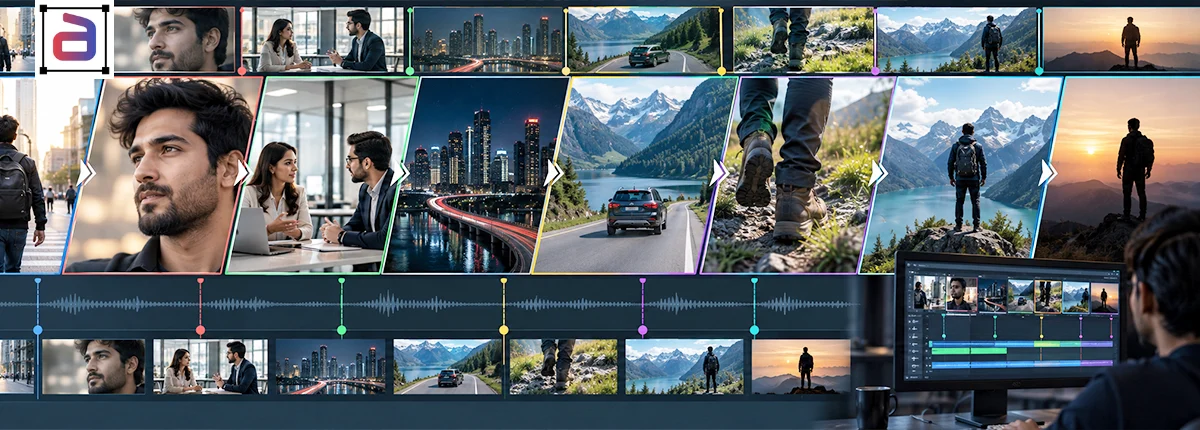
A camera cut is more than a visual change. It represents a boundary between two shots and can signal a change in perspective, subject, location, or event. Consider a sports video. The footage may switch from a wide-angle view of a football field to a close-up of a player, followed by a replay and then a shot of the audience. If an AI model interprets all these frames as one uninterrupted sequence, it may incorrectly associate actions and objects that belong to different shots. Annotating camera cuts enables AI systems to identify these boundaries and process each visual segment with greater contextual awareness. This becomes especially important for models designed for:
- Video search and retrieval
- Automated video summarization
- Event detection
- Surveillance analytics
- Sports intelligence
- Media content understanding
- Multimodal AI applications
Better temporal boundaries lead to better contextual understanding.
From Camera Cuts to Meaningful Scene Transitions
Not every visual transition represents the same type of change. A robust annotation strategy should capture different transition patterns and establish clear labeling rules.
Hard Cuts
A hard cut instantly replaces one shot with another. These are common in films, advertisements, news broadcasts, sports footage, and online video content.
Fade-In and Fade-Out
Gradual visual changes can indicate the beginning or conclusion of a sequence. Correctly labeling these transitions helps models understand video structure.
Dissolves
Dissolves blend two scenes together over a period of time. Since information from both scenes may temporarily appear simultaneously, precise temporal boundaries are important.
Graphic and Stylized Transitions
Broadcast videos frequently use wipes, animations, overlays, and graphical transitions. Annotation guidelines should distinguish these editing effects from genuine changes in visual context.
Natural Scene Changes
Some of the most challenging transitions occur without an editing effect. A continuous camera recording may follow a person from one room into another or move from a street into a building. Here, annotators must determine whether the footage represents a new scene or simply a continuation of the same event.
Scene Annotation Requires Context, Not Just Frame-Level Labels
Shot boundary detection identifies where one shot ends. Scene annotation goes further by identifying meaningful contextual changes. For example, a news broadcast may show a reporter in a studio, cut to footage from an accident site, and then return to the reporter. These are separate shots, but each transition also represents a meaningful change in location and context. A well-designed dataset can therefore include multiple annotation layers:
- Shot start and end timestamps
- Camera-cut labels
- Transition categories
- Scene boundaries
- Scene or shot IDs
- Event labels
- Confidence scores
- Relevant contextual metadata
This layered approach allows models to learn both the visual structure and semantic organization of a video.
How Transition Annotation Improves Video Understanding Models
Accurate scene-transition data can enhance several AI capabilities.
1. Improved Temporal Segmentation
Long videos can be divided into meaningful segments, allowing models to analyze content more efficiently.
2. Better Event Recognition
Transition boundaries can help models determine when an activity begins, changes, or ends.
3. More Accurate Video Retrieval
Instead of retrieving isolated frames, AI systems can identify relevant scenes or sequences associated with a user’s query.
4. Smarter Video Summarization
Scene boundaries provide useful signals for selecting representative portions of long videos.
5. Stronger Multimodal Understanding
Video rarely exists independently. Visual information may need to be interpreted alongside dialogue, audio, subtitles, metadata, and other signals. Temporal transition labels can help models align these modalities more effectively.
As computer vision researcher Fei-Fei Li has emphasized, “If our intelligence is a human intelligence, we need to understand the world the way humans do.” For video AI, understanding the world means understanding not just individual images, but the sequence and context connecting them.
The Challenges of Annotating Scene Transitions
Transition annotation can appear straightforward until real-world footage introduces ambiguity. Rapid camera movement, motion blur, occlusion, lighting changes, overlays, repeated footage, advertisements, split screens, and abrupt environmental changes can make boundaries difficult to identify. For this reason, annotation teams need detailed guidelines covering:
- What constitutes a shot boundary
- When a new scene should be created
- How to classify gradual transitions
- How to handle camera movement
- How to treat overlays and graphics
- How to resolve ambiguous boundaries
- How to assign timestamps consistently
Quality assurance is equally important. A small timestamp error can influence temporal segmentation and potentially introduce noise into the training dataset. At Annotera, our approach combines structured annotation guidelines with multi-stage quality control to help organizations maintain consistency across large-scale video datasets.
Why Video Annotation Outsourcing Makes Sense
Building an internal video annotation operation can become expensive and difficult to scale. Organizations may need to recruit annotators, develop training programs, create quality-control workflows, and continuously manage large volumes of video. With video annotation outsourcing, businesses can access trained annotation teams and established quality processes without building the entire infrastructure internally. Professional video annotation outsourcing services can also help organizations handle diverse datasets across resolutions, environments, industries, and video formats. For growing AI teams, this means they can focus more resources on model development and less on the operational complexity of dataset production.
How Annotera Helps Build Smarter Video Training Data
Annotera brings expertise in structured data annotation for AI and machine learning applications. Our video annotation capabilities can be tailored to projects involving camera cuts, scene transitions, temporal events, object tracking, activity recognition, and video segmentation. We understand that high-quality video data requires more than labeling individual frames. It requires understanding the temporal relationships that connect those frames. Our annotation workflows are designed to help AI teams create consistent, scalable datasets that support increasingly sophisticated video understanding models. As AI researcher Andrew Ng famously stated, “AI is the new electricity.” But just as electricity requires infrastructure, AI requires dependable training data. For video intelligence, that infrastructure begins with accurately structured visual information.
Build Better Video AI With Annotera
The future of video understanding depends on models that can interpret time, context, continuity, and change. Annotating camera cuts and scene transitions gives these models an important foundation for understanding how visual events unfold. Whether you are developing a video analytics platform, intelligent surveillance solution, media intelligence system, or multimodal AI model, high-quality temporal annotation can make your training data more valuable and your models more context-aware. Ready to turn raw video into intelligent training data? Partner with Annotera for scalable, high-quality video annotation outsourcing services tailored to your AI requirements. From camera-cut detection and scene-transition labeling to comprehensive temporal annotation, our expert teams can help you build datasets designed for the next generation of video understanding. Contact Annotera today and start building smarter video AI with better training data.
A closely related read: A Deep Dive into Data Annotation for Security & Surveillance.