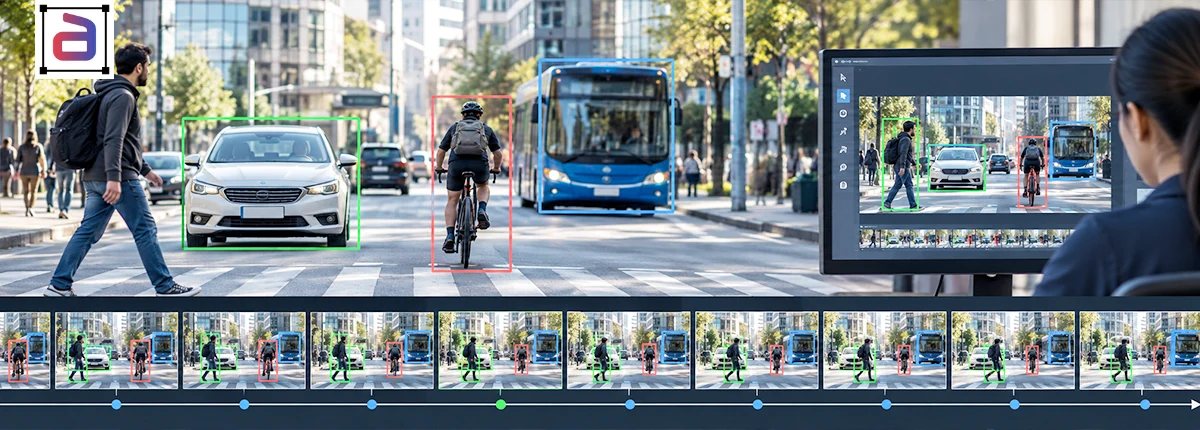

As computer vision programs mature, success increasingly depends on the ability to scale high-quality training data without compromising accuracy. While early pilots may rely on limited datasets, production-grade AI requires millions of precisely labeled images. In this context, semantic segmentation at scale has become a critical capability for organizations managing complex, high-volume image pipelines.
For data operations leaders, scaling pixel-level labeling is not simply a staffing challenge. Instead, it is a question of process design, quality governance, and operational resilience. Learn more about panoptic segmentation combining semantic and instance labels. Learn more about semantic segmentation for flood and disaster mapping.
Key Points
- Scaling pixel-level labeling requires annotation tooling that supports interpolation, pre-labeling, and quality sampling — human-only pixel-by-pixel labeling cannot maintain consistency across millions of images.
- Annotation consistency in semantic segmentation degrades at scale because small guideline ambiguities compound across large annotator teams producing large correlated errors at boundary regions.
- Large-scale segmentation programs require tiered quality control: automated consistency checks for obvious errors, statistical sampling for systematic drift, and expert review for edge cases.
- The economics of pixel-level annotation at scale require semi-automated pre-labeling pipelines that produce rough masks for human correction, not blank canvases for human completion from scratch.
Table of Contents
Why Pixel-Level Labeling Becomes a Bottleneck at Scale
Pixel-level annotation is inherently resource-intensive. Consequently, as image volumes grow, annotation time, review cycles, and error rates tend to increase.
Moreover, inconsistent labeling standards across teams or time periods introduce variability that directly impacts model performance. Therefore, scalability must be approached systematically rather than reactively.
What Semantic Segmentation at Scale Requires
Semantic segmentation demands more than annotation tools. It requires standardized class taxonomies, documented guidelines, and repeatable workflows.
Additionally, scalable programs depend on calibrated annotator training, structured review layers, and real-time quality monitoring to maintain consistency across large corpora.
Operational Challenges in Large-Scale Segmentation Programs
Volume and Throughput Management
High image volumes place pressure on turnaround times. Without parallelized workflows, delivery schedules quickly become unmanageable.
Quality Drift Over Time
As datasets expand, subtle deviations in labeling practices can accumulate. Consequently, models begin learning noise rather than signal.
Workforce Coordination
Managing distributed annotation teams introduces coordination complexity, especially when datasets span geographies and domains.
Strategies for Scaling Without Losing Accuracy
To scale effectively, organizations must separate annotation, review, and audit responsibilities. As a result, quality checks remain objective and independent.
Furthermore, sampling strategies and gold-standard benchmarks help detect drift early, allowing corrective action before issues propagate.
Why Transactional Buyers Choose Managed Segmentation Models
For data operations VPs, managed semantic segmentation at scale reduces execution risk. Predictable throughput, governed quality, and elastic capacity support rapid growth without operational disruption.
As a result, internal teams remain focused on model performance and deployment rather than annotation firefighting.
How Annotera Scales Pixel-Level Labeling Programs
Annotera delivers semantic segmentation at scale through a managed operating model that combines trained annotation teams, standardized workflows, and multi-layer quality assurance. For a scene-parsing and spatial understanding angle on how segmentation is applied, see image segmentation services for scene parsing.
Continuous performance tracking, capacity planning, and process optimization ensure that large image corpora are labeled accurately and delivered on schedule.
Conclusion
Scaling pixel-level labeling is a defining challenge for enterprise computer vision initiatives. When executed without governance, scale introduces risk. However, when supported by structured processes, it becomes a competitive advantage.
Semantic segmentation at scale enables organizations to move confidently from pilot projects to production-grade AI systems.
Looking to scale pixel-level labeling across large image datasets? Partner with Annotera for expert-managed semantic segmentation at scale that delivers accuracy, speed, and operational confidence.
A closely related read: pixel-level labeling in a diagnostic context.