When disaster strikes, every minute matters. Whether responding to catastrophic floods, hurricanes, wildfires, or landslides, emergency teams depend on accurate information to make life-saving decisions. Yet traditional disaster assessment methods often struggle to keep pace with rapidly evolving situations. By the time manual surveys are completed, conditions on the ground may have already changed. This challenge has fueled the adoption of artificial intelligence (AI) across disaster management workflows. Among the most impactful technologies is semantic segmentation, a computer vision technique that enables AI systems to understand disaster-affected environments at the pixel level. Learn more about drone video annotation for disaster response AI.
From identifying flooded roads to assessing infrastructure damage and mapping evacuation routes, semantic segmentation is helping emergency responders act faster and more effectively. At Annotera, we support organizations developing next-generation geospatial AI solutions through high-precision annotation services that power reliable and scalable disaster response models.
Key Points
- Semantic segmentation of aerial disaster imagery enables emergency AI to classify flooded zones, damaged structures, and accessible routes at operational speed.
- Disaster zone annotation requires rapid turnaround — dataset freshness matters when conditions change hour by hour during active emergencies.
- Annotators must consistently distinguish water intrusion, structural collapse, debris fields, and temporary shelters using stable class definitions.
- High-quality segmentation datasets for disaster response directly improve evacuation routing, resource allocation, and damage assessment AI accuracy.
Table of Contents
The Growing Need for Intelligent Disaster Mapping
Climate-related disasters are becoming more frequent and more severe across the globe. According to the United Nations Office for Disaster Risk Reduction (UNDRR), disaster events have increased significantly over the past two decades, affecting billions of people and causing trillions of dollars in economic losses. Floods alone remain among the most devastating natural disasters worldwide.
The World Bank estimates that natural disasters generate more than $520 billion in annual economic losses, while displacing millions of people every year. The challenge for emergency response teams is not simply collecting data—it is converting massive volumes of satellite imagery, aerial photographs, and drone footage into actionable intelligence quickly enough to support decision-making. This is where semantic segmentation becomes indispensable. As climate-related disasters become more frequent and severe, the demand for intelligent disaster mapping continues to grow. Consequently, organizations are leveraging AI-powered semantic segmentation to rapidly analyze affected areas, improve situational awareness, and support faster emergency response decisions.
What Is Semantic Segmentation?
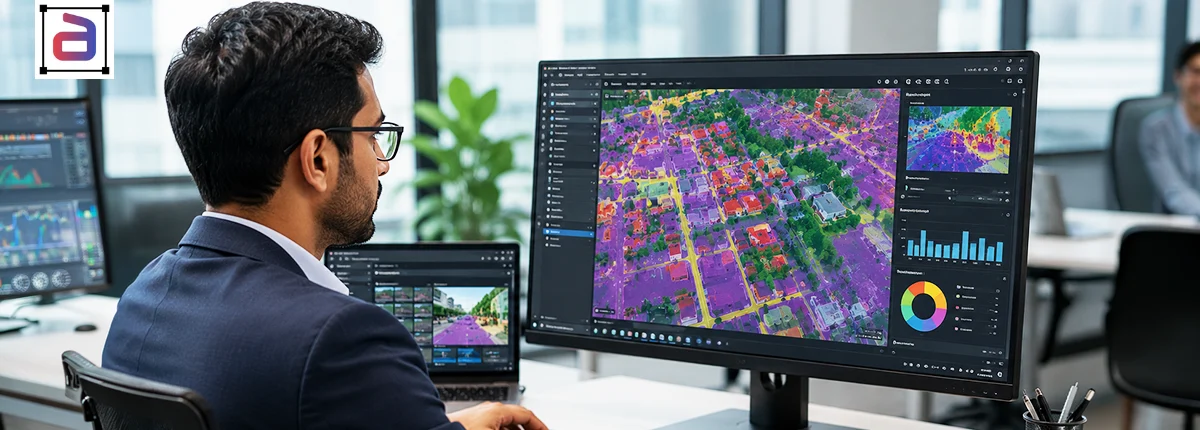
Semantic segmentation is a computer vision technique that classifies every pixel within an image into predefined categories. Unlike traditional object detection, which identifies objects using bounding boxes, semantic segmentation provides precise boundaries and detailed scene understanding. Semantic segmentation is a computer vision technique that classifies every pixel within an image into predefined categories. As a result, AI models can precisely identify disaster-affected areas, thereby enabling more accurate mapping, analysis, and emergency response planning.
For disaster zone mapping, AI models can segment:
- Floodwater
- Roads
- Buildings
- Vegetation
- Debris
- Burned land
- Damaged infrastructure
- Emergency access routes
- Water bodies
The result is a highly detailed digital map that provides responders with a clear picture of affected regions and operational priorities. Imagine a flood-affected city. Rather than simply detecting that flooding exists, semantic segmentation identifies exactly which streets are submerged, which buildings are impacted, and which evacuation routes remain accessible. That level of precision can directly influence rescue operations and resource allocation.
Why Pixel-Level Accuracy Matters During Emergencies
Emergency response depends on accuracy. A road incorrectly classified as accessible could delay rescue efforts. A damaged bridge missed by an AI system could create dangerous operational risks. In disaster management, small errors can have significant consequences. During emergencies, even minor mapping errors can lead to delayed rescue efforts or misallocated resources. Therefore, pixel-level accuracy is essential, as it enables AI systems to precisely identify hazards, assess damage, and support informed decision-making.
“The data is the food for AI.” — Andrew Ng, AI Researcher and Founder of DeepLearning.AI
While advanced algorithms attract attention, the success of any disaster response model ultimately depends on the quality of the training data behind it. For semantic segmentation, that means creating precise pixel-level annotations that accurately represent real-world conditions.
Training AI for Flood and Disaster Mapping
Developing reliable semantic segmentation models requires vast amounts of annotated imagery collected from multiple sources:
- Satellite imagery
- Drone surveys
- Aerial photography
- Remote sensing platforms
- Geographic Information Systems (GIS)
Each image must be carefully labeled to distinguish critical features such as floodwater, road networks, vegetation, debris, and infrastructure. This process is significantly more complex than traditional image labeling because annotators must outline exact object boundaries rather than drawing simple bounding boxes. For example, floodwater may appear visually similar to shadows, reflections, rivers, or lakes.
Burned vegetation may resemble barren land. Training AI for flood and disaster mapping requires accurately annotated satellite, aerial, and drone imagery. Consequently, high-quality semantic segmentation datasets help models recognize affected areas, thereby improving disaster assessment, situational awareness, and emergency response outcomes.
Damaged structures can vary dramatically depending on disaster type and image quality. Creating accurate training datasets requires experienced annotation specialists, rigorous quality control, and clearly defined annotation protocols. This is where partnering with an experienced image annotation company becomes critical.
How Semantic Segmentation Supports Emergency Response
Semantic segmentation enhances emergency response by delivering detailed, real-time insights into disaster-affected regions. As a result, responders can quickly identify hazards, assess damage, prioritize rescue operations, and allocate resources more effectively during critical situations.
Flood Extent Analysis
Flood mapping remains one of the most valuable applications of semantic segmentation. AI models can rapidly identify flood boundaries from satellite and drone imagery, helping authorities determine:
- Impacted communities
- Safe evacuation corridors
- Priority rescue zones
- Infrastructure risks
Instead of waiting days for manual assessments, responders can access detailed flood maps within hours.
Infrastructure Damage Assessment
Following hurricanes, earthquakes, and severe storms, governments need immediate visibility into damaged assets. Semantic segmentation enables AI systems to identify:
- Collapsed buildings
- Damaged roads
- Destroyed bridges
- Utility disruptions
This accelerates recovery planning and resource deployment.
Wildfire Monitoring
Wildfires create rapidly changing environments that require continuous monitoring. Semantic segmentation helps emergency agencies distinguish:
- Active burn zones
- Burn scars
- Vegetation coverage
- Firebreaks
These insights improve containment strategies and support public safety efforts.
Emergency Route Optimization
Road accessibility is one of the most important variables during disaster response. By accurately segmenting transportation networks and identifying blocked routes, AI systems can help first responders reach affected populations faster and more safely.
Why High-Quality Annotation Is the Foundation of Reliable AI
The effectiveness of any semantic segmentation model depends directly on the quality of its annotations. Poorly labeled datasets introduce bias, reduce model accuracy, and increase operational risk. High-quality annotation forms the foundation of reliable AI because accurate labels directly influence model performance. Moreover, consistent and precise annotations help reduce errors, improve prediction accuracy, and ensure dependable results in real-world disaster response scenarios.
“The engine of AI is not algorithms. It’s data.” — Fei-Fei Li, Computer Scientist and AI Researcher
For organizations building disaster response solutions, this statement holds particular relevance. At Annotera, we understand that every pixel matters. Our annotation teams follow stringent quality assurance processes to ensure consistent and accurate labeling across complex geospatial datasets. By combining domain expertise, scalable workflows, and multi-stage quality reviews, we help clients build training datasets capable of supporting mission-critical AI systems.
Why Organizations Are Turning to Data Annotation Outsourcing
As disaster management platforms increasingly leverage AI, the demand for large-scale annotated datasets continues to grow. Building and managing internal annotation teams can be costly, time-consuming, and difficult to scale. This has made data annotation outsourcing a strategic advantage for organizations seeking to accelerate AI development while maintaining quality standards. Benefits include:
- Faster dataset creation
- Access to specialized annotation expertise
- Lower operational costs
- Flexible scaling for large projects
- Consistent quality assurance processes
Similarly, image annotation outsourcing enables organizations to process massive volumes of satellite and aerial imagery without diverting internal resources from core AI development initiatives. As a trusted data annotation company, Annotera provides scalable annotation solutions tailored to the unique requirements of geospatial intelligence and disaster response applications.
Why Annotera Is the Partner of Choice for Disaster Mapping AI
Disaster response AI demands more than annotation volume—it requires annotation precision. Annotera delivers:
- Pixel-perfect semantic segmentation
- Expert geospatial annotation teams
- Scalable production workflows
- Multi-layer quality assurance
- Rapid turnaround times
- Support for satellite, aerial, and drone imagery
Our teams work closely with AI developers, geospatial analytics providers, governments, and technology innovators to create datasets that improve model performance and accelerate deployment. Whether you are developing flood monitoring systems, wildfire detection platforms, infrastructure assessment tools, or emergency response solutions, Annotera provides the annotation expertise needed to transform raw imagery into actionable intelligence.
The Future of Disaster Response Is Data-Driven
As climate-related disasters continue to intensify, the need for faster, smarter, and more accurate emergency response technologies will only increase. Semantic segmentation is enabling a new generation of AI-powered disaster management systems capable of delivering unprecedented situational awareness. But these systems can only perform as well as the data used to train them. Organizations that invest in high-quality annotation today will build more reliable AI models tomorrow—models capable of helping emergency responders save lives, protect communities, and strengthen disaster resilience worldwide.
We built exactly this kind of rapid-response workforce for a wildfire detection platform — see our case study on scaling a wildfire monitoring workforce.
Partner with Annotera
Looking to build AI models for flood mapping, disaster assessment, geospatial intelligence, or emergency response? Annotera’s expert annotation teams deliver high-quality semantic segmentation datasets that help organizations accelerate AI development with confidence. Contact Annotera today to learn how our data annotation outsourcing and image annotation outsourcing solutions can support your next disaster mapping initiative.A closely related read: Training AI to Understand Environmental Context.