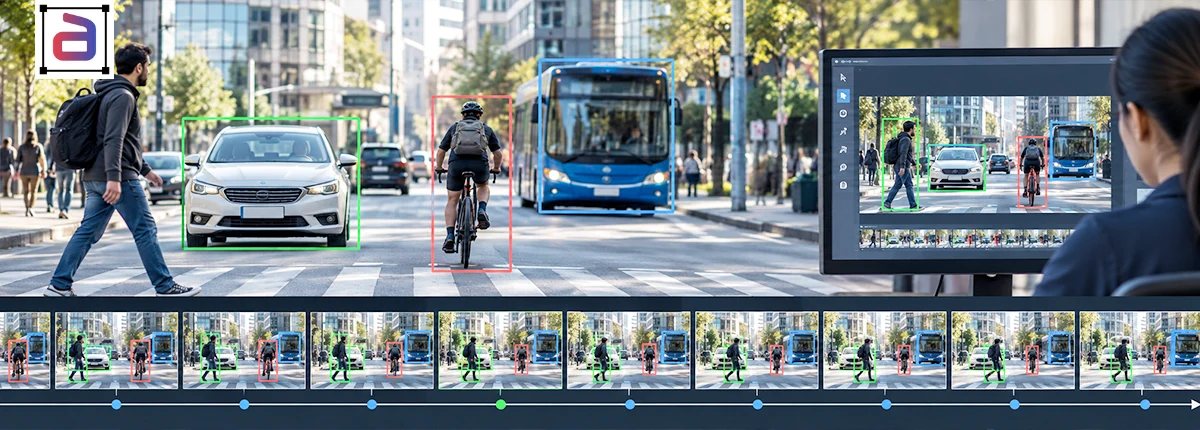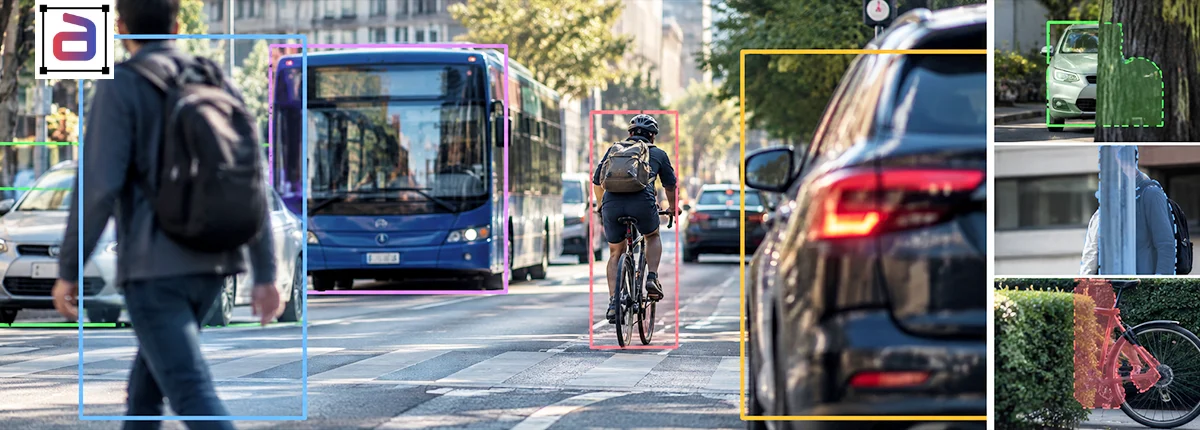

As artificial intelligence systems move beyond narrow task execution, understanding environmental context has become increasingly important. Rather than reacting to isolated objects, modern models must interpret scenes holistically to make informed decisions. In this progression, a well-structured semantic segmentation guide plays a vital role by helping AI systems learn how different elements within an environment relate to one another. Scene parsing annotation — which maps those relationships into trainable structure — is the focus of image segmentation services for scene parsing. Learn more about scene parsing for urban video intelligence. Learn more about why perception AI needs panoptic segmentation.
For AI generalists exploring computer vision, semantic segmentation provides the conceptual and practical foundation for building context-aware models.
Key Points
- Environmental context understanding requires segmentation annotation that captures spatial relationships between scene elements, not just the identity of individual objects within a scene.
- AI systems that understand environmental context can correctly interpret ambiguous sensor readings by using surrounding scene labels to disambiguate — a key capability that object detection alone cannot provide.
- Annotation for environmental context must cover adverse conditions — poor lighting, weather, unusual environments — because context understanding is most valuable precisely when individual object signals are degraded.
- Scene context annotation programs must define class hierarchies that reflect how the target AI system will use scene understanding, not just how humans naturally categorise visual environments.
Table of Contents
What Environment Context Means in Computer Vision
Environmental context refers to the spatial, relational, and semantic understanding of all elements within a scene. Consequently, it allows AI systems to recognize not only what objects are present, but also how they coexist and interact.
Without context, models may correctly detect objects yet fail to interpret their meaning. Therefore, contextual learning is essential for higher-level reasoning.
How Semantic Segmentation Enables Context Awareness
Semantic segmentation assigns a class label to every pixel in an image. As a result, models gain complete visibility into scene composition.
Because each pixel is classified, AI systems can infer boundaries, adjacency, and hierarchy. Consequently, they develop an understanding of the environment layout rather than a fragmented perception.
Why a Semantic Segmentation Guide Matters
A semantic segmentation guide defines labeling rules, class taxonomies, and edge-handling conventions. Therefore, it ensures that training data reflects consistent environmental logic.
For generalists, such guides reduce ambiguity and accelerate learning by translating complex segmentation practices into structured, repeatable processes.
Practical Applications of Context-Aware AI
Autonomous Systems and Robotics
Context-aware models understand navigable space, obstacles, and safe zones, enabling intelligent movement and interaction. Context-aware AI enhances autonomous systems and robotics by enabling real-time decision-making based on environmental cues, improving navigation, object interaction, and adaptability across dynamic, unpredictable real-world scenarios.
Smart Infrastructure and Cities
Semantic segmentation supports the interpretation of roads, buildings, and public spaces, thereby improving planning and monitoring.
Retail and Industrial Vision
Understanding environment context helps models distinguish between foreground activity and background noise.
Common Challenges in Contextual Segmentation
Despite its benefits, semantic segmentation introduces challenges such as class overlap, boundary ambiguity, and annotation complexity.
However, with clear guidance and consistent labeling strategies, these challenges can be systematically addressed.
Best Practices for Training Context-Aware Models
To train AI systems effectively, teams should maintain consistent class definitions, apply uniform labeling standards, and validate contextual relationships.
Furthermore, iterative refinement ensures that models continue to learn meaningful environmental structure.
How Annotera Supports Contextual AI Training
Annotera provides a structured semantic segmentation guide supported by trained annotation teams and governed workflows. Multi-layer quality assurance ensures consistency across datasets and use cases.
As a result, AI teams receive reliable training data that supports robust context learning.
Conclusion
Understanding environment context is a critical milestone in AI maturity. Through semantic segmentation, models learn how scenes are organized and how elements interact.
For AI generalists, following a clear semantic segmentation guide simplifies this complexity and enables the development of context-aware computer vision systems.
Building AI systems that require holistic scene understanding? Partner with Annotera for expert-managed semantic segmentation solutions designed to train context-aware models.
Related reading: segmentation for flood and disaster mapping.
To go deeper on this topic, applying segmentation to medical diagnosis instead.