Cities are becoming smarter, faster, and more connected than ever before. From intelligent traffic management to automated public safety monitoring, artificial intelligence is transforming how urban environments operate. At the heart of this transformation lies one powerful computer vision technology: video semantic segmentation. Modern surveillance systems no longer simply record footage — they interpret it. They identify vehicles, distinguish pedestrians from cyclists, analyze traffic patterns, detect anomalies, and help authorities make real-time decisions. However, none of this is possible without highly accurate training data and expert annotation workflows. This is where industry-leading annotation providers like Annotera make a measurable impact. As a trusted data annotation company, Annotera helps AI innovators build highly accurate computer vision models that power next-generation smart city surveillance systems.
Key Points
- Video semantic segmentation in smart city surveillance classifies every pixel in every frame — enabling AI to track vehicles, pedestrians, and incidents simultaneously.
- Pixel-level annotation at video scale is orders of magnitude more expensive than image segmentation; annotation efficiency tooling is a budget-critical decision.
- Training data for urban surveillance AI must cover night conditions, rain, glare, and high crowd density to prevent dangerous blind spots in production.
- Smart city AI decisions — traffic signal timing, crowd routing, incident response — are only as reliable as the segmentation labels they were trained on.
Table of Contents
What Is Video Semantic Segmentation?
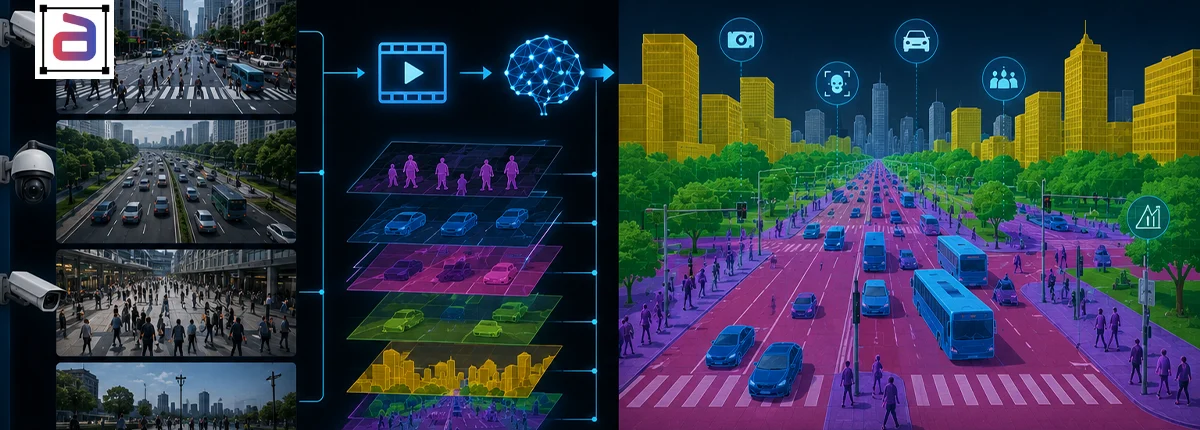
Video semantic segmentation is an advanced computer vision process that classifies every pixel within a video frame into predefined categories. Unlike basic object detection, semantic segmentation gives AI systems a deeper contextual understanding of entire environments. Video semantic segmentation is an advanced computer vision technique that classifies every pixel within a video frame into specific categories. As a result, AI systems can better understand environments and, therefore, improve surveillance accuracy, traffic monitoring, and public safety analysis. For smart city surveillance, this means AI systems can accurately differentiate between:
- Roads and sidewalks
- Vehicles and pedestrians
- Buildings and infrastructure
- Traffic signs and signals
- Public spaces and restricted zones
This pixel-level precision enables surveillance systems to interpret urban environments with remarkable intelligence and reliability. According to MarketsandMarkets, the global video analytics market is expected to exceed $22 billion by 2027, driven largely by growing investments in smart city technologies and AI-powered surveillance infrastructure.
Why Smart Cities Need Intelligent Surveillance Systems
Urban populations are growing rapidly, creating increasing pressure on transportation systems, infrastructure, and public safety operations. Traditional surveillance systems alone cannot manage the scale and complexity of modern cities. As urban populations continue to grow, smart cities increasingly require intelligent surveillance systems to manage traffic, enhance public safety, and monitor infrastructure. Moreover, AI-powered surveillance enables faster decision-making and, consequently, improves overall operational efficiency across connected urban environments. Today’s smart cities require AI-powered systems capable of:
- Real-time traffic analysis
- Crowd density monitoring
- Suspicious activity detection
- Automated incident response
- Infrastructure monitoring
- Emergency management coordination
Video semantic segmentation enables these capabilities by helping AI systems understand dynamic urban environments frame by frame.
“Artificial intelligence is becoming the brain of smart cities.” — Bernard Marr
However, even the most advanced AI systems are only as good as the data used to train them.
How Video Semantic Segmentation Enhances Smart City Surveillance
Video semantic segmentation enhances smart city surveillance by enabling AI systems to identify roads, vehicles, pedestrians, and public spaces with pixel-level precision. Consequently, cities can improve traffic monitoring, strengthen public safety, and optimize real-time urban decision-making more effectively.
Intelligent Traffic Management
Traffic congestion costs cities billions in lost productivity every year. Semantic segmentation allows surveillance AI to accurately identify vehicles, lanes, pedestrians, and road conditions simultaneously. This helps smart city systems:
- Optimize traffic signal timing
- Detect accidents instantly
- Reduce congestion
- Improve emergency response routing
- Monitor pedestrian safety
By improving traffic visibility in real time, cities can reduce delays and improve transportation efficiency significantly.
Advanced Public Safety Monitoring
Public safety remains one of the most important applications of AI surveillance. Semantic segmentation helps AI systems recognize unusual movement patterns, abandoned objects, restricted-area violations, and potential threats. Unlike traditional surveillance tools, segmentation-based AI understands contextual relationships within a scene, enabling faster and more accurate threat assessment.
Smarter Crowd Analysis
Managing large crowds during concerts, festivals, sporting events, and public gatherings presents enormous logistical challenges. Video semantic segmentation enables precise crowd monitoring by analyzing density, movement flow, and bottlenecks in real time. This technology supports:
- Safer event management
- Improved evacuation planning
- Public transportation optimization
- Better emergency preparedness
As smart cities become increasingly data-driven, accurate crowd intelligence is becoming essential.
Infrastructure Monitoring and Maintenance
Semantic segmentation is also transforming infrastructure management. AI systems trained with high-quality annotated video data can detect potholes, road damage, broken signage, and structural deterioration automatically. This enables cities to move from reactive maintenance to predictive maintenance strategies. The result:
- Lower repair costs
- Improved public safety
- Faster infrastructure response times
- Better urban planning
Why High-Quality Annotation Is Critical
Building reliable smart city surveillance systems requires massive volumes of accurately labeled video data. Semantic segmentation, in particular, demands pixel-level precision across thousands of frames. High-quality annotation is critical because AI surveillance systems rely on precise training data for accurate predictions. Moreover, consistent video labeling improves object recognition and, therefore, enhances the overall reliability, safety, and performance of smart city surveillance applications. A professional video annotation company ensures:
- Accurate object boundaries
- Temporal consistency across frames
- High-quality segmentation masks
- Multi-class annotation accuracy
- Scalable annotation workflows
Without precise annotation, AI systems generate unreliable predictions, false alerts, and inconsistent performance.
“Data is the food of AI.”— Andrew Ng
For smart city surveillance, expertly annotated video data is what fuels intelligent decision-making.
Why Businesses Are Choosing Data Annotation Outsourcing
As AI projects grow in complexity, many organizations are turning to data annotation outsourcing to accelerate development while maintaining quality. Businesses are increasingly choosing data annotation outsourcing because it reduces operational costs and accelerates AI development. Additionally, outsourcing provides access to skilled annotation experts and, therefore, ensures scalable, accurate, and high-quality training data for advanced AI applications. Creating in-house annotation operations often involves:
- High infrastructure costs
- Long onboarding cycles
- Resource management challenges
- Quality control limitations
Outsourcing solves these challenges by providing access to trained annotation specialists and scalable production workflows. At Annotera, we help organizations streamline AI development through enterprise-grade annotation solutions tailored for advanced computer vision applications.
The Rising Demand for Video Annotation Outsourcing
The rapid expansion of smart city initiatives has created unprecedented demand for high-quality training data. The rising demand for video annotation outsourcing is driven by the rapid growth of AI-powered surveillance and computer vision technologies. Consequently, businesses are seeking scalable annotation solutions that improve dataset accuracy while also accelerating AI model training and deployment processes. According to Grand View Research, the global data annotation tools market is projected to grow at a CAGR of more than 26% through 2030 due to increasing AI adoption across surveillance, transportation, and urban infrastructure sectors. Organizations developing intelligent surveillance systems increasingly depend on video annotation outsourcing to:
- Scale large annotation projects
- Improve AI accuracy
- Accelerate deployment timelines
- Reduce operational costs
Why Annotera Stands Out
At Annotera, we combine technical precision, scalable workflows, and human expertise to support the next generation of AI innovation. Our expertise includes:
- Video semantic segmentation
- Polygon annotation
- Object tracking
- Cuboid annotation
- Instance segmentation
- Multi-frame video labeling
- AI dataset quality assurance
Whether organizations require large-scale data annotation outsourcing or specialized video annotation outsourcing, Annotera delivers annotation solutions engineered for real-world AI performance.
The Future of Smart Cities Depends on Better AI Training Data
Smart city technologies are evolving rapidly, but their success ultimately depends on the quality of the data powering their AI systems. Organizations that invest in high-quality annotation today will lead the next wave of urban AI innovation tomorrow. The future of smart cities depends on better AI training data because accurate datasets directly influence surveillance performance and decision-making. Furthermore, high-quality annotation enables AI systems to operate more efficiently and, consequently, deliver safer and smarter urban infrastructure solutions.
Partner with Annotera for Scalable AI Annotation Excellence
At Annotera, we help businesses transform raw video footage into high-quality training data that powers intelligent surveillance systems. If your organization is building the future of smart city surveillance, Annotera is ready to support your AI journey with precision-driven annotation solutions. Get in touch with Annotera today to build smarter, safer, and more intelligent urban AI systems.
Related reading: traffic-specific video categorization for cities.
A closely related read: How Video Annotation Supports AI-Powered Smart City Infrastructure.