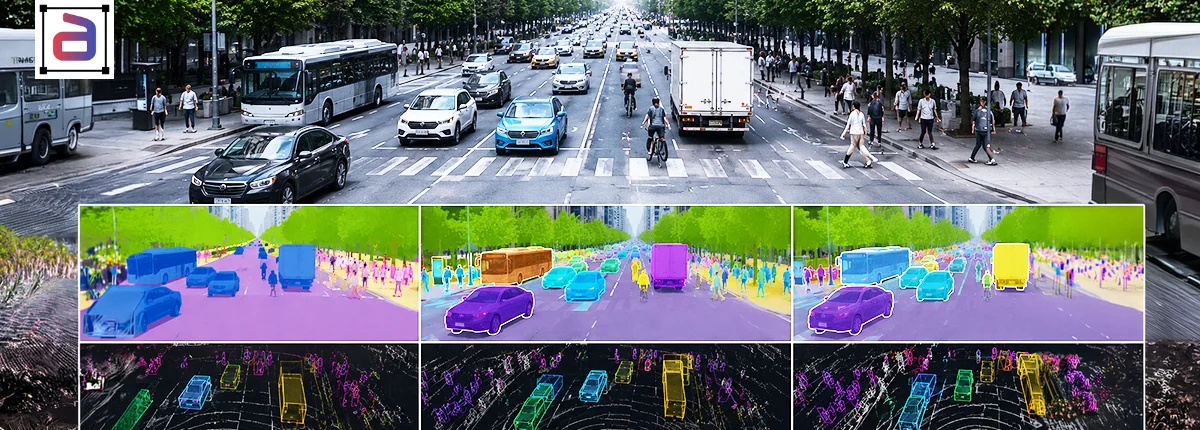
Artificial Intelligence is rapidly evolving from simply detecting objects to truly understanding the world around it. Whether it’s a self-driving vehicle navigating crowded streets, a robot operating in a warehouse, or a medical imaging system identifying abnormalities, today’s AI systems need far more than object recognition—they need context. Panoptic segmentation combines semantic and instance segmentation to provide complete scene understanding — and the foundational scene-parsing capability that underpins it is explored in image segmentation services and scene parsing., enabling AI systems to identify every pixel’s category while distinguishing individual objects within complex visual environments. This growing demand for contextual intelligence is driving the adoption of panoptic segmentation, one of the most advanced approaches in computer vision. By combining the strengths of semantic segmentation and instance segmentation, panoptic segmentation enables machines to interpret scenes with a level of detail that closely resembles human perception. At Annotera, we are seeing organizations across industries increasingly invest in sophisticated perception AI systems that require richer, more accurate training data. As these systems become more complex, panoptic segmentation is emerging as a foundational technology powering the next generation of intelligent vision models.
Key Points
- Panoptic segmentation labels every pixel with both a category and an individual instance ID — significantly more demanding than either method alone.
- Autonomous driving and robotics perception systems require panoptic labels to distinguish between two objects of the same type in the same scene.
- Annotation cost for panoptic datasets is substantially higher than bounding box or semantic methods — quality controls must scale accordingly.
- The shift to panoptic annotation reflects the AI industry’s demand for complete scene understanding rather than simple object presence detection.
Table of Contents
The Evolution of Scene Understanding in Computer Vision
For years, computer vision models have relied on different segmentation techniques to understand images.
Semantic Segmentation: Understanding the Environment
Semantic segmentation classifies every pixel in an image into a predefined category. For example:
- Road pixels are labeled as “road”
- Building pixels are labeled as “building”
- Tree pixels are labeled as “tree”
- Vehicle pixels are labeled as “vehicle”
This approach gives AI a comprehensive understanding of the environment. However, it cannot distinguish between multiple objects of the same category. Imagine a busy parking lot. Semantic segmentation can tell a model that certain pixels belong to cars, but it cannot determine how many cars are present.
Instance Segmentation: Understanding Individual Objects
Instance segmentation solves this challenge by identifying each object separately. Instead of labeling all vehicles as one category, it differentiates:
- Car #1
- Car #2
- Car #3
This capability is essential for applications that require object tracking, counting, and interaction. However, instance segmentation primarily focuses on identifiable objects and may not fully capture the broader scene context.
Panoptic Segmentation: The Best of Both Worlds
Panoptic segmentation combines semantic and instance segmentation into a unified framework. Every pixel receives:
- A semantic label (what it is)
- An instance identifier (which object it belongs to)
The result is a complete, holistic understanding of a scene.
“If our era is the next Industrial Revolution, as many claim, AI is surely one of its driving forces.” — Fei-Fei Li
For AI to truly become that driving force, it must understand visual environments at a much deeper level—and panoptic segmentation is a major step toward achieving that goal.
Why Perception AI Needs Both Semantic and Instance Labels
Modern AI systems don’t just need to see objects; they need to understand relationships between objects and their surroundings. Consider an autonomous vehicle approaching an intersection. The system must recognize:
- The road surface
- Sidewalk boundaries
- Traffic signals
- Lane markings
- Pedestrians
- Cyclists
- Multiple nearby vehicles
At the same time, it must distinguish each pedestrian and vehicle as separate entities. Semantic segmentation alone provides environmental understanding.Instance segmentation alone provides object-level understanding. Panoptic segmentation delivers both simultaneously, creating a richer representation of reality that enables better decision-making.This comprehensive scene awareness is becoming increasingly critical as AI systems move from experimental environments into real-world deployments.
Industry Momentum Behind Advanced Segmentation
The business case for advanced perception AI has never been stronger. According to MarketsandMarkets, the global artificial intelligence market size was estimated at USD 390.91 billion in 2025 and is projected to reach USD 3,497.26 billion in 2033, expanding at a CAGR of 30.6% from 2026 to 2033.. Meanwhile, research from McKinsey suggests that AI-enabled automation and autonomous technologies could contribute trillions of dollars in economic impact globally over the next decade. More specifically, highly accurate annotated data that enables models to understand complex visual environments.
“Rather than focusing on the code, companies should focus on the data.” — Andrew Ng
This perspective has become increasingly relevant as model architectures mature and data quality becomes the primary differentiator in AI performance.
Real-World Applications of Panoptic Segmentation
Autonomous Driving
Self-driving systems require complete environmental awareness. Panoptic segmentation enables vehicles to simultaneously understand roads, lane markings, pedestrians, traffic signs, and individual vehicles—supporting safer navigation decisions.
Retail Intelligence
Retailers increasingly use computer vision to monitor inventory, analyze customer behavior, and optimize store operations. Panoptic segmentation allows systems to identify product categories while distinguishing individual products on shelves, improving inventory visibility and compliance monitoring.
Medical Imaging
Healthcare AI solutions require exceptional precision. Panoptic segmentation can classify tissue structures while separately identifying tumors, lesions, and anatomical features, supporting more accurate diagnostics and treatment planning.
Smart Manufacturing
Manufacturers use computer vision for quality control, defect detection, and automation. By combining scene understanding with object-level recognition, panoptic segmentation helps production systems operate with greater efficiency and accuracy.
Robotics and Automation
For robots to interact effectively with their environments, they need contextual awareness alongside object recognition. Panoptic segmentation enables robots to understand where objects are located, what surrounds them, and how they relate to one another.
Why Annotation Quality Determines Model Success
While panoptic segmentation offers extraordinary capabilities, its effectiveness depends entirely on the quality of training data. Unlike conventional object detection tasks, panoptic segmentation requires pixel-perfect annotations across entire images.
- Every object boundary must be accurately defined.
- Every semantic class must remain consistent.
- Every instance must be uniquely identified.
This level of complexity creates significant challenges for organizations attempting to scale annotation operations internally. That’s why many AI companies are increasingly partnering with an experienced data annotation company that specializes in complex computer vision workflows. Industry studies consistently show that improving data quality often delivers greater performance gains than modifying model architectures. In other words, even the most advanced AI models cannot overcome poor-quality annotations.
Why Businesses Are Turning to Annotation Specialists
As AI initiatives scale, maintaining annotation quality becomes increasingly difficult. Organizations often discover that recruiting, training, managing, and auditing in-house annotation teams can slow development cycles and increase operational costs. Partnering with a specialized image annotation company offers several advantages:
- Access to trained annotation professionals
- Scalable production capacity
- Faster project turnaround
- Robust quality assurance processes
- Consistent annotation standards
- Reduced operational overhead
For businesses building next-generation perception AI systems, outsourcing annotation operations can significantly accelerate time-to-market while maintaining exceptional dataset quality.
How Annotera Powers Advanced Computer Vision Projects
At Annotera, we recognize that perception AI is only as strong as the data behind it. Our teams support organizations developing advanced computer vision systems through high-quality annotation services tailored to complex AI applications. Our expertise includes:
- Semantic segmentation
- Instance segmentation
- Panoptic segmentation
- Polygon annotation
- Autonomous vehicle datasets
- Medical imaging datasets
- Retail analytics datasets
- Industrial inspection datasets
As a trusted data annotation company, Annotera combines domain expertise, scalable workflows, and rigorous quality control to help organizations build reliable AI models. Whether companies require a specialized image annotation outsourcing for complex segmentation tasks, our focus remains the same: delivering high-precision datasets that drive measurable model performance improvements.
The Future Belongs to Context-Aware AI
The next generation of AI will not be defined solely by bigger models or greater computational power. It will be defined by better understanding. Panoptic segmentation represents a significant leap forward because it allows machines to understand both the meaning of a scene and the individuality of the objects within it. As perception AI continues transforming industries—from transportation and healthcare to manufacturing and retail—the demand for high-quality panoptic segmentation datasets will only grow. Organizations that invest in advanced annotation strategies today will be best positioned to build the intelligent systems of tomorrow.
Partner with Annotera to Build Smarter Vision AI
Developing high-performing perception AI starts with high-quality training data. At Annotera, we help organizations transform complex visual data into accurate, scalable, and model-ready datasets through expert annotation services tailored for advanced computer vision applications. Whether you’re building autonomous systems, intelligent retail solutions, healthcare AI, or industrial automation platforms, our team is ready to support your success. Ready to power the next generation of perception AI?Contact Annotera today and discover how our expert image annotation and data annotation services can accelerate your AI development journey.
A closely related read: Training AI to Understand Environmental Context.
A closely related read: Scaling Pixel-Level Labeling for Large Image Corpora.
A closely related read: Scene Parsing: How Semantic Segmentation Trains AI.