Robots are moving beyond controlled environments. They are increasingly expected to navigate warehouses, collaborate with human workers, manipulate objects, inspect products, and operate safely around complex machinery. To accomplish these tasks, robots need more than the ability to detect an object. They need to understand where every object begins and ends, what it represents, and how it changes across time. This is where semantic and panoptic segmentation become critical. By providing pixel-level information across video frames, segmentation enables computer vision models to build a richer understanding of industrial environments. For organizations developing robotics and manufacturing AI, high-quality segmentation data can become the difference between a model that performs well in testing and one that performs reliably in the real world. As a specialized data annotation company, Annotera helps AI teams transform complex visual data into structured, production-ready training datasets for advanced computer vision applications.
Key Points
- Pixel-Level Precision for Robotics – Semantic and panoptic segmentation help robots precisely identify objects, boundaries, people, and environments for better navigation, manipulation, and safety.
- Enhanced Manufacturing AI – Segmentation supports automated defect detection, assembly-line monitoring, robotic picking, workplace safety, and industrial inspection.
- Temporal Consistency Matters – Video segmentation requires accurate frame-to-frame labeling to handle motion, occlusion, changing lighting, and complex object interactions.
- High-Quality Annotation Drives AI Performance – Annotera provides scalable video annotation outsourcing and expert annotation workflows to help businesses build accurate, consistent, production-ready training datasets.
What Is Semantic Segmentation in Video?
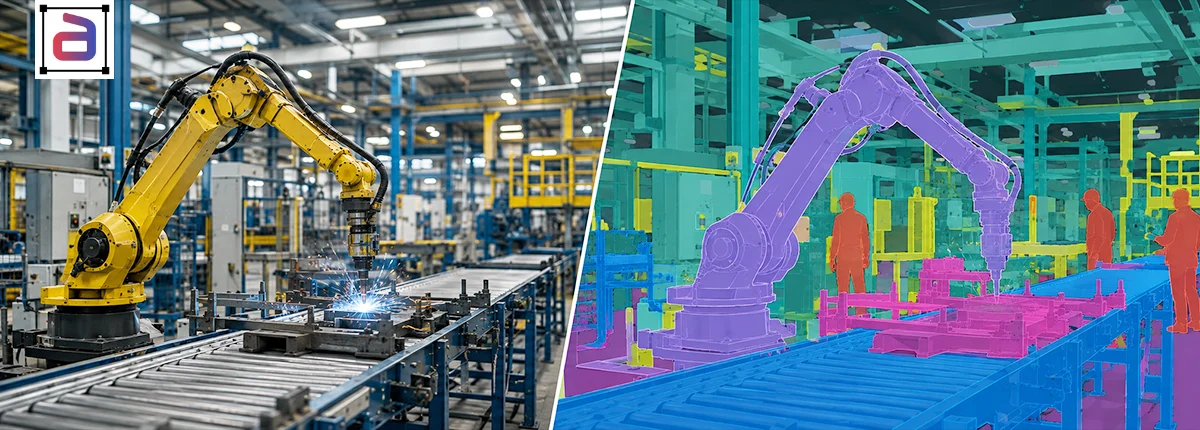
Semantic segmentation classifies every pixel in a video frame according to a predefined category. Instead of simply drawing a box around a robot, worker, machine, or product, the annotation identifies the precise pixels belonging to each class. For example, a manufacturing video could contain semantic classes such as:
- Robot arm
- Human worker
- Conveyor belt
- Product
- Machine
- Floor
- Safety barrier
- Tool
If several workers appear in a scene, semantic segmentation identifies all of them as the “worker” category. It does not necessarily distinguish one worker from another. This detailed scene-level understanding is valuable for robotic navigation, industrial inspection, workspace analysis, and safety-oriented computer vision.
“Raw video is hours of pixels, motion, and noise. Without structure, it is meaningless to a model.” — Annotera
What Is Panoptic Segmentation?
Panoptic segmentation takes scene understanding a step further by combining semantic segmentation and instance-level identification. Every pixel receives both a semantic category and, where appropriate, an instance identity. This means an AI model can understand that three objects belong to the same class while recognizing each as a separate entity. Imagine a robotic system operating beside four workers and two robotic arms. Semantic segmentation can identify the pixels associated with workers and robots. Panoptic segmentation can additionally distinguish:
- Worker 1 from Worker 2
- Robotic Arm 1 from Robotic Arm 2
- Individual products on a conveyor
- Separate objects within a crowded workspace
That distinction is particularly important for robotics, where individual object identity can influence navigation, manipulation, collision avoidance, and task planning. Annotera has previously highlighted this evolution toward complete scene understanding: panoptic segmentation combines category-level and instance-level information to help AI systems interpret complex environments more comprehensively.
Why Pixel-Level Precision Matters for Robotics
For a robot, knowing that an object exists is often not enough. Suppose a robotic gripper needs to pick up a small component positioned beside several other components. A bounding box may include surrounding objects or irrelevant background pixels. A precise segmentation mask, however, can provide a much clearer representation of the component’s actual shape. This can support:
Robotic Manipulation
Accurate object boundaries help robots identify graspable regions and distinguish target objects from nearby items.
Navigation
Segmentation can help autonomous robots differentiate floors, obstacles, people, equipment, and restricted areas.
Human-Robot Collaboration
Robots operating around people need to understand where workers are located and how they move through shared spaces.
Industrial Inspection
Pixel-level labels can identify precise defect regions rather than simply classifying an entire product as defective.
Scene Understanding
Segmentation gives AI models a detailed representation of the environment, supporting more sophisticated perception and decision-making. Annotera’s video annotation capabilities include frame-level validation, multi-object tracking, occlusion tagging, object classification, and other techniques designed for complex computer vision workflows.
Why Video Makes Segmentation More Challenging
Annotating a single image is already a precision-intensive task. Applying segmentation consistently across thousands or millions of video frames introduces another dimension: time. Objects move. Cameras shift. Lighting changes. Objects become partially hidden. Workers cross paths. Machines rotate. Products enter and leave the frame. Consequently, annotation teams must maintain temporal consistency while preserving pixel-level accuracy. Consider a robotic arm moving toward a component. If its segmentation mask suddenly changes shape between frames without a genuine physical reason, the training dataset can introduce noise into the model. Effective video annotation therefore requires careful handling of:
- Occlusion
- Motion blur
- Object entry and exit
- Camera movement
- Partial visibility
- Re-identification
- Changing illumination
- Overlapping objects
- Complex object boundaries
As Annotera’s video annotation guidance notes, temporal consistency is a core requirement because video annotation must preserve relationships across consecutive frames rather than treating each frame as an isolated image.
Semantic vs. Panoptic Segmentation: Which Is Right?
The choice depends on the AI application’s objectives. Semantic segmentation is appropriate when the model needs to understand the composition of a scene. For example, an industrial robot may need to distinguish floor space, machinery, workers, and work areas. Panoptic segmentation becomes more valuable when the model needs to distinguish individual objects within the same category. This is particularly relevant when multiple workers, products, tools, or machines appear simultaneously. In many advanced robotics applications, panoptic segmentation can provide richer information because the system needs both what an object is and which individual object it is.
Applications in Manufacturing AI
Manufacturing is one of the strongest environments for pixel-level video understanding.
Automated Defect Detection
Segmentation models can identify the exact boundaries of scratches, cracks, surface imperfections, missing components, or contamination.
Assembly-Line Monitoring
AI systems can understand product positions, machine states, worker interactions, and process changes across video sequences.
Robotic Picking
Panoptic segmentation can help robotic systems distinguish individual components, even when multiple similar objects appear together.
Workplace Safety
Segmentation can identify workers, machines, safety zones, and potential interactions that require attention.
Warehouse Robotics
Autonomous mobile robots can use segmentation data to recognize pathways, pallets, packages, people, shelving, and obstacles. These applications depend on training data that accurately represents real-world variability rather than idealized laboratory conditions.
The Importance of High-Quality Annotation
Advanced segmentation architectures cannot compensate for fundamentally poor training data. If masks contain inaccurate boundaries, inconsistent labels, missing objects, or frame-to-frame identity errors, models can learn the wrong visual patterns. A robust annotation program should therefore include: Detailed annotation guidelines: Every class, boundary, occlusion scenario, and edge case should have clearly defined rules. Pixel-level accuracy: Annotators must carefully capture object boundaries, including irregular shapes. Temporal consistency: Labels should remain logically consistent across video sequences. Multi-stage quality assurance: Independent reviews can identify annotation errors before data reaches model-training pipelines. Representative datasets: Training footage should include different lighting conditions, camera angles, object configurations, environments, and operating scenarios.
Why Data Annotation Outsourcing Can Accelerate AI Development
Building a large segmentation dataset internally can consume substantial time and resources. Companies may need to recruit annotators, train teams, manage quality assurance, purchase annotation infrastructure, and continuously adjust workflows as project requirements evolve. Data annotation outsourcing offers an alternative by giving AI teams access to specialized annotation expertise and scalable production capacity. However, outsourcing is most effective when the partner understands the technical complexity of the task—not simply when it can process high volumes of images. For advanced video segmentation projects, organizations should evaluate a video annotation company based on its experience with pixel-level annotation, temporal consistency, quality assurance, security, scalability, and complex computer vision use cases.
Why Choose Annotera for Video Segmentation?
Annotera combines human expertise, structured workflows, and multi-layer quality controls to support production-grade AI training data. Its video annotation services cover complex requirements such as frame-by-frame labeling, multi-object tracking, object classification, occlusion tagging, and frame-level validation. Annotera also supports semantic segmentation and other advanced computer vision annotation techniques as part of its broader image and video annotation capabilities. For robotics and manufacturing organizations, this means segmentation workflows can be designed around the actual requirements of the AI model—from scene understanding and robotic manipulation to industrial inspection and safety applications.
Building the Next Generation of Industrial AI
The future of robotics will depend on machines that can interpret environments with greater precision. Semantic segmentation provides pixel-level category understanding. Panoptic segmentation adds individual object awareness. Applied consistently across video, these techniques provide AI systems with a much richer representation of dynamic industrial environments. The underlying principle is straightforward: better visual intelligence begins with better training data.
“The quality of your annotations directly determines the quality of your model.” — Annotera
For organizations developing robotics, manufacturing, and industrial computer vision systems, investing in precise segmentation annotation is therefore not merely a data-labeling decision. It is a foundational step toward building AI that can perceive, reason, and operate reliably in the physical world.
Build More Reliable Computer Vision with Annotera
Need high-quality semantic or panoptic segmentation for robotics, manufacturing, or industrial AI? Partner with Annotera to transform your raw video into accurate, consistent, and production-ready training data. Contact Annotera today to discuss your video annotation requirements and start building datasets designed for real-world AI performance.
A closely related read: Video Annotation for Human-Object Interaction: Teaching AI to Understand Actions and Context.