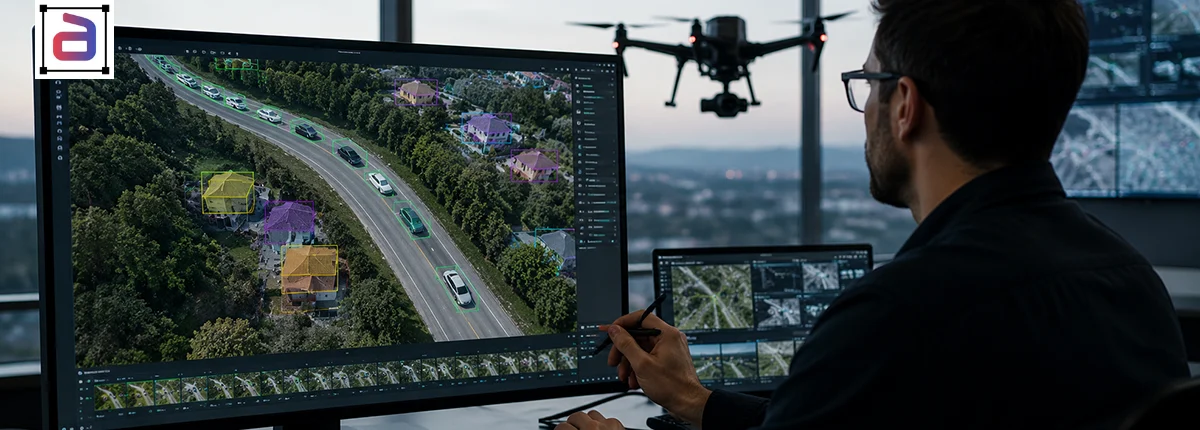
The drone revolution is transforming how organizations collect, interpret, and act on visual data. Across industries such as construction, agriculture, logistics, infrastructure management, public safety, and environmental monitoring, drones are generating massive volumes of aerial video that fuel next-generation artificial intelligence systems. However, collecting drone footage is only the first step. The true value of aerial data lies in how accurately it is annotated. Without high-quality video annotation, even the most advanced AI models struggle to detect, track, and understand objects from an aerial perspective. At Annotera, we help AI innovators transform complex drone footage into structured, machine-learning-ready datasets through precise and scalable annotation services. As a trusted data annotation company and video annotation company, we understand the unique challenges aerial datasets present—and how to overcome them. For organizations building aerial AI applications, this statement could not be more relevant. Learn more about annotating wildlife in aerial drone footage.
Key Points
- Aerial drone footage requires annotation standards different from ground-level cameras due to top-down perspective, altitude variation, and GPS context.
- Object size, rotation, and density shift dramatically with flight altitude, requiring adaptive annotation guidelines per drone use case.
- Overlapping objects, moving shadows, and terrain variation are annotation challenges unique to aerial imagery with no ground-level equivalent.
- Best practices include resolution-stratified labeling, geo-referenced annotations, and annotator training specific to aerial perspective interpretation.
Table of Contents
The Rising Demand for Drone-Powered AI
Drone adoption continues to accelerate worldwide. As industries increasingly adopt autonomous systems, the demand for drone-powered AI continues to grow. Moreover, drones generate vast amounts of visual data, enabling faster decision-making, enhanced monitoring capabilities, and improved operational efficiency across sectors such as agriculture, logistics, security, and infrastructure management. According to MarketsandMarkets, the global drone services market is expected to surpass $57 billion by 2030, driven by increasing demand for automation, remote monitoring, and intelligent analytics. Today’s AI-powered drone applications support:
- Precision agriculture
- Traffic and transportation monitoring
- Infrastructure inspections
- Construction progress tracking
- Environmental conservation
- Wildlife monitoring
- Disaster response
- Security and surveillance
- Smart city initiatives
These applications depend on vast amounts of accurately annotated video data to train machine learning models capable of making reliable decisions in real-world environments.
“The quality of data is often more important than the quantity of data.”— Andrew Ng
Why Video Annotation is Critical for Drone Footage
Unlike static images, drone videos contain dynamic scenes where objects move continuously while the camera itself is also in motion. This introduces a level of complexity that requires specialized annotation expertise. Drone footage captures vast and complex environments; however, raw video data has limited value without proper labeling. Therefore, video annotation is essential for training AI models to accurately detect objects, track movements, interpret scenes, and support autonomous decision-making. Drone footage provides a powerful aerial perspective for monitoring wildlife across vast and often inaccessible habitats. However, raw video alone cannot train AI systems effectively. Video annotation is critical because it labels animal species, movement patterns, group behaviors, and habitat interactions frame by frame. Consequently, AI models can accurately detect, track, and analyze wildlife activity from aerial footage, thereby enabling more efficient conservation efforts, population monitoring, and environmental research.
Video annotation enables AI systems to learn:
- Object detection
- Multi-object tracking
- Activity recognition
- Behavioral analysis
- Semantic segmentation
- Instance segmentation
For aerial AI models, annotations may include vehicles, pedestrians, agricultural equipment, construction machinery, wildlife, roads, buildings, and countless other objects. The more accurate the annotations, the better the AI performs in real-world deployment.
Key Challenges in Drone Video Annotation
Drone video annotation presents several challenges, including varying altitudes, rapid object movement, and complex backgrounds. Additionally, changing weather and lighting conditions can affect visibility, making accurate labeling more difficult and requiring highly precise annotation workflows.
1. Constant Camera Motion
Traditional surveillance cameras operate from fixed positions. Drones do not. Constant camera motion is a common challenge in drone footage because objects and backgrounds continuously shift. Consequently, maintaining accurate annotations becomes more difficult; however, advanced tracking techniques can improve label consistency and overall dataset quality. Drone footage involves continuous changes in:
- Altitude
- Viewing angle
- Speed
- Orientation
- Flight path
As a result, objects appear differently across frames, making consistent labeling significantly more challenging. Experienced annotators must accurately track objects despite constantly changing perspectives and backgrounds.
2. Small Objects and Long-Distance Views
Aerial footage often captures scenes from hundreds of feet above ground level. People, vehicles, animals, and equipment may occupy only a tiny portion of the frame. Small objects and long-distance views often make drone video annotation more challenging because targets appear with limited detail. Consequently, accurate labeling requires greater precision; moreover, advanced zooming and tracking tools help improve annotation quality and consistency. This creates challenges such as:
- Reduced visibility
- Lower pixel density
- Difficult object identification
- Increased annotation complexity
Precise labeling of small objects is essential for developing AI models that perform effectively in real-world drone operations.
3. Occlusions and Visual Obstructions
Occlusions and visual obstructions occur when objects are partially or completely hidden by other elements within a scene. As a result, accurate annotation becomes more difficult; however, consistent tracking and expert review can help maintain labeling precision. Objects frequently move behind:
- Trees
- Buildings
- Utility poles
- Bridges
- Shadows
Temporary occlusions create difficulties for both annotators and AI models. Maintaining object continuity across multiple frames requires well-defined annotation protocols and expert review processes.
4. Environmental Variability
Drone footage is captured in highly diverse conditions. Environmental variability, including changes in weather, lighting, and terrain, can significantly impact drone footage quality. Consequently, annotation becomes more complex; however, diverse datasets and standardized labeling practices help ensure accurate and reliable AI model training.
Models must learn to interpret objects across:
- Bright sunlight
- Cloud cover
- Rain
- Fog
- Snow
- Low-light environments
“The ability to see and understand the visual world is one of the most fundamental challenges in artificial intelligence.”— Fei-Fei Li
For aerial AI, understanding the visual world means handling every environmental condition nature presents.
5. Rapid Scale Changes
Objects can dramatically change size within seconds as drones ascend, descend, or zoom. For example, a construction vehicle may occupy a large portion of the frame during an inspection pass and appear as a tiny object moments later. Training data must accurately represent these scale variations to ensure robust model performance. Rapid scale changes occur when objects quickly appear larger or smaller as drones change altitude or distance. Consequently, maintaining annotation accuracy becomes challenging; therefore, adaptive tracking methods and careful review are essential for consistent labeling.
Best Practices for High-Quality Drone Video Annotation
To achieve high-quality drone video annotation, organizations should use clear labeling guidelines, implement rigorous quality checks, and leverage advanced annotation tools. Furthermore, consistent frame tracking and skilled annotators help ensure accurate, reliable, and scalable AI training datasets.
Establish Comprehensive Annotation Guidelines
Comprehensive annotation guidelines ensure consistency and accuracy across drone video datasets. Moreover, clearly defined labeling rules help annotators handle complex scenarios effectively, while reducing errors and improving the overall quality of AI training data. Consistency is the foundation of successful AI training. Detailed annotation instructions should define:
- Object classes
- Boundary rules
- Occlusion handling
- Tracking standards
- Edge-case scenarios
At Annotera, we develop project-specific annotation frameworks that ensure every label remains consistent across thousands of video frames.
Leverage Temporal Tracking
Annotating every frame independently is inefficient and can introduce inconsistencies. Temporal tracking enables annotators to follow objects consistently across video frames, thereby improving label continuity and accuracy. Additionally, it reduces manual effort, while helping AI models better understand movement patterns, object behavior, and long-term scene dynamics. Advanced object-tracking workflows allow annotators to follow objects across sequential frames, resulting in:
- Faster annotation
- Improved accuracy
- Better object continuity
- Reduced manual effort
This approach is particularly valuable for traffic monitoring, surveillance, and infrastructure inspection projects.
Implement Rigorous Quality Assurance
Poor-quality labels create poor-performing AI models. Rigorous quality assurance is essential for maintaining annotation accuracy and consistency. Furthermore, regular audits, multi-level reviews, and validation processes help identify errors early, thereby improving dataset reliability and enhancing the performance of AI-powered drone applications. A robust quality-control framework should include:
- Multi-stage reviews
- Annotation audits
- Automated validation checks
- Expert verification
- Inter-annotator agreement analysis
At Annotera, quality assurance is embedded into every stage of the annotation lifecycle, ensuring reliable and production-ready datasets.
Build Diverse Training Datasets
Drone AI systems must perform across numerous environments. Building diverse training datasets is crucial for developing robust AI models. Moreover, incorporating footage from different environments, weather conditions, and object types helps improve model generalization, thereby enhancing accuracy and performance in real-world drone applications. Training datasets should include:
- Urban landscapes
- Rural regions
- Industrial facilities
- Agricultural fields
- Different weather conditions
- Multiple seasons
- Various flight altitudes
Diverse datasets help improve model generalization and reduce performance degradation when deployed in unfamiliar environments.
Combine Human Expertise with AI-Assisted Annotation
Combining human expertise with AI-assisted annotation accelerates labeling workflows while maintaining high accuracy. Additionally, AI can automate repetitive tasks, whereas human reviewers validate complex scenarios, thereby ensuring reliable and scalable training datasets for drone-based AI systems. Modern annotation platforms now offer:
- Automated object tracking
- Smart interpolation
- AI-assisted labeling
- Segmentation tools
- Workflow automation
While automation accelerates production, human validation remains essential for maintaining annotation accuracy. The most effective annotation strategy combines advanced technology with experienced human oversight.
Why Businesses Are Embracing Video Annotation Outsourcing
As drone deployments expand, organizations face growing annotation demands. Managing large-scale annotation projects internally often requires substantial investments in hiring, training, infrastructure, and quality management. This is why many organizations choose video annotation outsourcing and data annotation outsourcing partners. Businesses are increasingly embracing video annotation outsourcing because it offers scalability, cost efficiency, and access to specialized expertise. Furthermore, outsourcing partners help accelerate project timelines while ensuring consistent annotation quality, thereby supporting faster AI model development and deployment.
Key benefits include:
- Faster project delivery
- Lower operational costs
- Access to trained annotation specialists
- Scalable workforce capacity
- Consistent quality assurance
- Accelerated AI development timelines
By partnering with an experienced video annotation company, businesses can focus on innovation while trusted experts manage data preparation.
Why Leading AI Teams Choose Annotera
At Annotera, we specialize in delivering high-quality annotation services that support the development of advanced computer vision systems. Leading AI teams choose Annotera because of its commitment to accuracy, scalability, and domain expertise. Moreover, Annotera combines skilled human annotators with advanced workflows, thereby delivering high-quality video annotation datasets that accelerate AI model performance and deployment. Our expertise includes:
- Video Annotation
- Bounding Box Annotation
- Polygon Annotation
- Semantic Segmentation
- Instance Segmentation
- Object Tracking
- Activity Recognition
- Drone Footage Annotation
Whether you’re developing autonomous inspection systems, agricultural monitoring solutions, traffic analytics platforms, or surveillance applications, our expert annotation teams help ensure your models are trained on accurate, scalable, and reliable datasets. As a trusted data annotation company, we combine human expertise, rigorous quality processes, and scalable production capabilities to help organizations accelerate AI deployment with confidence.
Ready to Build Smarter Aerial AI Models?
See a real-world deployment of this in our wildfire monitoring workforce case study.
High-performing drone AI starts with high-quality training data. Ready to build smarter aerial AI models? Partner with Annotera to access expert video annotation services and high-quality training data. Furthermore, our scalable solutions help accelerate development, improve model accuracy, and support real-world drone intelligence applications.
If your organization is looking for a reliable partner for drone footage annotation, video annotation outsourcing, or large-scale data annotation outsourcing projects, Annotera is ready to help. Contact Annotera today to discuss your aerial AI data requirements and discover how our annotation expertise can help you develop more accurate, reliable, and scalable computer vision solutions.