
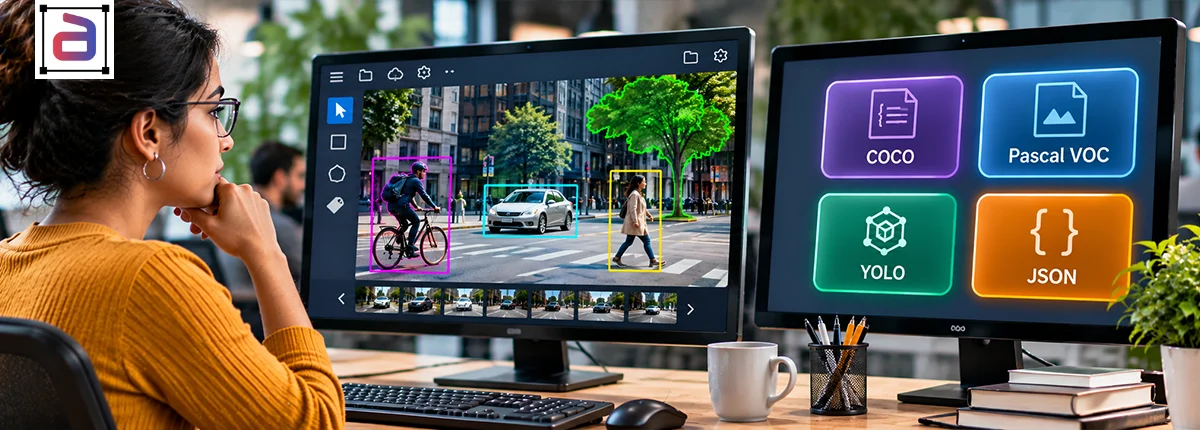
Building an accurate computer vision model starts long before the training process begins. Behind every reliable object detection system, autonomous vehicle, and intelligent surveillance application lies a structured dataset that enables machines to interpret visual information. However, collecting images and assigning labels is not enough. These annotations must also be stored in formats that machine learning frameworks can understand and process efficiently. This is where image annotation formats become essential. COCO, Pascal VOC, YOLO, and JSON are among the commonly used formats for organizing and exporting image annotation data. Each serves different technical requirements, from basic object detection to advanced instance segmentation and customized AI workflows.
For organizations developing computer vision solutions, understanding these formats can significantly improve dataset compatibility, annotation efficiency, and model development. At Annotera, we recognize that high-quality AI training data requires more than accurate labeling. It also requires structured annotation workflows, consistent metadata, and exports aligned with downstream machine learning requirements. Let’s explore the major image annotation formats, their capabilities, and how to select the right one for your AI project.
Key Points
- COCO, Pascal VOC, YOLO, and JSON are widely used image annotation formats, each designed to support different computer vision and machine learning requirements.
- COCO supports advanced annotation tasks such as object detection, instance segmentation, and keypoint detection, while Pascal VOC offers a simpler XML-based structure for object detection.
- YOLO enables lightweight, efficient object detection workflows, whereas JSON exports provide flexibility for customized annotation structures and AI pipeline integrations.
- High-quality, model-ready datasets require accurate labeling, consistent annotation guidelines, and structured exports. Annotera supports these requirements through scalable image annotation services and quality-focused workflows.
Why Are Image Annotation Formats Important?
Image annotation formats determine how labeled visual information is represented, stored, and transferred into machine learning pipelines. They define how essential information, including object categories, bounding boxes, segmentation masks, image dimensions, and keypoints, is organized. An incompatible or poorly structured export can create unnecessary preprocessing work, introduce data inconsistencies, and delay model training.
Consider an autonomous driving application. Its perception system may need to recognize pedestrians, vehicles, traffic signs, and road boundaries. While bounding boxes might be sufficient for some object detection tasks, semantic or instance segmentation requires more detailed annotation structures. Similarly, retail analytics applications may prioritize object localization and product identification, making lightweight detection formats suitable for specific workflows. As a general principle, the annotation format should support the model’s requirements rather than dictate the capabilities of the model. Let’s examine four widely used options.
1. COCO Format: Supporting Advanced Computer Vision Applications
<escape>COCO (Common Objects in Context)</escape> is a widely adopted annotation format originally developed around the Microsoft COCO dataset. It supports multiple computer vision tasks, including object detection, instance segmentation, keypoint detection, and image captioning. COCO generally uses JSON files to organize image metadata, object categories, and annotations within a structured framework.
Key Features:
- Image metadata, including filenames, dimensions, and image IDs.
- Category information with corresponding class identifiers.
- Bounding boxes represented as [x, y, width, height].
- Segmentation annotations using polygons or run-length encoding (RLE).
- Keypoint coordinates for pose estimation and landmark detection.
Advantages: COCO provides a comprehensive structure for complex annotation requirements. It is particularly useful for large-scale datasets involving multiple annotation types.
Limitations: Its detailed JSON structure can be challenging to manage manually. Teams may require preprocessing or conversion when working with frameworks that expect different formats.
Best use cases: Autonomous driving, human pose estimation, instance segmentation, robotics, and advanced computer vision research.
2. Pascal VOC: A Practical Format for Object Detection
Pascal VOC (Visual Object Classes) is an established annotation format commonly associated with traditional object detection workflows. Unlike COCO, which typically uses JSON, Pascal VOC stores annotation information in XML files. Each image generally has a corresponding XML file describing its metadata and annotated objects.
Key Features:
- Image filename and dimensions.
- Object category names.
- Bounding box coordinates using xmin, ymin, xmax, and ymax.
- Additional attributes such as pose, truncation, and difficult-object indicators.
Advantages: Its XML structure is relatively simple, readable, and straightforward to interpret. It is suitable for projects requiring conventional object detection annotations.
Limitations: Pascal VOC offers fewer standardized capabilities for complex segmentation and keypoint annotation compared with COCO.
Best use cases: Traditional object detection, image classification workflows, and applications requiring straightforward bounding box labeling.
3. YOLO Format: Optimizing Real-Time Object Detection Workflows
YOLO (You Only Look Once) is a popular family of object detection models designed for fast visual recognition. Its annotation format is lightweight and particularly convenient for training object detection systems. YOLO typically stores annotations in TXT files, with each image having a corresponding annotation file. Each object is represented through five values: class_id x_center y_center width height The bounding box coordinates and dimensions are normalized between 0 and 1 relative to the image dimensions.
Key Features:
- Normalized bounding box coordinates.
- Numerical class identifiers.
- Lightweight TXT annotation files.
- Straightforward integration with compatible YOLO training pipelines.
Advantages: YOLO’s simple structure makes dataset handling efficient. Its normalized coordinates also simplify image resizing and preprocessing.
Limitations: The basic detection format primarily supports bounding boxes. Segmentation and pose estimation require task-specific annotation extensions.
Best use cases: Traffic monitoring, retail analytics, security surveillance, autonomous driving, and real-time object detection. For applications where speed and detection accuracy are critical, properly structured YOLO annotations can help streamline model training and deployment.
4. JSON Exports: Flexibility for Customized AI Pipelines
JSON (JavaScript Object Notation) is a lightweight data-interchange format frequently used in modern AI development. Unlike COCO, Pascal VOC, and YOLO, JSON is not one specific image annotation standard. It is a flexible representation that allows developers to define customized annotation schemas according to project requirements.
Key Features:
- Customizable annotation structures.
- Support for nested objects and metadata.
- Integration with APIs and cloud-based platforms.
- Representation of object attributes and relationships.
- Machine-readable data for automated processing.
Advantages: JSON is particularly useful when organizations need customized exports or integration with proprietary machine learning systems.
Limitations: Without a clearly documented schema, different teams may structure annotation information inconsistently. Schema validation and standardized guidelines are essential.
Best use cases: Custom computer vision applications, proprietary AI platforms, API integrations, and specialized multimodal workflows.
COCO vs. Pascal VOC vs. YOLO vs. JSON: A Quick Comparison
| Feature | COCO | Pascal VOC | YOLO | JSON |
|---|---|---|---|---|
| File type | JSON | XML | TXT | JSON |
| Bounding boxes | Yes | Yes | Yes | Custom |
| Segmentation | Yes | Limited standard support | Task-specific | Custom |
| Keypoints | Yes | Limited standard support | Task-specific | Custom |
| Complexity | High | Moderate | Low | Variable |
| Main application | Advanced CV | Object detection | Real-time detection | Custom workflows |
The important distinction is that COCO is a defined annotation format built on JSON, whereas JSON itself is a general-purpose data representation. Consequently, the two should not be treated as interchangeable annotation standards.
How to Choose the Right Image Annotation Format
Selecting an annotation format requires evaluating the intended application, model architecture, and downstream data processing requirements. Here are four considerations:
- Define the annotation task: Determine whether your project requires bounding boxes, polygons, segmentation masks, keypoints, or multiple annotation types.
- Check framework compatibility: Verify which formats your machine learning framework and training pipeline support.
- Consider dataset scalability: Choose a structure that can accommodate increasing image volumes, additional categories, and evolving annotation requirements.
- Establish quality validation: Check coordinate accuracy, category consistency, missing annotations, and export integrity before model training. As computer vision projects become more sophisticated, organizations increasingly need annotation partners who understand both labeling requirements and technical data specifications.
How Annotera Helps Deliver Model-Ready Image Annotation Data
Choosing the correct export format is only one part of building a dependable computer vision dataset. Annotation accuracy, consistency, metadata management, and quality assurance are equally important. Annotera helps businesses transform unstructured visual data into structured, AI-ready training datasets. With capabilities across multiple image annotation requirements, Annotera supports organizations developing computer vision applications across industries. Its image annotation capabilities include:
- Bounding Box Annotation: Identifying and localizing objects with accurate rectangular coordinates.
- Polygon Annotation: Capturing object boundaries for detailed visual recognition.
- Semantic Segmentation: Assigning pixel-level labels to different objects and regions.
- Instance Segmentation: Distinguishing individual objects belonging to the same category.
- Keypoint Annotation: Identifying important landmarks for pose estimation and object tracking.
- Quality Assurance: Applying structured review processes to improve annotation consistency and dataset reliability.
Annotera also understands that different AI applications require different data preparation approaches. Its workflows can be aligned with project-specific export requirements, including COCO, Pascal VOC, YOLO, and customized JSON structures. Beyond visual datasets, businesses developing language-based AI systems can also benefit from specialized text annotation outsourcing services. Working with an experienced text annotation company helps maintain structured, high-quality training data across different AI applications.
Conclusion: The Right Format Builds a Stronger AI Foundation
COCO, Pascal VOC, YOLO, and JSON exports each serve distinct purposes in the computer vision ecosystem. While COCO supports comprehensive annotation requirements, Pascal VOC provides a straightforward XML structure, YOLO enables lightweight object detection workflows, and JSON offers flexibility for customized applications. However, selecting the right format is only the beginning. Consistent labeling guidelines, accurate annotations, structured exports, and rigorous quality checks ultimately determine the usefulness of a training dataset. As AI applications continue to evolve, businesses need annotation workflows that can adapt to increasingly complex data requirements.
Build Better Computer Vision Models with Annotera Looking for reliable image annotation services to prepare high-quality, model-ready datasets?
Partner with Annotera for scalable image annotation, structured data exports, and quality-focused annotation workflows. Whether you are developing autonomous driving systems, retail intelligence platforms, robotics applications, or advanced computer vision models, our team can help you prepare training data aligned with your technical requirements. Connect with Annotera today and turn your visual data into a stronger foundation for AI innovation.