
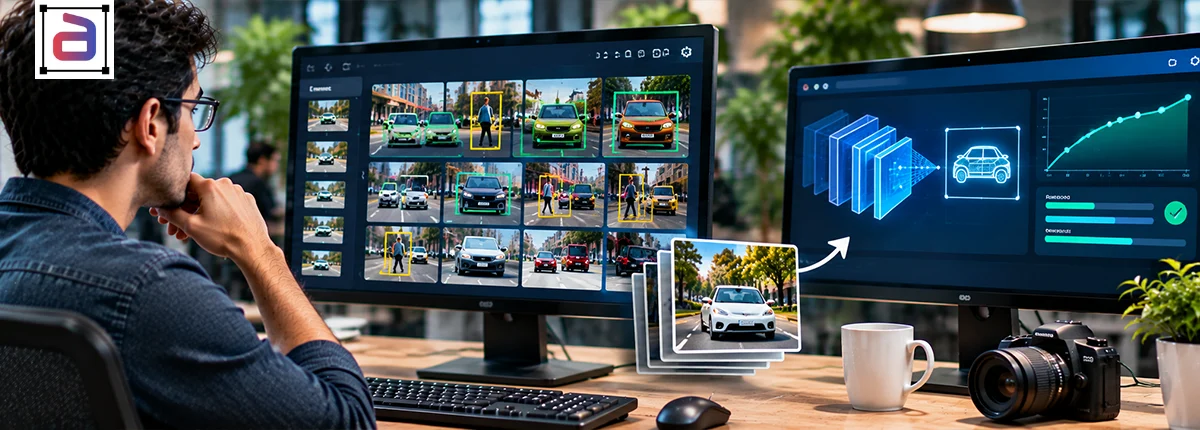
Computer vision is transforming how businesses understand and interact with visual information. From autonomous vehicles identifying pedestrians to retail systems recognizing products and manufacturing platforms detecting defects, computer vision models are becoming essential to modern AI applications. However, behind every accurate computer vision model is a critical component: a high-quality training dataset.
One of the most common questions AI developers and machine learning teams face is:
How many images are actually required to train a computer vision model?
Should you start with 1,000 images, 10,000 images, or millions of visual samples? The answer depends on several factors, including the complexity of the task, the number of object categories, image diversity, annotation accuracy, and the model architecture.
More importantly, collecting more images does not automatically translate into better model performance. A smaller, carefully curated dataset with accurate annotations can sometimes outperform a much larger dataset containing inconsistent or repetitive images. At Annotera, we understand that successful computer vision development begins with the right training data. Let’s explore how to determine the ideal dataset size and why image annotation quality plays such an important role in building reliable AI models.
Key Points
- Dataset Size Depends on Model Complexity: The number of images required varies based on the computer vision task, object categories, model architecture, and desired accuracy.
- Image Diversity Matters More Than Volume: Training datasets should include variations in lighting, angles, backgrounds, object sizes, and real-world environmental conditions.
- Annotation Quality Directly Impacts Model Performance: Accurate bounding boxes, polygon annotations, segmentation masks, and consistent labeling help models learn reliable visual patterns.
- Adopt an Iterative Dataset Development Strategy: Start with a representative image dataset, train and evaluate the model, identify data gaps, and expand the dataset strategically.
1. Why Does Image Quantity Matter in Computer Vision Training?
Computer vision models learn to identify patterns, objects, shapes, textures, and relationships by analyzing visual examples. The quality and quantity of these examples influence how effectively a model performs on previously unseen images. For instance, consider an object detection model designed to identify vehicles. If the training dataset contains only daytime images of cars captured from the front, the model may struggle to recognize vehicles at night, during heavy rainfall, or from different viewing angles. A larger and more diverse dataset exposes the model to these variations, improving its ability to generalize. However, dataset size should always be considered alongside three essential factors:
-
Diversity: Images should represent different environments, lighting conditions, backgrounds, angles, and object variations.
-
Annotation consistency: Labels, bounding boxes, and segmentation masks must follow standardized guidelines.
-
Class balance: Every target category should have sufficient examples, including less frequently occurring objects.
As the machine learning principle suggests, models learn from the information represented in their training data, not simply from the number of files collected.
2. How Many Images Are Required for Different Computer Vision Tasks?
There is no fixed dataset requirement for every computer vision application. Different tasks involve different levels of visual complexity and annotation requirements. The following table provides practical starting estimates for planning an image dataset.
| Computer Vision Application | Suggested Initial Dataset |
|---|---|
| Basic image classification | 500–2,000 images per class |
| Multi-class classification | 1,000–5,000 images per class |
| Object detection | 1,000–10,000 images |
| Image segmentation | 1,000–10,000+ images |
| Facial recognition | Thousands of diverse identity samples |
| Medical image analysis | 1,000–10,000+ images |
| Autonomous driving | Tens of thousands to millions of images |
These figures are illustrative planning ranges rather than guaranteed minimum requirements. Actual dataset requirements depend on model architecture, pretraining, class complexity, image diversity, and target performance. For example, a basic image classification model distinguishing cats from dogs may achieve reasonable results with a relatively small dataset. In comparison, autonomous driving models must recognize pedestrians, vehicles, traffic signs, road markings, cyclists, and unexpected obstacles across different environmental conditions. Similarly, medical imaging applications require carefully curated datasets where even subtle visual differences can influence diagnostic predictions.
3. Five Factors That Determine Your Computer Vision Dataset Size
Before investing in large-scale image collection and annotation, organizations should evaluate the following factors.
A. Complexity of the Recognition Task
The complexity of the computer vision problem directly influences data requirements. A model identifying a single product category has a relatively straightforward learning objective. However, a model detecting multiple objects in crowded environments must learn overlapping objects, occlusion, different orientations, and varying backgrounds. Applications involving robotics, autonomous vehicles, and security surveillance generally require more extensive datasets because they operate in unpredictable environments.
B. Number of Object Categories
The number of classes a model needs to recognize also affects dataset requirements. For instance, a model distinguishing five product categories requires fewer visual examples than one identifying 100 visually similar product categories. Each category needs sufficient examples to capture variations in shape, color, size, orientation, and appearance. Organizations should also pay attention to class imbalance. If a dataset contains 10,000 images of cars but only 200 images of bicycles, the model may struggle to recognize bicycles accurately.
C. Image Diversity and Environmental Conditions
Image diversity is often more valuable than simply increasing image volume. A reliable training dataset should include:
-
Different lighting conditions, including daylight and low-light environments.
-
Multiple camera angles and object orientations.
-
Variations in image resolution and quality.
-
Occluded, partially visible, and overlapping objects.
-
Different backgrounds and environmental conditions.
-
Rare and unusual real-world scenarios.
For example, an autonomous driving model must recognize pedestrians and road signs during daytime, nighttime, rain, fog, and other challenging conditions.
D. Model Architecture and Transfer Learning
Models trained entirely from scratch typically require more training data than models using transfer learning. Transfer learning allows developers to use pretrained architectures and fine-tune them for specific applications. Models such as ResNet and YOLO can reduce initial data requirements, depending on the task and implementation. However, pretrained models still need representative target-domain images to perform reliably in specialized environments.
E. Image Annotation Accuracy
A large dataset cannot compensate for inaccurate annotations. Incorrect bounding boxes, inconsistent class labels, missing objects, and poorly defined segmentation masks introduce noise into training data. For example, if a pedestrian is consistently mislabeled as a cyclist, the model may learn incorrect visual associations. This makes professional image annotation and quality assurance essential components of computer vision dataset development.
4. Why Image Annotation Quality Matters More Than Image Volume
Collecting images is only the beginning of the computer vision training process. Every image must be labeled according to the specific requirements of the model. Different applications require different annotation techniques.
- Bounding Box Annotation: Identifies objects using rectangular coordinates. It is commonly used in vehicle detection, retail analytics, and surveillance systems.
- Polygon Annotation: Captures irregular object boundaries with greater precision, particularly when objects have complex shapes.
- Semantic Segmentation: Assigns category labels to individual pixels, helping models understand different regions within an image.
- Instance Segmentation: Separately identifies individual objects belonging to the same category.
- Keypoint Annotation: Marks important points on objects, human bodies, or structures for pose estimation and movement analysis.
Consider an autonomous driving application. The model may require bounding boxes around vehicles, polygon annotations for road boundaries, and semantic segmentation for sidewalks and drivable surfaces. Each annotation must follow consistent labeling guidelines to ensure that the training dataset provides reliable supervision. At Annotera, we emphasize structured annotation workflows and quality control to help organizations develop accurate, scalable, and application-specific computer vision datasets.
5. How to Determine the Right Number of Images for Your Model
Instead of immediately collecting millions of images, AI development teams should adopt an iterative dataset development strategy.
Step 1: Define the Model Objective
Identify the target application, object categories, environmental conditions, and expected performance requirements.
Step 2: Create an Initial Dataset
Start with a representative sample covering all important classes and scenarios. The initial dataset may range from hundreds to several thousand images, depending on task complexity.
Step 3: Annotate and Train
Apply suitable annotation techniques, establish labeling guidelines, and train an initial computer vision model.
Step 4: Evaluate Model Performance
Use separate validation and test datasets to measure performance. Monitor precision, recall, F1-score, and mean Average Precision (mAP), depending on the application.
Step 5: Identify Data Gaps
Analyze false positives, false negatives, underperforming categories, and challenging environmental conditions.
Step 6: Expand the Dataset Strategically
Collect and annotate additional images that address the identified weaknesses. Retrain the model and evaluate whether the additional data improves performance. This approach helps organizations control annotation costs while continuously improving model accuracy.
6. How Annotera Helps Build High-Quality Computer Vision Datasets
Developing an effective computer vision model requires more than access to large image repositories. Organizations need structured data collection, accurate annotations, consistent labeling guidelines, and systematic quality assurance. Annotera helps businesses transform raw visual data into structured, machine-learning-ready datasets. Our image annotation capabilities support diverse computer vision applications, including:
-
Object detection and image classification.
-
Bounding box, polygon, and semantic segmentation annotation.
-
Image annotation for autonomous vehicles and robotics.
-
Retail product recognition and visual inspection.
-
Security surveillance and video analytics.
-
Quality assurance and human-in-the-loop annotation workflows.
Beyond visual data, organizations developing multimodal AI systems may also require complementary text annotation outsourcing services to structure textual descriptions, metadata, and contextual information. As a text annotation company, Annotera supports broader AI data preparation requirements, helping businesses develop more comprehensive training datasets. Our focus is not simply on delivering annotated images at scale. It is on helping AI teams build datasets that are accurate, diverse, consistent, and aligned with real-world machine learning objectives.
Conclusion: Focus on Dataset Quality, Not Just Image Quantity
So, how many images do you need to train a computer vision model? The answer depends on your application, model architecture, environmental complexity, and desired accuracy. A few hundred carefully selected images may be sufficient for a basic classification experiment, while advanced applications such as autonomous driving and robotics may require hundreds of thousands or millions of visual samples. However, one principle remains consistent: More data is valuable only when it contributes meaningful information to the learning process. Organizations should prioritize image diversity, annotation accuracy, class balance, and continuous model evaluation rather than focusing exclusively on dataset size. With the right data strategy and annotation partner, businesses can build more reliable computer vision models while optimizing development time and resources.
Build Better Computer Vision Models with Annotera
Looking to develop a high-quality image dataset for your next AI project? Partner with Annotera for scalable image annotation, expert quality assurance, and customized data preparation solutions. Whether you are developing autonomous driving systems, retail intelligence platforms, robotics applications, or advanced computer vision models, our team can help you prepare training data aligned with your requirements. Visit Annotera today and discover how high-quality annotated data can strengthen your AI development journey.
Read More : How Multimodal Data Annotation is Creating More Human-Like AI