
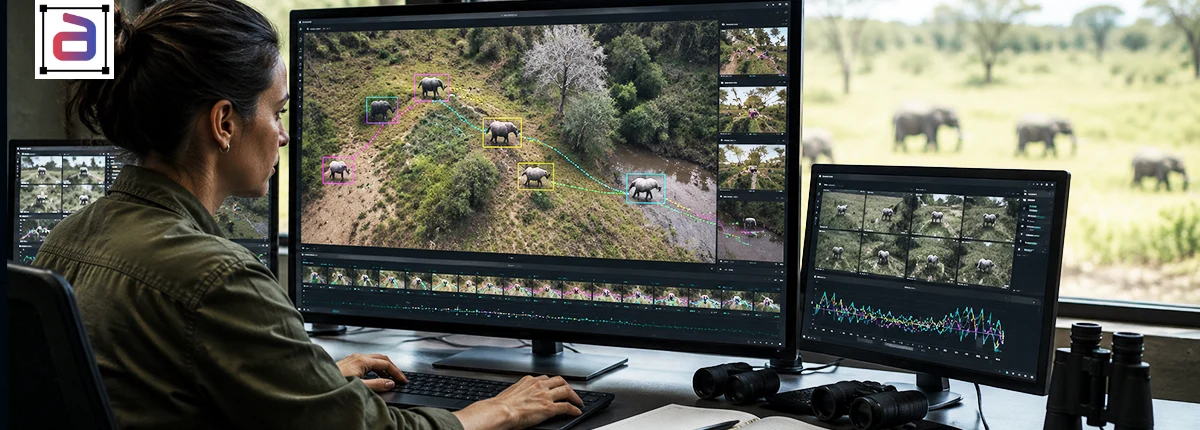
is Wildlife conservation is undergoing a technological transformation. As researchers, environmental organizations, and government agencies seek better ways to monitor biodiversity and protect endangered species, artificial intelligence (AI) has emerged as a powerful ally. From tracking elephant migrations across Africa to monitoring marine life in vast ocean ecosystems, AI-powered wildlife monitoring systems are helping conservationists collect insights at unprecedented scale. Video annotation for wildlife monitoring enables AI systems to accurately identify, track, and analyze animal movement across natural habitats using footage from camera traps, drones, and remote surveillance systems. Learn more about annotation for marine and aquatic environments. Learn more about aerial drone footage annotation for environmental AI.
By labeling species, behaviors, migration patterns, and environmental interactions frame by frame, annotated video data becomes the foundation for intelligent conservation solutions. As wildlife researchers increasingly adopt computer vision to monitor biodiversity and protect endangered species, high-quality video annotation plays a critical role in transforming raw footage into actionable ecological insights. However, AI is only as intelligent as the data used to train it. Behind every successful wildlife monitoring model lies a foundation of accurately labeled video data. This is where video annotation plays a critical role. At Annotera, we help organizations convert massive volumes of wildlife footage into high-quality training datasets that enable AI systems to detect, track, and analyze animal behavior in real-world environments. As a trusted video annotation company, we understand the unique challenges involved in building datasets for ecological and conservation applications.
Key Points
- Wildlife monitoring AI requires annotation of species identity, individual behavior, movement trajectory, and interaction across long video sequences.
- Camouflage, variable lighting, and partial occlusion in natural habitats make wildlife annotation significantly harder than structured indoor environments.
- Conservation organizations use annotated video datasets to track endangered species, detect poaching activity, and study migration at scale.
- Domain expertise in ecology or zoology measurably improves annotation accuracy when identifying species and behaviors in natural footage.
Table of Contents
Why Wildlife Monitoring Needs AI More Than Ever
According to the World Wildlife Fund’s Living Planet Report, monitored wildlife populations have experienced an average decline of nearly 69% since 1970. At the same time, climate change, habitat loss, poaching, and human encroachment continue to threaten ecosystems worldwide. Wildlife populations face increasing threats from habitat loss, climate change, and poaching. Consequently, traditional monitoring methods often fall short. AI-powered systems, however, enable faster data analysis, real-time tracking, and more accurate conservation decisions across vast and remote ecosystems. Traditional wildlife monitoring methods often rely on field surveys, manual observation, and physical tracking devices. While valuable, these approaches are time-intensive, expensive, and difficult to scale. Today’s conservation efforts increasingly utilize:
- Camera trap networks
- Drone surveillance
- Satellite imagery
- Autonomous monitoring stations
- Remote environmental sensors
These technologies generate enormous volumes of video data every day. Manually reviewing thousands of hours of footage is neither practical nor efficient.
“Only if we understand, can we care. Only if we care, will we help.”— Jane Goodall
AI-powered wildlife monitoring enables researchers to gain that understanding faster and more accurately than ever before. As wildlife populations face increasing environmental pressures, AI-powered monitoring has become essential for conservation efforts. Multi-object tracking annotation enables AI models to accurately track multiple animals across video sequences, helping researchers monitor behavior, migration patterns, and population dynamics more efficiently.
The Critical Role of Video Annotation in Wildlife Monitoring
Video annotation is the process of labeling objects, behaviors, and events within video footage to create training datasets for machine learning models. Video annotation serves as the foundation of wildlife AI models by converting raw footage into structured training data. As a result, systems can accurately identify species, track movements, and analyze behaviors, thereby improving monitoring efficiency and conservation outcomes. In wildlife monitoring applications, annotated videos teach AI systems how to:
- Identify species
- Track individual animals
- Detect movement patterns
- Recognize behavioral activities
- Analyze migration routes
- Monitor population density
- Detect environmental threats
Without properly annotated datasets, even the most advanced AI models struggle to perform accurately in dynamic natural environments. This is why organizations increasingly partner with an experienced video annotation company to ensure the quality and consistency of their training data.
Key Video Annotation Techniques Used in Wildlife Tracking
Several annotation techniques contribute to effective wildlife tracking. For instance, bounding boxes, polygon annotation, object tracking, and behavior labeling help AI models understand animal movements. Consequently, researchers can generate more accurate insights from complex wildlife footage.
Object Detection and Bounding Box Annotation
Bounding boxes remain one of the most widely used annotation methods for wildlife AI systems. Object detection and bounding box annotation enable AI models to identify and locate animals within video frames. Moreover, by tracking animals across sequences, these annotations improve detection accuracy and support reliable wildlife monitoring in diverse natural environments. Annotators draw boxes around animals frame-by-frame, enabling models to learn how to identify and track species across different environments. Common use cases include:
- Monitoring elephant herds
- Tracking migratory birds
- Observing deer populations
- Detecting marine mammals
These datasets allow AI systems to automatically detect animals in future video streams with remarkable accuracy.
Polygon Annotation for Complex Natural Environments
Wildlife footage rarely occurs in controlled conditions. Animals often move through dense vegetation, rocky terrain, water bodies, or crowded habitats where precise outlines are essential. Polygon annotation provides precise object outlines, making it ideal for wildlife footage captured in dense forests, grasslands, or rugged terrains. Consequently, AI models can better distinguish animals from complex backgrounds, thereby improving segmentation and tracking accuracy. Polygon annotation enables annotators to trace the exact contours of animals, creating highly accurate training datasets. This technique is particularly valuable for:
- Forest wildlife monitoring
- Aerial drone imagery
- Marine ecosystem analysis
- Endangered species tracking
As a specialized data annotation company, Annotera frequently deploys polygon annotation workflows for projects requiring pixel-level precision.
Multi-Object Tracking
Understanding wildlife behavior requires more than identifying animals in isolated frames. Multi-object tracking enables AI systems to follow multiple animals simultaneously across video frames. As a result, researchers can analyze movement patterns, social interactions, and migration behaviors more effectively, thereby gaining deeper insights into wildlife ecosystems. Object tracking annotations follow animals continuously throughout video sequences, helping AI systems analyze:
- Migration routes
- Territorial behavior
- Predator-prey interactions
- Social group dynamics
The resulting insights are invaluable for ecological research and conservation planning.
Behavioral Annotation
Behavioral analysis has become one of the fastest-growing applications of wildlife AI. Thlabels specific animal activities such as feeding, hunting, nesting, or migration. Consequently, AI models can recognize behavioral patterns more accurately, thereby helping researchers better understand species interactions, habitat usage, and ecosystem dynamics. Annotators label activities such as:
- Feeding
- Nesting
- Hunting
- Resting
- Mating
- Movement patterns
These annotations help researchers gain deeper understanding of species behavior and ecosystem health.
How AI-Powered Wildlife Monitoring Creates Real-World Impact
AI-powered wildlife monitoring transforms raw environmental data into actionable insights. As a result, conservation teams can track species, detect threats, and monitor ecosystems more efficiently, thereby improving decision-making and supporting long-term biodiversity preservation efforts. AI-powered wildlife monitoring in underwater environments enables researchers to track marine species, assess ecosystem health, and detect environmental changes more efficiently. Consequently, accurately annotated video data supports conservation efforts, sustainable resource management, and informed decision-making across marine ecosystems.
Protecting Endangered Species
AI systems trained with high-quality annotations can automatically detect endangered species from camera traps and drone footage. AI-powered monitoring helps identify and track endangered species with greater accuracy and minimal human disturbance. Consequently, conservationists can respond more quickly to population changes, thereby improving protection strategies and supporting long-term species survival efforts. Researchers can monitor vulnerable populations without disturbing natural habitats, improving conservation outcomes while reducing operational costs.
Combating Poaching and Illegal Activities
Many conservation organizations now deploy intelligent surveillance systems capable of identifying suspicious activities in protected areas. AI-enabled surveillance systems can detect suspicious activities in protected habitats more efficiently. As a result, conservation teams receive timely alerts about poaching, illegal hunting, or habitat intrusion, thereby enabling faster intervention and stronger wildlife protection measures. Annotated video datasets help AI models detect:
- Human intrusion
- Unauthorized vehicles
- Illegal hunting activity
- Habitat destruction
Early detection enables faster intervention and stronger protection efforts.
Understanding Climate Change Effects
Climate change continues to alter migration routes, breeding patterns, and habitat distribution worldwide. Climate change continues to influence animal migration, breeding patterns, and habitat availability. Therefore, AI-powered wildlife monitoring helps researchers identify these changes early, thereby enabling more informed conservation strategies and long-term ecosystem management decisions. Video analytics powered by accurately annotated datasets allow researchers to identify these shifts and respond proactively.
“With every drop of water you drink, every breath you take, you’re connected to the sea.”— Dr. Sylvia Earle
The same interconnection applies across all ecosystems, making accurate wildlife monitoring increasingly essential.
Why Organizations Choose Video Annotation Outsourcing
Wildlife monitoring projects often involve millions of frames collected from multiple locations and devices. Managing annotation internally can quickly become overwhelming. This is why many organizations adopt video annotation outsourcing strategies. Wildlife monitoring projects generate vast amounts of video data that require precise labeling. Therefore, organizations increasingly choose video annotation outsourcing to access skilled experts, accelerate dataset creation, reduce costs, and maintain consistent annotation quality at scale. Benefits include:
- Faster project execution
- Access to trained annotation specialists
- Scalable workforce capacity
- Consistent quality control
- Reduced operational costs
Similarly, data annotation outsourcing allows conservation organizations and AI developers to focus on research and model development while annotation experts handle dataset creation.
Why Annotera Is the Preferred Partner for Wildlife Annotation Projects
At Annotera, we combine domain expertise, rigorous quality assurance, and scalable annotation operations to support AI initiatives across environmental and conservation sectors. Annotera combines domain expertise, scalable annotation workflows, and rigorous quality assurance to support wildlife AI initiatives. Moreover, our experienced teams deliver accurate, high-quality datasets, thereby helping organizations accelerate conservation-focused model development with confidence. Our wildlife annotation capabilities include:
- Bounding box annotation
- Polygon annotation
- Multi-object tracking
- Behavioral labeling
- Species identification
- Drone video annotation
- Large-scale dataset management
As a leading video annotation company, we understand that conservation projects require more than just labels—they require accuracy, consistency, and contextual understanding. Whether you’re developing wildlife detection models, biodiversity monitoring platforms, or intelligent conservation systems, Annotera delivers the human-in-the-loop expertise needed to build reliable AI.
The Future of Wildlife Conservation Depends on Better Data
The future of conservation will increasingly rely on AI-powered insights. From protecting endangered species and preventing poaching to understanding ecosystem changes, intelligent monitoring systems are becoming indispensable tools for researchers worldwide. As conservation challenges continue to grow, high-quality data becomes increasingly important. Therefore, accurately annotated wildlife footage helps power more reliable AI models, thereby enabling smarter decisions, stronger conservation strategies, and better protection of global biodiversity. Yet the success of these systems begins with one critical element: high-quality annotated data. Organizations that invest in accurate video annotation today will be better positioned to develop reliable wildlife AI solutions tomorrow.
Partner with Annotera for Wildlife Video Annotation Excellence
A similar monitoring model powers our wildfire detection partner’s operations — see the case study.
Looking to build high-performance AI models for wildlife monitoring, biodiversity analysis, or environmental conservation? Whether you’re building wildlife detection, tracking, or conservation AI solutions, Annotera delivers precise and scalable annotation services. Moreover, our expert teams ensure high-quality datasets, thereby helping organizations accelerate development and achieve reliable AI outcomes. Annotera provides scalable, precision-driven annotation services tailored for complex ecological datasets. Our expert teams help organizations accelerate AI development with high-quality annotations delivered at enterprise scale. Ready to transform wildlife footage into actionable AI intelligence? Contact Annotera today and discover how our data annotation outsourcing and video annotation outsourcing solutions can power your next conservation initiative.