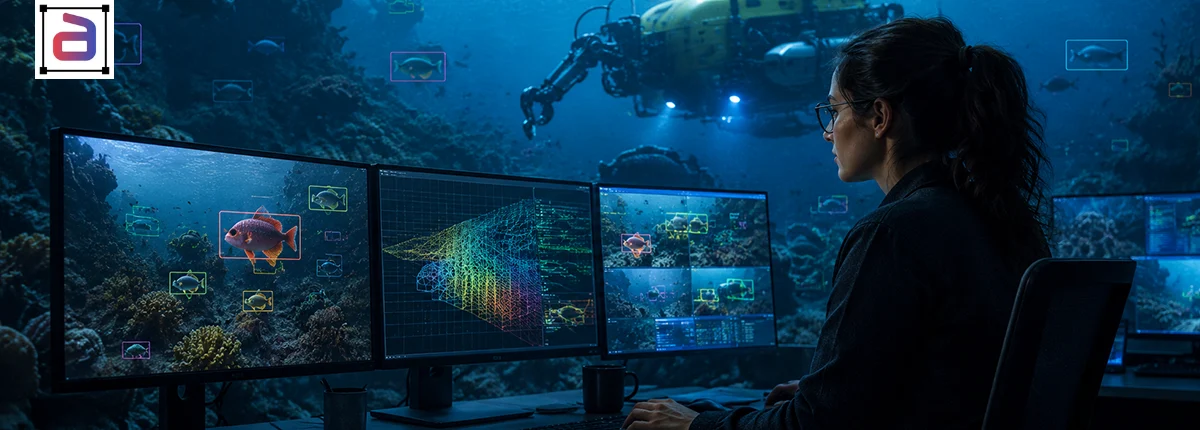
The ocean remains one of the least explored frontiers on Earth, yet it is rapidly becoming one of the most data-rich environments for artificial intelligence. From autonomous underwater vehicles (AUVs) and marine conservation programs to offshore energy inspections and fisheries management, organizations are deploying AI-powered systems to understand and navigate underwater ecosystems with unprecedented precision. Video annotation for underwater environments enables marine AI systems to accurately identify, track, and analyze objects beneath the surface. Learn more about tracking animal behavior in natural habitats.
From marine life monitoring to autonomous underwater navigation, high-quality annotation helps overcome visibility, motion, and environmental challenges that are unique to underwater video data. However, building effective marine AI models requires more than advanced algorithms. Success depends on high-quality training data—and that begins with accurate video annotation. Underwater video presents a unique set of challenges that traditional computer vision datasets rarely encounter. Variable visibility, color distortion, biological diversity, and complex environmental conditions make annotation significantly more demanding than labeling footage captured on land. At Annotera, we help organizations overcome these challenges through specialized video annotation services that transform complex underwater footage into reliable AI training data.
Key Points
- Underwater video annotation faces challenges absent from surface imagery: color distortion, low visibility, motion blur, and unfamiliar species.
- Marine AI applications require domain-expert annotators with biology knowledge — general-purpose annotation teams produce systematic misidentification errors.
- Optical distortion and light attenuation in underwater footage require adjusted bounding box and segmentation standards.
- Annotated marine datasets are a bottleneck for ocean conservation AI, autonomous underwater vehicle navigation, and fishery management systems.
Table of Contents
Why Underwater Video Annotation Matters
As marine industries increasingly adopt AI-driven technologies, accurate underwater video annotation becomes essential. Moreover, it enables reliable object detection, species tracking, and environmental analysis, ensuring that marine AI systems can effectively operate in complex and constantly changing underwater environments.
Marine AI systems rely heavily on video data captured by:
- Autonomous underwater vehicles (AUVs)
- Remotely operated vehicles (ROVs)
- Underwater drones
- Fixed marine monitoring stations
- Research vessels
- Offshore inspection systems
These systems are used for applications such as:
- Marine biodiversity monitoring
- Fish population analysis
- Coral reef assessment
- Seafloor mapping
- Offshore infrastructure inspection
- Environmental impact studies
- Autonomous underwater navigation
According to the National Oceanic and Atmospheric Administration (NOAA), more than 80% of the world’s oceans remain unmapped, unobserved, and unexplored. As governments, research institutions, and private organizations invest heavily in ocean intelligence, AI-driven analysis is becoming a critical tool for accelerating discovery and operational efficiency. Yet even the most advanced AI model can only perform as well as the data it learns from.
“The strength of AI is not in the algorithm alone, but in the quality of the data used to train it.”— Fei-Fei Li, AI Researcher
For marine AI systems, that quality depends on precise and consistent video annotation.
The Underwater Annotation Challenge
Unlike terrestrial footage, underwater video presents unique obstacles such as poor visibility, color distortion, and constant motion. Consequently, annotating marine datasets requires specialized expertise and robust quality controls to ensure accurate, consistent training data for AI systems.
1. Visibility Changes from One Frame to the Next
Unlike controlled terrestrial environments, underwater conditions can change dramatically within seconds. Sediment movement, plankton concentration, water turbidity, and changing depths often reduce image clarity. Objects may appear sharp in one frame and nearly invisible in the next. For annotation teams, this means accurately identifying and tracking marine species and underwater assets despite inconsistent visual quality. At Annotera, our annotation workflows are designed to maintain labeling consistency even when visibility fluctuates across long video sequences. Underwater visibility can fluctuate rapidly due to sediment, currents, and lighting conditions. As a result, objects may appear clear in one frame yet obscured in the next, making consistent annotation and accurate object tracking significantly more challenging.
2. Color Distortion Creates Identification Challenges
Water absorbs light differently than air. As depth increases, colors begin to disappear. Reds vanish first, followed by oranges and yellows, leaving underwater footage dominated by blue and green tones. As underwater depth increases, colors gradually fade and shift, making objects harder to distinguish. Consequently, annotators must rely on shape, texture, and contextual cues rather than color alone to ensure accurate identification and consistent labeling. This creates significant challenges for AI training datasets because:
- Species may appear different at varying depths
- Infrastructure components lose visual distinction
- Object boundaries become difficult to identify
Annotation teams must be trained to recognize underwater objects beyond simple color cues, relying instead on shape, movement patterns, texture, and contextual indicators.
3. Marine Species Are Difficult to Differentiate
Marine ecosystems contain thousands of species that often look remarkably similar. Certain fish species differ only by subtle markings, fin structures, or body proportions. Juvenile specimens may look entirely different from adults. Seasonal changes and adaptive camouflage add another layer of complexity. Many marine species share similar physical characteristics, while factors such as camouflage, growth stages, and environmental conditions further complicate identification. Therefore, accurate annotation often requires specialized expertise to distinguish species and maintain dataset reliability.
“Knowing is the key to caring, and understanding is the key to preservation.” — Sylvia Earle, Oceanographer
For marine AI systems, understanding begins with accurately identifying what is present in underwater footage. This is why many marine AI projects require annotation specialists working alongside subject-matter experts to ensure classification accuracy.
4. Continuous Motion Complicates Object Tracking
Underwater environments are constantly moving. Fish schools change direction abruptly. Ocean currents shift vegetation. Floating particles create visual noise. Marine mammals move rapidly through large areas of the frame. Training effective AI models requires temporal consistency across hundreds or thousands of frames. Underwater environments are constantly in motion due to currents, marine life, and drifting particles. As a result, tracking objects across video frames becomes more complex, requiring precise annotations to maintain consistency and improve AI model accuracy. Object tracking annotation becomes particularly important for:
- Migration studies
- Behavioral analysis
- Population monitoring
- Autonomous navigation systems
As a trusted video annotation company, Annotera implements multi-stage quality assurance processes that preserve object identity throughout long video sequences.
5. Habitat Complexity Increases Annotation Difficulty
Coral reefs, kelp forests, rocky seabeds, and underwater structures create highly cluttered visual environments. Coral reefs, kelp forests, and rocky seabeds create visually dense underwater scenes. Consequently, objects are often partially hidden or overlapping, requiring more detailed annotation techniques to accurately capture boundaries and improve AI model performance. Objects are frequently:
- Partially hidden
- Temporarily occluded
- Overlapping with other species
- Blending into their surroundings
Simple bounding boxes are often insufficient. Marine AI applications increasingly require advanced annotation techniques such as:
- Polygon annotation
- Semantic segmentation
- Instance segmentation
- Multi-object tracking
These methods provide the level of precision required for habitat mapping and environmental monitoring initiatives.
Why Human Expertise Remains Essential
While automated annotation tools continue to improve, underwater environments remain among the most challenging domains for computer vision. Although automation has advanced significantly, underwater environments still present challenges that AI alone cannot reliably interpret. Therefore, human expertise remains critical for validating annotations, resolving ambiguities, and ensuring the accuracy required for high-performing marine AI systems.
Automated systems often struggle with:
- Poor visibility
- Rare species
- Occluded objects
- Low-contrast footage
- Complex marine habitats
Human-in-the-loop annotation remains essential for validating and correcting machine-generated labels. This is where experienced data annotation outsourcing partners deliver significant value. At Annotera, we combine AI-assisted workflows with expert human review to achieve both scalability and accuracy—helping clients accelerate dataset production without compromising quality.
The Growing Demand for Marine AI Data
The global blue economy is expected to exceed $3 trillion by 2030, according to the Organisation for Economic Co-operation and Development (OECD). As investment in marine technology accelerates, demand for high-quality annotated underwater datasets will continue to rise. Organizations developing marine AI systems require annotation partners capable of handling:
- Large-scale video datasets
- Complex marine environments
- Specialized taxonomy requirements
- Long-duration tracking projects
- Enterprise-grade quality standards
Choosing the right video annotation outsourcing provider can significantly influence model performance, deployment timelines, and long-term AI success.
How Annotera Supports Marine AI Innovation
At Annotera, we understand that underwater annotation projects require more than generic labeling capabilities. Our specialized annotation teams support:
- Marine life detection and tracking
- Coral reef monitoring
- Fisheries analytics
- Environmental conservation initiatives
- Offshore asset inspection
- Autonomous underwater vehicle training datasets
- Seafloor mapping projects
Through scalable delivery models, rigorous QA frameworks, and domain-focused annotation expertise, we help organizations build marine AI systems that perform reliably in some of the world’s most challenging environments.
Transform Complex Underwater Footage into Reliable AI Training Data
The future of marine AI depends on accurate, high-quality data. Whether you’re developing autonomous underwater vehicles, monitoring marine ecosystems, or building next-generation ocean intelligence platforms, your models need annotation workflows designed specifically for underwater environments.