High-quality AI starts with high-quality data. Whether you’re building autonomous vehicles, intelligent surveillance systems, robotics, or sports analytics platforms, the success of your computer vision model depends on one critical factor: the accuracy and consistency of your annotated video data. However, as annotation projects scale from thousands of clips to millions of frames, maintaining consistent quality becomes increasingly challenging. A single inconsistency in object tracking or class labeling can propagate across thousands of frames, reducing model accuracy, increasing retraining costs, and delaying AI deployment. This is why leading AI companies don’t simply invest in annotation—they invest in quality assurance (QA) frameworks that ensure every labeled frame meets rigorous quality standards.
At Annotera, we believe quality isn’t a final checkpoint—it’s an integral part of every annotation workflow. As a trusted data annotation company, we combine expert reviewers, AI-assisted validation, and enterprise-grade quality processes to deliver scalable video annotation services that help organizations build reliable AI systems faster.
Key Points
- Quality assurance is essential for enterprise AI success. Large-scale video annotation projects require structured QA frameworks to ensure annotation accuracy, temporal consistency, and reliable AI model performance.
- A multi-layered QA process improves dataset quality. Combining detailed annotation guidelines, multi-level human reviews, AI-assisted validation, and continuous quality monitoring significantly reduces labeling errors and rework.
- Human expertise remains critical alongside automation. Human-in-the-Loop (HITL) workflows help validate complex scenarios that AI cannot consistently interpret, resulting in more accurate and production-ready training datasets.
- Annotera delivers scalable, enterprise-grade video annotation services. Through robust quality assurance frameworks and expert data annotation outsourcing, Annotera enables businesses to build trustworthy computer vision models with confidence.
Why Quality Assurance Is the Backbone of Video Annotation
Unlike image annotation, video annotation introduces an additional layer of complexity—time. Objects continuously move, disappear behind obstacles, change orientation, and reappear. Every annotation must remain accurate and consistent across hundreds or even thousands of consecutive frames. Without a structured QA framework, annotation teams often encounter:
- Object tracking inconsistencies
- Bounding box drift
- Missed objects during occlusion
- Incorrect object identities
- Frame-to-frame labeling errors
- Annotation fatigue
- Reduced dataset reliability
As IBM aptly states:
“AI systems are only as good as the data used to train them.”
For enterprise AI, this statement couldn’t be more accurate. Even the most advanced machine learning algorithms cannot compensate for poor-quality training data. For teams running large object-detection pipelines, that discipline starts with rigorous quality-control practices for large-scale bounding box projects.
The Business Cost of Poor Annotation Quality
Annotation errors don’t just affect model performance—they directly impact business outcomes. According to Gartner, organizations lose an average of $12.9 million every year due to poor data quality. While this figure spans enterprise data broadly, AI training datasets are no exception. Inaccurate annotations lead to costly model retraining, delayed product launches, increased operational risks, and reduced customer trust. Similarly, McKinsey & Company notes:
“Organizations that combine advanced AI with strong human oversight are significantly more likely to realize measurable business value from AI.”
This reinforces a critical reality: automation alone isn’t enough. Human expertise remains essential for ensuring annotation accuracy at scale.
Why Large-Scale Video Annotation Projects Demand Structured QA
As projects grow, quality risks multiply. A dataset containing one million video frames may involve dozens—or even hundreds—of annotators working simultaneously. Without standardized quality controls, annotation consistency naturally begins to drift. Data annotation quality metrics provide measurable standards for evaluating labeling accuracy, consistency, completeness, and agreement. In large-scale video projects, these metrics help identify annotation errors, monitor quality trends, strengthen QA workflows, and ensure reliable datasets for machine learning models. Common challenges include:
Annotation Drift
Different annotators interpret labeling guidelines differently over time.
Temporal Inconsistency
Objects “jump” between frames because bounding boxes are not consistently tracked.
Identity Switching
During multi-object tracking, object IDs accidentally change across frames.
Class Confusion
Visually similar objects—such as forklifts and pallet carts or bicycles and motorcycles—are inconsistently labeled.
Annotator Fatigue
Repetitive labeling tasks increase human error rates over long production cycles. These challenges highlight why quality assurance must be embedded into every stage of the annotation lifecycle—not simply performed before dataset delivery.
The Five Pillars of an Enterprise QA Framework
At Annotera, our quality assurance methodology is built around five interconnected pillars that ensure scalable accuracy across complex video datasets.
1. Clear Annotation Guidelines
Quality begins with clarity. Every project starts with detailed annotation documentation covering:
- Object definitions
- Class hierarchies
- Occlusion handling
- Truncation rules
- Tracking protocols
- Edge-case examples
- Keyframe policies
- Escalation procedures
Well-defined guidelines eliminate ambiguity and ensure every annotator works from the same standard.
2. Multi-Level Human Review
Enterprise datasets should never rely on a single review pass. A mature QA workflow typically includes:
- Level 1: Initial annotation
- Level 2: Peer review
- Level 3: Senior QA validation
- Level 4: Random quality audits
This layered review process dramatically reduces annotation errors before final delivery.
3. AI-Assisted Validation
Automation accelerates quality—but doesn’t replace human expertise. Modern QA systems automatically detect:
- Missing annotations
- Empty labels
- Broken object tracks
- Invalid coordinates
- Duplicate objects
- Overlapping bounding boxes
- Frame gaps
Automated validation allows reviewers to focus on complex edge cases rather than routine quality checks.
4. Consensus-Based Annotation
For safety-critical applications such as autonomous driving and healthcare AI, multiple annotators independently label the same samples. Any disagreements are escalated to senior specialists who establish the correct annotation through consensus. This approach significantly improves dataset reliability while reducing subjective bias.
5. Continuous Quality Monitoring
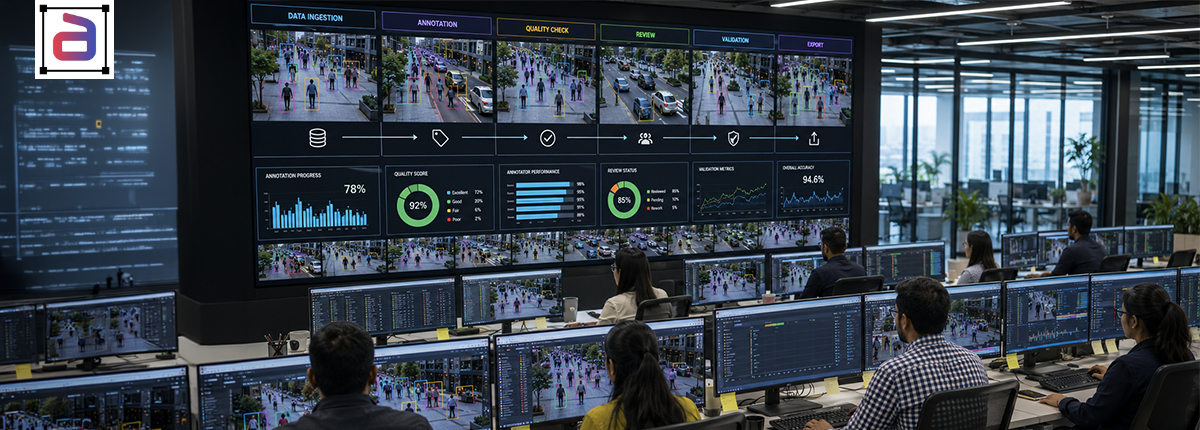
Quality should be measured continuously—not only at project completion. Key performance indicators include:
| Quality Metric | Why It Matters |
|---|---|
| Annotation Accuracy | Measures labeling correctness |
| Inter-Annotator Agreement (IAA) | Ensures consistency across teams |
| Tracking Accuracy | Maintains object identity over time |
| Precision & Recall | Evaluates false positives and missed objects |
| QA Pass Rate | Tracks accepted annotations |
| Rework Percentage | Identifies recurring quality issues |
| Frame Consistency Score | Measures temporal stability |
These metrics provide actionable insights that enable continuous process improvement throughout production.
Human-in-the-Loop: The Competitive Advantage
While AI-assisted annotation tools continue to evolve, they still struggle with complex real-world scenarios, including:
- Dense traffic environments
- Motion blur
- Heavy rain and fog
- Crowded public spaces
- Low-light conditions
- Partial object visibility
This is where Human-in-the-Loop (HITL) quality assurance becomes indispensable. AI generates preliminary annotations, while experienced reviewers validate, refine, and correct them—combining automation with expert judgment. This hybrid approach delivers faster turnaround times without compromising annotation quality.
Why Enterprises Choose Data Annotation Outsourcing
Scaling an in-house annotation team for millions of video frames can be expensive and resource-intensive. Strategic data annotation outsourcing enables organizations to access experienced annotators, specialized QA teams, and scalable infrastructure without building internal operations from scratch. However, not every outsourcing partner delivers the same level of quality. When selecting a data annotation company, enterprises should evaluate:
- Dedicated QA specialists
- Standardized review workflows
- Domain-specific annotation expertise
- ISO-aligned quality processes
- Secure data handling
- Performance reporting dashboards
- Flexible production scalability
- Service-level quality commitments
The right partner becomes an extension of your AI team—not merely a labeling vendor.
Why Annotera Is the Trusted Partner for Enterprise AI
At Annotera, quality is embedded into every stage of the annotation lifecycle. Our experienced annotation specialists, senior QA reviewers, and AI-assisted validation workflows work together to ensure every dataset meets the highest standards of accuracy, consistency, and scalability. Our comprehensive video annotation services support industries including autonomous vehicles, robotics, healthcare, manufacturing, retail, logistics, agriculture, smart cities, and intelligent surveillance. Whether you’re annotating thousands of clips or millions of frames, our scalable workflows are designed to accelerate AI development while maintaining exceptional data quality. As a leading data annotation company, Annotera understands that successful AI models are built on trusted data—not just labeled data. Through flexible data annotation outsourcing, we help enterprises reduce operational overhead, shorten development cycles, and deploy production-ready AI with confidence.
Conclusion
The future of enterprise AI depends on more than powerful algorithms—it depends on trustworthy training data. As video datasets continue to grow in size and complexity, organizations need robust quality assurance frameworks that combine standardized processes, human expertise, and intelligent automation. A well-designed QA framework minimizes annotation errors, improves model performance, reduces costly rework, and accelerates time-to-market. More importantly, it creates the foundation for AI systems that perform reliably in real-world environments. With Annotera as your annotation partner, you gain more than accurate labels—you gain a dedicated team committed to delivering enterprise-grade quality at scale.
Ready to Build AI on Data You Can Trust? Whether you’re developing autonomous driving systems, robotics platforms, intelligent surveillance solutions, or next-generation computer vision models, Annotera delivers the precision, scalability, and quality your AI deserves. Partner with Annotera’s expert video annotation team today to access industry-leading video annotation services, scalable data annotation outsourcing, and a quality assurance framework designed for enterprise success. Contact Annotera today to discuss your next AI data annotation project and discover how high-quality video annotation can accelerate your journey from prototype to production.
A closely related read: The Role of High-Quality Data Annotation in Autonomous Driving Systems.