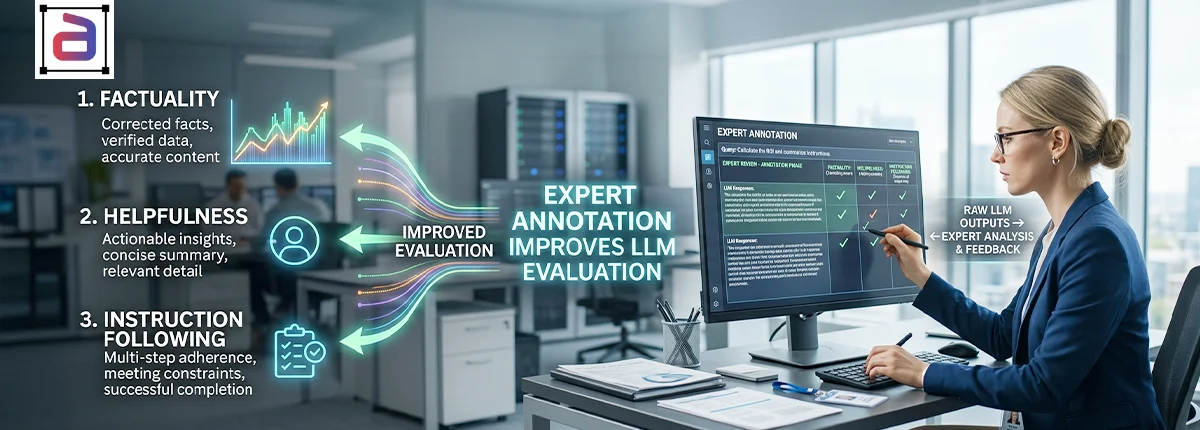

Annotation quality directly predicts model performance. Teams that measure the right metrics during annotation catch data issues before they become model failures. This post covers the metrics that matter most and how to implement them in production annotation workflows.
This blog explores the data annotation quality metrics that directly predict model performance—and how organizations can operationalize them through the right data annotation company and data annotation outsourcing strategy. At scale, those metrics must be tracked batch by batch to catch quality degradation before it reaches the model — see the guide to how to scale image annotation without sacrificing quality. The QA frameworks that put those metrics into operational practice are the focus of annotation quality assurance frameworks for enterprise AI. Metrics alone are not enough — the audit process that surfaces problems before they compound is covered in auditing outsourced annotation work for enterprise AI. Outsourcing strategy.
Table of Contents
Key Points
- The most predictive annotation quality metric for model performance is per-class precision: errors on rare but safety-critical object classes have disproportionate impact on production failure rates relative to their contribution to aggregate accuracy.
- Inter-annotator agreement measures consistency, not correctness: high IAA on a task with poorly defined guidelines produces consistently wrong labels, not reliably correct ones.
- Annotation quality audits must be tied to model evaluation cycles: quality metrics collected only during annotation tell you about the annotation program; quality metrics collected at model evaluation tell you about how annotation quality affected model behaviour.
- Tracking annotation quality metrics over time reveals systematic drift that single-batch audits miss: annotator interpretation shifts gradually in ways that produce labels that are internally consistent but inconsistent with earlier batches.
Why Annotation Quality Is a Leading Indicator of Model Success
Industry research continues to highlight a critical reality: label errors are far more common than most teams expect. Large-scale audits of widely used machine learning benchmarks have revealed label error rates ranging from 3% to over 6%, even in datasets considered “gold standard.” In enterprise environments—where data is more complex and contextual—those figures are often higher.
The downstream impact is significant. Studies show that noisy or inconsistent labels can reduce model accuracy by up to 20%, distort confidence calibration, and introduce bias that persists across retraining cycles. Annotation quality does not merely influence models—it sets a ceiling on what models can achieve. As Amazon’s applied science team puts it, in supervised learning “the accuracy of [a] machine learning model directly depends on the annotation quality,” and label noise is a persistent reality across real-world datasets.
Core Quality Metrics
Data annotation quality metrics evaluate accuracy, consistency, and completeness of labeled data. Moreover, they include inter-annotator agreement, precision-recall scores, and error rates, ensuring reliable datasets for robust AI model performance.
- Inter-Annotator Agreement (IAA): IAA measures how consistently multiple annotators label the same data. High agreement indicates clear guidelines and well-calibrated teams. Low agreement signals ambiguous instructions or insufficient training. Common measures include Cohen’s Kappa for classification tasks and IoU (Intersection over Union) for spatial annotation.
- Label Accuracy Against Gold Standards: Gold-standard datasets provide an objective benchmark. Comparing annotator output against expert-validated gold labels reveals systematic errors, individual annotator weaknesses, and guideline gaps.
- Error Rate and Error Type Distribution: Tracking not just how many errors occur but what types — missed labels, wrong classes, imprecise boundaries — helps teams prioritize fixes. A high rate of boundary errors points to different interventions than a high rate of classification errors.
Predictive Metrics: Linking Annotation to Model Outcomes
- Label Noise and Model Degradation: Research shows that even small increases in label noise produce outsized drops in model accuracy. Tracking annotation noise rates during production — not just after delivery — enables early intervention before contaminated data reaches training pipelines.
- Class Balance and Coverage: Imbalanced annotation across classes causes models to underperform on minority categories. Monitoring class distribution during annotation — not just after — prevents costly rebalancing and re-annotation later.
Implementing Metrics in Practice
Effective annotation programs embed quality metrics into daily workflows, not quarterly audits. This means automated dashboards tracking IAA, error rates, and throughput in real time. Annotera provides full KPI visibility to clients, enabling data-driven decisions about annotator calibration, guideline updates, and batch acceptance.
Conclusion
Annotation quality metrics are not just operational hygiene — they are leading indicators of model performance. Teams that track IAA, gold-standard accuracy, and error distributions build better models, faster.
Need annotation with built-in quality metrics and reporting? Contact Annotera to get started.
Want annotation with built-in quality metrics? Annotera delivers IAA tracking, error categorisation, and per-label confidence scores on all projects. Explore annotation services or request a free pilot.
Quality Metrics That Predict Downstream Model Performance
The most operationally useful annotation quality metrics are those with demonstrated correlation to downstream model performance, not those that are simply easy to calculate. Inter-annotator agreement (IAA) measured by Cohen’s Kappa or Krippendorff’s Alpha is the most widely used metric, but it measures annotator consistency rather than annotator correctness — a team that consistently makes the same wrong decision will show high IAA. Gold-standard accuracy, measured by embedding verified correct examples in the annotation queue and scoring annotators against them, is a stronger predictor of model quality because it measures correctness against ground truth. Annotera uses both IAA and gold-standard accuracy in every annotation program, with gold-standard samples making up 3–5% of each batch.
Annotation Metrics by Task Type
Different annotation task types require different metrics. For bounding box tasks, the primary metric is Intersection over Union (IoU): the ratio of the area of overlap between annotated and ground-truth boxes to their combined area. An IoU of 0.7 is a common minimum threshold; 0.85+ is required for safety-critical applications. For segmentation tasks, mean IoU (mIoU) averaged across all classes is the standard metric, with boundary pixel accuracy tracked separately since boundary errors are the most common failure mode. For classification tasks, per-class accuracy and confusion matrices matter more than overall accuracy, since class imbalance can make overall accuracy misleading — a model that is 95% accurate but wrong on the rare class your application cares about is not a good model.
Building a Quality Feedback Loop
Annotation quality metrics are most valuable when they are fed back into the annotation program in real time rather than reported at delivery. Annotera’s quality dashboard tracks per-annotator IoU scores, gold-standard accuracy, and IAA by day and by task type, enabling quality managers to identify individual annotators or annotation categories where accuracy is degrading before the degradation compounds across the batch. Annotators flagged by the quality system are retrained on the affected task type using calibration exercises drawn from verified examples, and their output is reviewed at higher sampling rates until accuracy recovers.
This connects closely with connecting annotation quality to model outcomes.
A closely related read: How Data Annotation Outsourcing Improves AI Accuracy and Time-to-Market.
Also read : Quality Assurance Frameworks for Large-Scale Video Annotation Projects