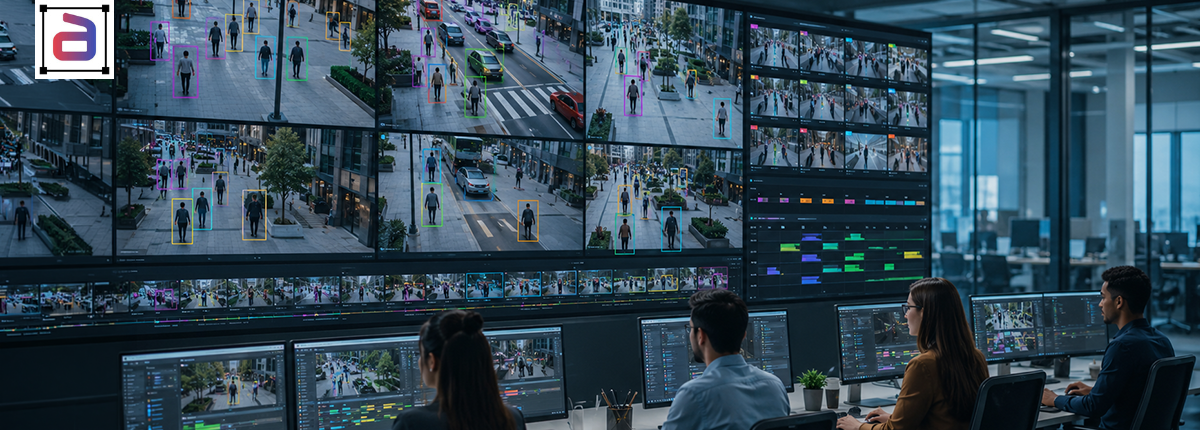
Every day, enterprises generate terabytes of video from autonomous vehicles, manufacturing lines, retail stores, smart cities, hospitals, warehouses, and surveillance networks. This wealth of visual data promises powerful AI applications—but only if machines can understand what they’re seeing. Annotating long-form video involves labeling objects, actions, and events consistently across extended video sequences. It enables AI models to understand temporal relationships, improve tracking accuracy, and make reliable decisions in enterprise applications such as surveillance, autonomous driving, manufacturing, and healthcare. Raw video alone holds little value. Without accurate annotations, AI models struggle to recognize objects consistently, understand events over time, or make reliable decisions in real-world environments. This is especially true for long-form video datasets, where a single recording may span hours and contain thousands of interactions, changing environments, and evolving scenarios.
For enterprises investing millions into AI initiatives, that statement has never been more relevant. At Annotera, we help organizations unlock the full potential of long-duration video through enterprise-grade video annotation services that prioritize precision, scalability, and temporal consistency.
Key Points
- The hidden crisis of poor annotation quality is its invisibility: annotation errors produce confident, wrong model outputs that appear correct until the model encounters the real-world scenarios that expose the gap between what it learned and what is true.
- Combining AI-assisted annotation with human-in-the-loop quality assurance significantly improves annotation accuracy, reduces errors, and creates enterprise-ready training datasets.
- Strategic workflows such as keyframe annotation, object tracking, and scalable quality control help enterprises annotate massive video datasets efficiently while reducing costs and turnaround time.
- Partnering with an experienced data annotation company like Annotera enables organizations to leverage scalable video annotation services and data annotation outsourcing to accelerate AI development and improve model performance.
Why Long-Form Video Annotation Is an Enterprise Challenge
Unlike image annotation or short video clips, long-form videos require AI to understand continuous actions, object movements, and event sequences rather than isolated frames. Imagine annotating:
- Eight hours of warehouse operations
- Continuous traffic footage from smart intersections
- Manufacturing assembly lines running 24/7
- Hospital monitoring videos
- Retail customer journeys
- Multi-camera security surveillance
Every object must remain consistently labeled across thousands—or even millions—of frames while accounting for occlusions, lighting changes, camera motion, and complex interactions. The scale alone is staggering. According to IDC, the global datasphere is projected to reach 393 zettabytes by 2028, with video representing one of the fastest-growing data types generated by enterprises. Organizations are no longer struggling to collect data—they’re struggling to prepare it for AI.
As Andrew Ng, founder of DeepLearning.AI, famously stated:
“The quality of your data is often more important than the quantity.”
Why Annotation Quality Determines AI Success
Enterprise AI models learn patterns from labeled data. If annotations drift between frames, objects lose their identities, or events are inconsistently labeled, AI models inherit those errors. The result?
- Lower detection accuracy
- Poor object tracking
- Increased false positives
- Reduced model generalization
- Higher retraining costs
Research from Gartner consistently highlights that poor data quality remains one of the leading reasons AI initiatives fail to achieve expected business outcomes. High-quality annotation is therefore not an operational task—it’s a strategic investment.
The Biggest Challenges in Long-Form Video Annotation
1. Managing Massive Scale
One hour of video recorded at 30 frames per second contains over 108,000 frames. Now multiply that across thousands of videos from multiple cameras. Manual frame-by-frame labeling quickly becomes impractical without optimized workflows.
2. Maintaining Temporal Consistency
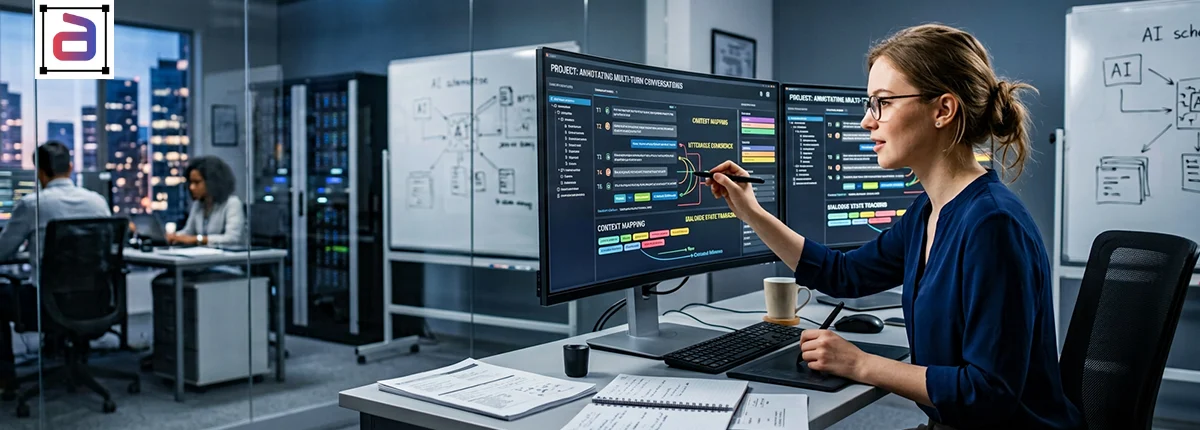
Objects don’t exist independently in each frame. People walk. Vehicles accelerate. Machines rotate. Workers interact with equipment. Annotations must follow every object naturally across time without sudden jumps, identity switches, or inconsistent labels. Temporal consistency is what separates production-grade datasets from average ones.
3. Capturing Complex Events
Modern AI increasingly focuses on understanding activities rather than objects. Examples include:
- Unauthorized facility access
- Worker safety violations
- Product picking behavior
- Equipment malfunction
- Lane-changing vehicles
- Patient movement analysis
These events often span several minutes and require precise temporal boundaries.
4. Multiple Object Tracking
Enterprise environments are dynamic. A warehouse may contain dozens of forklifts and workers. Traffic footage may include hundreds of moving vehicles. Retail stores monitor thousands of customer interactions daily. Each object requires persistent IDs throughout the video sequence to enable reliable tracking models.
Proven Strategies for Annotating Long-Form Video Datasets
Leverage AI-Assisted Keyframe Annotation
Rather than labeling every frame manually, experienced annotators identify strategic keyframes. Advanced interpolation algorithms automatically propagate annotations between those frames while human reviewers validate and refine the results. This hybrid workflow significantly reduces annotation time without compromising accuracy.
Combine Automation with Human Expertise
AI-assisted annotation tools have transformed enterprise workflows by accelerating repetitive tasks such as:
- Object tracking
- Bounding box propagation
- Semantic segmentation
- Instance tracking
- Frame interpolation
However, automation alone cannot resolve complex edge cases. As computer vision pioneer Fei-Fei Li observed:
“AI is everywhere. It’s not that big, scary thing in the future. AI is here with us.”
Making AI trustworthy requires human expertise to verify ambiguous scenes, crowded environments, severe occlusions, and unusual object behavior. At Annotera, our human-in-the-loop quality assurance ensures automation enhances productivity without sacrificing precision.
Establish Comprehensive Annotation Guidelines
Consistency begins long before annotation starts. Successful enterprise projects rely on standardized documentation covering:
- Object definitions
- Class hierarchy
- Occlusion handling
- Tracking policies
- Event definitions
- Edge-case resolution
- Review criteria
Well-defined guidelines reduce subjectivity and ensure uniform labeling across distributed annotation teams.
Prioritize Temporal Quality Assurance
Traditional image QA evaluates isolated annotations. Long-form video demands additional validation, including:
- Identity continuity
- Motion consistency
- Bounding box stability
- Timestamp accuracy
- Event completeness
- Missing-frame detection
This multi-stage review process dramatically improves downstream AI performance.
Build Scalable Annotation Pipelines
Large enterprises rarely annotate entire videos in a single workflow. Instead, successful projects divide recordings into structured segments while preserving metadata continuity. This approach enables:
- Parallel annotation
- Faster project delivery
- Easier quality control
- Better workforce allocation
- Continuous production monitoring
Scalability isn’t simply about adding annotators—it’s about designing intelligent annotation workflows.
Why Enterprises Choose Data Annotation Outsourcing
Developing an internal annotation operation requires hiring specialists, implementing annotation platforms, establishing QA systems, and managing workforce scalability. For many organizations, partnering with an experienced data annotation company is significantly more efficient. Through professional data annotation outsourcing, enterprises gain:
- Faster turnaround times
- Flexible production capacity
- Domain-specific annotation expertise
- Enterprise-grade security practices
- Consistent quality assurance
- Reduced operational overhead
Instead of building annotation infrastructure from scratch, internal AI teams can focus on developing models while experienced partners prepare production-ready datasets.
Industries Driving Demand for Long-Form Video Annotation
The need for accurate video annotation continues to grow across industries:
- Autonomous Vehicles: Continuous tracking of vehicles, pedestrians, cyclists, traffic signs, and road behavior.
- Manufacturing: Production monitoring, defect detection, worker safety, and predictive maintenance.
- Retail: Customer journey analytics, shelf interaction, queue monitoring, and loss prevention.
- Healthcare: Surgical video analysis, rehabilitation monitoring, and patient activity recognition.
- Security & Smart Cities: Surveillance analytics, anomaly detection, crowd monitoring, and incident investigation.
- Robotics: Human-robot collaboration, warehouse automation, navigation, and object manipulation.
Each application relies on accurate temporal annotations to build AI systems capable of understanding real-world environments.
Why Annotera Is the Right Partner for Enterprise Video Annotation
Enterprise AI projects demand more than annotation—they require a partner capable of delivering consistent, scalable, and production-ready datasets. At Annotera, we’ve built our video annotation services around the needs of modern AI teams. Our experts combine advanced annotation platforms with rigorous human validation to deliver:
- High temporal consistency
- Multi-object tracking expertise
- Frame-level precision
- Event-based video annotation
- Human-in-the-loop quality assurance
- Scalable annotation operations
- Secure enterprise workflows
- Rapid turnaround for large-scale AI projects
Whether you’re training computer vision models for autonomous driving, industrial automation, surveillance, retail analytics, or healthcare AI, Annotera delivers annotation quality you can trust.
Conclusion
Long-form video annotation is no longer just another step in the AI pipeline—it has become a competitive advantage. Enterprises that invest in accurate, temporally consistent annotations build models that perform better, adapt faster, and deliver greater business value. As AI systems become increasingly dependent on sequential visual understanding, choosing the right annotation strategy—and the right annotation partner—can determine the success of an entire AI initiative. With deep domain expertise, scalable operations, and uncompromising quality standards, we empower organizations to transform complex video data into reliable AI training datasets that accelerate innovation.
Ready to Build Better AI with Enterprise-Grade Video Annotation? Whether you’re annotating surveillance footage, autonomous driving datasets, industrial inspections, or human activity recognition videos, Annotera provides scalable, accurate, and secure video annotation services tailored to enterprise AI projects. Partner with a trusted data annotation company and discover how expert data annotation outsourcing can reduce costs, accelerate model development, and improve AI performance. Contact Annotera today to discuss your project and build high-quality video datasets that power the next generation of intelligent AI solutions.
A closely related read: How Video Annotation Supports AI-Powered Smart City Infrastructure.