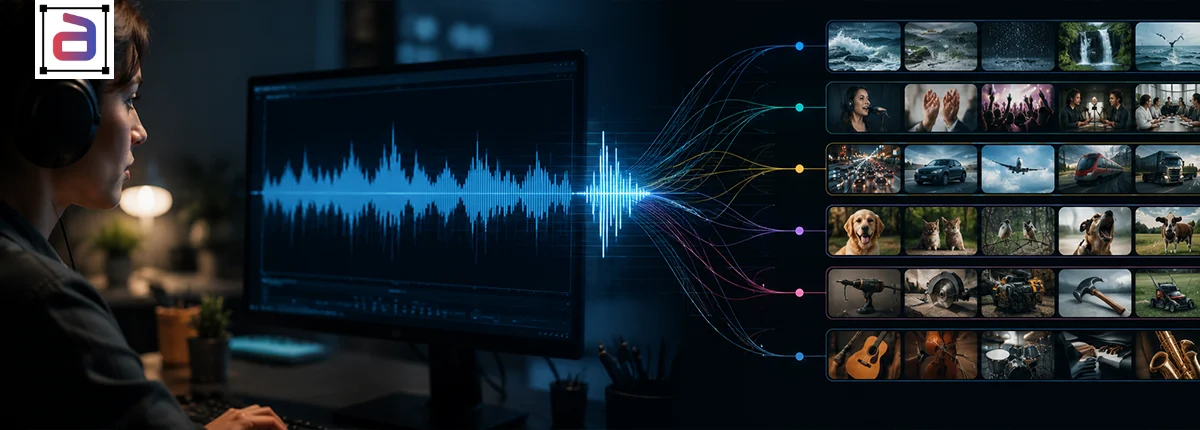
A door slams. A baby cries. An ambulance approaches in the distance. Someone speaks while music plays in the background. Humans recognize these sounds almost instantly. For an AI model, however, they begin as nothing more than complex patterns in an audio waveform. The audio classification guide for content filtering covers how content filtering programs annotate these patterns. Teaching machines to distinguish one acoustic event from another requires audio classification—the process of organizing sounds into meaningful, machine-readable categories.
From conversational AI and smart-home devices to automotive systems and industrial monitoring, audio classification enables machines to interpret what is happening in their acoustic environment. But sophisticated models cannot compensate for poorly structured training data. The accuracy of an audio AI system ultimately depends on the quality, consistency, and diversity of the labeled examples it learns from. This is why organizations increasingly rely on specialized audio annotation services to transform massive collections of unstructured recordings into reliable AI training datasets. These categories are the foundation for tagging the audio world.
Key Points
- The hidden crisis of poor annotation quality is its invisibility: annotation errors produce confident, wrong model outputs that appear correct until the model encounters the real-world scenarios that expose the gap between what it learned and what is true.
- Poor annotation quality is more expensive to fix after training than before: retraining on corrected labels requires re-running the full model training pipeline, while fixing annotation before training requires only updating the labels.
- Data quality in annotation is a preventable crisis: the practices that prevent annotation quality failures — precise guidelines, structured calibration, continuous quality sampling — are known and established; the crisis occurs when teams treat annotation as a commodity rather than as a precision activity.
- Annotation quality failures compound across the AI development lifecycle: a model trained on poor labels fails evaluation, triggers re-annotation, requires retraining, and delays deployment in ways that each add cost beyond the original annotation program.
What Is Audio Classification?
Audio classification is a machine learning task in which audio recordings—or individual segments within recordings—are assigned predefined labels based on their acoustic content. Imagine training a smart-home system. Its training dataset might include categories such as:
- Doorbell
- Dog barking
- Baby crying
- Glass breaking
- Smoke alarm
- Human conversation
- Television
- Vacuum cleaner
After being exposed to sufficiently representative labeled examples, the model learns acoustic patterns associated with each category and attempts to identify similar sounds in previously unseen recordings. Audio classification should not be confused with speech transcription. While transcription answers the question “What was said?”, audio classification answers questions such as “What sound occurred?”, “What type of audio is this?”, or “What is happening in this recording?” For advanced AI systems, these tasks frequently work together. A contact-center dataset, for example, could combine speech transcription with speaker identification, sentiment labels, background-noise categories, and acoustic event annotations to provide a richer understanding of the conversation.
Why Audio Classification Is Becoming Critical for AI
Audio represents one of the richest sources of contextual information available to AI systems. Words alone rarely tell the entire story. A customer may say, “That’s fine,” while their vocal tone suggests frustration. A vehicle may detect an emergency siren before it visually identifies the ambulance. An industrial monitoring system may recognize an abnormal mechanical sound before equipment fails. The commercial growth of speech technologies demonstrates the importance of machine-readable audio.
Grand View Research reported that the global speech and voice recognition market was valued at approximately $20.25 billion in 2023 and projected it to grow at a 14.6% CAGR from 2024 to 2030. The volume of multimedia data being created is equally significant. According to YouTube, more than 500 hours of video are uploaded every minute, creating enormous quantities of associated speech, music, environmental sounds, and acoustic events. Yet collecting audio is only the beginning. To turn these recordings into usable model-training data, organizations need structured annotation frameworks capable of consistently answering a fundamental question: What exactly is the model hearing?
Building the Right Audio Classification Taxonomy
Successful audio classification starts before the first recording is labeled. It starts with the taxonomy. An audio taxonomy defines the categories, subcategories, relationships, and annotation rules used to organize sounds throughout a dataset. Consider an AI system being developed for an autonomous vehicle. A generic label such as “road noise” provides limited training value. A structured taxonomy might instead include: Vehicle Sounds
- Engine noise
- Car horn
- Braking
- Tire screech
Emergency Sounds
- Ambulance siren
- Police siren
- Fire engine siren
Human Sounds
- Conversation
- Shouting
- Footsteps
Environmental Sounds
- Rain
- Thunder
- Wind
- Construction noise
This hierarchical approach allows models to learn both broad acoustic categories and more granular sound events. However, adding more categories does not automatically create a better dataset. If labels become excessively granular or acoustically indistinguishable, annotators may interpret them differently. That inconsistency eventually becomes noise in the training data. At Annotera, taxonomy development is treated as a fundamental part of the annotation workflow. Categories should reflect the model’s actual deployment environment, expected edge cases, and required level of acoustic discrimination.
Turning Raw Sound Into Structured Training Data
Real-world recordings rarely contain one perfectly isolated sound. Imagine a 15-second recording containing: 00:00–00:04 — Human conversation 00:05–00:07 — Dog barking 00:08–00:11 — Traffic noise 00:12–00:15 — Car horn Simply labeling the entire recording “outdoor audio” would discard most of its useful information. Through professional audio annotation services, individual acoustic events can be identified, timestamped, categorized, and enriched with contextual metadata. Depending on the AI application, annotation workflows may incorporate:
- Audio classification
- Sound event detection
- Timestamp annotation
- Speaker diarization
- Speech transcription
- Background-noise labeling
- Emotion and sentiment tagging
- Acoustic quality annotation
This transforms an unstructured waveform into structured training information that machine learning pipelines can actually use.
The Real Challenge: Audio Rarely Happens in Isolation
One of the greatest challenges in audio classification is overlapping sound. A customer speaks while another person talks in the background. Music plays while traffic passes outside. A siren overlaps with vehicle noise. Which label should the annotator choose? Sometimes, the answer is multiple labels. Multi-label classification enables a recording or audio segment to carry several categories simultaneously. But that introduces another requirement: precise annotation guidelines. Annotators need clear instructions regarding label priority, overlapping events, uncertain sounds, background versus foreground audio, minimum event duration, and ambiguous cases. Without these rules, two annotators may interpret the same recording differently. For AI developers, that inconsistency can translate directly into model uncertainty.
Where Audio Classification Is Powering Real-World AI
Audio classification is already relevant across multiple industries. In conversational AI, models can use classified audio alongside transcripts to interpret speakers, call conditions, background environments, emotions, and conversational events. In smart homes, devices can recognize alarms, doorbells, breaking glass, appliances, pets, or other household sounds. For automotive AI, acoustic classification can help systems identify horns, sirens, mechanical noises, and environmental conditions that complement visual perception. In industrial environments, AI models can monitor machinery and classify abnormal acoustic patterns associated with wear or equipment anomalies. For media intelligence, audio classification helps distinguish speech, music, silence, sound effects, and other components within multimedia content. The taxonomy for each application must therefore be built around its specific operational context.
Why Human Expertise Still Matters
Automated preprocessing can accelerate audio annotation, but real-world recordings remain highly contextual. Accents, reverberation, compression, microphone quality, distance, background interference, overlapping speakers, and acoustically similar events can all complicate classification. Consider applause and heavy rainfall. In clean recordings they may be easy to distinguish. In compressed or distant audio, their acoustic patterns can become considerably harder to separate. Human annotators can evaluate these difficult cases using contextual reasoning. This is where working with an experienced data annotation company becomes valuable. Annotera combines structured annotation guidelines with trained human annotators and quality-control workflows to help organizations create consistent datasets across complex audio environments.
Scaling Audio AI Through Data Annotation Outsourcing
Production AI projects can require thousands or millions of audio clips. Managing these datasets internally means recruiting annotators, training teams, defining guidelines, resolving edge cases, monitoring inter-annotator agreement, conducting quality reviews, and scaling capacity as data volumes fluctuate. That operational burden can quickly distract AI teams from model development. Data annotation outsourcing provides an alternative. Working with a specialized annotation partner enables organizations to access scalable annotation teams, established quality processes, and domain-specific workflows without building the entire operation internally. At Annotera, the objective goes beyond increasing annotation throughput. The focus is on creating structured, consistent, contextually accurate training datasets aligned with the requirements of the AI system.
Better Audio AI Starts With Better-Labeled Sound
Audio classification may appear simple: identify a sound and give it a label. At production scale, it becomes a much more sophisticated data-engineering challenge. Taxonomy design, event boundaries, overlapping sounds, ambiguous recordings, environmental diversity, annotation consistency, and quality assurance all influence what an AI model ultimately learns. As Andrew Ng has emphasized in his work on data-centric AI:
“The consistency of the data is paramount.”
That principle is especially relevant for audio, where subtle acoustic differences can dramatically change the meaning of a recording.
Build AI-Ready Audio Datasets With Annotera
Whether you are developing conversational AI, speech recognition, smart devices, automotive intelligence, industrial monitoring, or another sound-aware application, your model needs more than raw audio—it needs structured, accurately labeled training data. Annotera delivers scalable audio annotation services, including audio classification, sound event detection, timestamping, speaker diarization, emotion and sentiment tagging, and speech transcription. As an experienced data annotation company, Annotera helps AI teams establish consistent annotation workflows while supporting the scale and quality requirements of production machine learning. Ready to turn complex audio into model-ready intelligence? Partner with Annotera for reliable data annotation outsourcing and build audio datasets designed to help your AI listen, distinguish, and understand with greater accuracy.
A closely related read: Audio Classification for Security and Threat Detection.