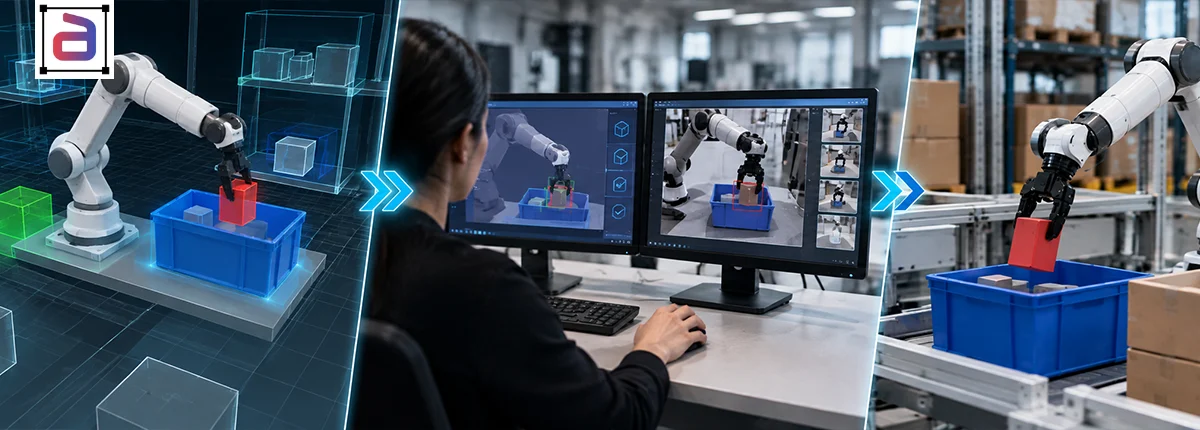
Simulation has transformed the way robots are trained. Instead of collecting every training example on expensive physical hardware, robotics teams can generate enormous volumes of synthetic data, test thousands of scenarios, and train models in controlled virtual environments. But there is a fundamental problem: the real world is not a simulation. A robot that performs flawlessly inside a virtual warehouse may struggle when deployed in an actual facility. Lighting changes. Objects become partially occluded. Cameras introduce noise.
Surfaces behave differently. Humans move unpredictably. Even small differences in physics, sensor characteristics, or object placement can cause an otherwise capable model to fail. This challenge is widely known as the sim-to-real gap or reality gap. Research has consistently identified the mismatch between simulated and physical environments as a major obstacle to transferring robotic intelligence to real-world systems. So, how can robotics companies make that transition more reliable? The answer is not simulation or real-world data. It is a carefully connected pipeline in which simulation, real-world data, and human-validated annotation work together.
“The real world is the ultimate test environment.”
For robotics developers, that test environment needs to be represented accurately in training and validation datasets. This is where Annotera can play a critical role.
Key Points
- Human-validated real-world data helps identify discrepancies between simulated environments and the unpredictable conditions robots encounter after deployment.
- Robotics datasets need detailed annotations for actions, interactions, trajectories, poses, temporal events, grasp points, and task outcomes—not just objects.
- Combining synthetic training data with carefully validated physical-world data helps identify edge cases, improve model generalization, and reduce deployment failures.
- Annotera provides specialized annotation workflows and human validation to help robotics teams build high-quality training and validation datasets for Physical AI and real-world robot deployment.
The Sim-to-Real Gap Is Ultimately a Data Challenge
Simulation provides something physical robots cannot easily provide: scale. A simulator can generate millions of images, trajectories, object configurations, and environmental variations without requiring a robot to physically execute every scenario. This makes simulation extremely valuable for training perception and control systems. Domain randomization is one established approach to improving transfer. By varying factors such as textures, lighting, camera perspectives, and physical parameters, developers can encourage models to become less dependent on a single simulated environment. However, simulation still represents an approximation of reality. As robotics researchers have noted, simulators are inherently based on models and therefore cannot perfectly reproduce the physical world. That creates a critical question: How do you know whether a model trained in simulation actually understands the real world? You validate it against real-world data. And that real-world data needs reliable ground truth.
Why Human-Validated Annotation Matters
Automated annotation can dramatically increase dataset production. Synthetic environments can generate labels automatically, while computer vision models can assist with labeling physical-world data. But robotics datasets often contain difficult cases that require human judgment. Imagine a robotic arm reaching for a product on a crowded shelf. The object may be:
- Partially hidden behind another object
- Reflective or transparent
- Damaged or deformed
- Similar in appearance to another item
- Located in an unusual orientation
- Interacting with a human hand
- Moving during the interaction
An automated system may produce a plausible label that is nevertheless incorrect. A trained human annotator can examine the scene, interpret context, identify ambiguity, and apply project-specific annotation rules. This makes human validation especially valuable for robotics datasets involving object interactions, manipulation, human behavior, temporal events, trajectories, poses, and complex scene understanding. Research on human-in-the-loop simulation workflows similarly highlights the value of human experts in validating simulation realism, identifying missing properties, correcting virtual representations, and verifying robot behavior.
“Better robot intelligence begins with better ground truth.”
From Synthetic Data to Real-World Ground Truth
A strong sim-to-real strategy should not treat synthetic and real-world data as separate silos. Instead, robotics teams can establish a continuous feedback loop: Simulation → Model Training → Physical Testing → Data Collection → Human Validation → Error Analysis → Dataset Refinement → Model Retraining This approach enables teams to discover where simulated assumptions break down. For example, suppose a simulated manipulation model achieves a 95% success rate but repeatedly fails to grasp dark, reflective objects in a real warehouse. Instead of simply retraining the model blindly, the development team can investigate the failure cases. Human-validated annotations can identify the objects, grasp regions, occlusions, hand-object relationships, and failure states involved. Those examples can then become targeted training data. The result is a more informed development cycle.
Annotation Must Capture Actions, Not Just Objects
Traditional computer vision annotation often focuses on identifying objects. Robotics requires a broader perspective. A robot needs to understand objects, environments, people, actions, interactions, and outcomes. Depending on the application, human-validated robotics annotation may include:
- Object detection and classification
- Semantic and instance segmentation
- 2D and 3D bounding boxes
- Human pose and hand keypoints
- Object affordances
- Grasp points
- Contact regions
- Robot trajectories
- Human-object interactions
- Temporal action sequences
- Object movement
- Task completion states
- Success and failure events
This distinction is particularly important for embodied AI. A robot does not merely need to recognize a cup. It may need to understand that a human is reaching for the cup, grasping it, moving it toward a particular location, and releasing it. That requires annotation that captures relationships and events over time, not just individual frames.
Where Sim-to-Real Annotation Services for Robotics Fit In
Developing this capability internally can be expensive and operationally demanding. Robotics companies need annotation specialists, quality-control processes, annotation guidelines, tooling, workforce management, and the ability to scale rapidly when datasets grow. This is where Sim-to-Real annotation services for robotics can provide strategic support. A specialized annotation partner can help transform raw real-world sensor data into structured, validated datasets that complement synthetic training environments. The objective should not simply be to produce more labels. It should be to produce more reliable labels that reflect the conditions robots will encounter after deployment.
Data Annotation Outsourcing Without Losing Quality
For robotics companies working under tight development timelines, data annotation outsourcing can provide scalable access to trained annotation teams and established quality-control workflows. However, outsourcing should never mean handing over the dataset and losing visibility into its quality. A capable partner should work closely with robotics teams to establish:
- Clear annotation taxonomies
- Task-specific labeling guidelines
- Multi-stage quality assurance
- Human validation procedures
- Edge-case identification
- Annotation consistency checks
- Continuous feedback mechanisms
The right data annotation company becomes an extension of the robotics development team. At Annotera, this principle is central to our approach.
How Annotera Helps Robotics Teams Prepare for Reality
At Annotera, we understand that robotics annotation is fundamentally different from generic image labeling. Robotic systems operate in dynamic environments where perception is connected directly to action. A seemingly minor annotation error can influence how a model perceives an object, predicts an interaction, or executes a task. Our approach focuses on creating structured, high-quality datasets that support robotics and Physical AI development. From visual perception and segmentation to temporal events, human-object interactions, pose estimation, and multimodal sensor data, Annotera helps robotics teams convert complex real-world information into actionable training and validation datasets. The emphasis is simple: Validate reality before deploying intelligence into it.
Human Validation Creates a Stronger Deployment Pipeline
Simulation will continue to be one of the most important tools in modern robotics. It enables rapid experimentation, scalable training, and safer development. But simulation should be viewed as a foundation—not the final proof of robotic capability. Real-world data provides the reality check. Human-validated annotation provides the reliable ground truth needed to interpret that reality. Research has shown that combining simulation strategies with carefully selected real-world experience can improve transfer efficiency. For example, studies of robotic grasping have demonstrated substantial improvements when limited real-world data is incorporated into sim-to-real workflows. The lesson for robotics companies is clear:
The goal is not to eliminate the sim-to-real gap. The goal is to continuously measure, understand, and reduce it.
And that requires a data pipeline built for the physical world.
Build Better Robotics Data With Annotera
As robots move from controlled demonstrations into warehouses, factories, healthcare environments, homes, and other complex settings, deployment success will depend increasingly on the quality of their training data. Simulation can teach robots what could happen. Real-world, human-validated annotation helps them understand what actually happens. That distinction can make the difference between a promising robotic prototype and a reliable deployed system. Annotera helps robotics companies build the high-quality, human-validated datasets needed to strengthen perception, improve model generalization, and prepare AI systems for real-world deployment. Ready to close the gap between simulation and reality? Partner with Annotera to build robotics training and validation data designed for the physical world.
A closely related read: Why Annotated Training Sets Matter for Robots in Real Environments.