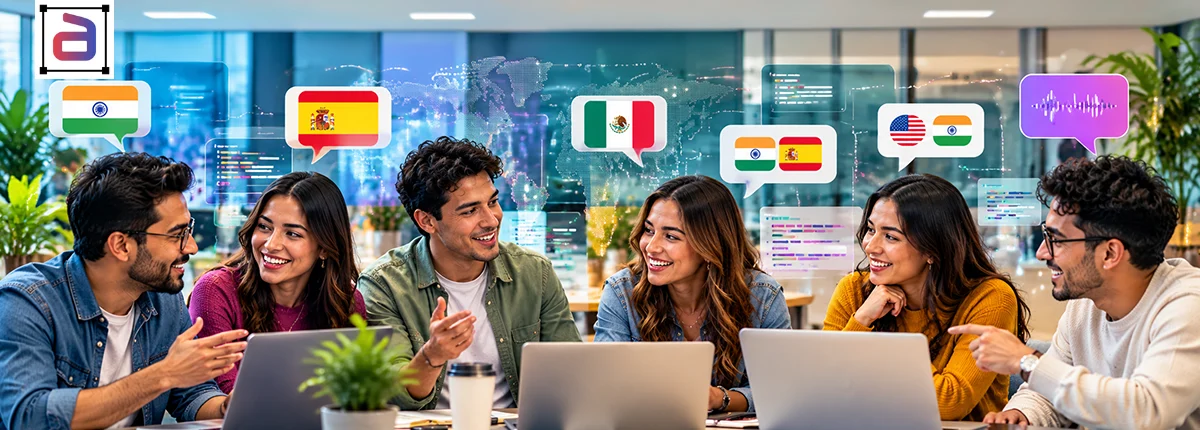
Human communication rarely follows the boundaries of a single language. In everyday conversations, people seamlessly switch between languages, combine familiar expressions, and write words using scripts that differ from their original writing systems. From Hinglish conversations in India to Spanglish expressions in the United States, multilingual communication reflects how people naturally express ideas, emotions, and cultural identities. Consider the sentence, “Kal meeting hai, please join on time.” A Hindi-English speaker might use this expression without consciously thinking about the transition between languages. Similarly, “Voy a checkear el schedule antes de salir” combines Spanish and English elements in a single sentence. For humans, these expressions are often easy to understand. For artificial intelligence (AI) systems, however, they present a significant challenge.
Traditional natural language processing (NLP) models may struggle to identify language boundaries, interpret transliterated words, and distinguish borrowed vocabulary from genuine code-switching. Without appropriately labeled training data, even sophisticated language models can misinterpret multilingual inputs. Code-switching and transliteration annotation bridge this gap by helping AI systems recognize, classify, and interpret mixed-language text more accurately. At Annotera, we understand that high-performing language models need training data that reflects real-world communication. Through structured text annotation workflows, Annotera helps organizations prepare linguistically diverse datasets that support more reliable and inclusive AI applications.
Key Points
- Code-switching and transliteration annotation help AI models understand mixed-language text, including Hinglish, Spanglish, and transliterated words.
- Accurate language identification and contextual labeling enable AI systems to distinguish language transitions, script variations, borrowed vocabulary, and regional expressions.
- High-quality multilingual annotation improves training data for chatbots, sentiment analysis, search engines, and large language models through consistent labeling and rigorous quality assurance.
- Annotera provides structured text annotation solutions to help businesses prepare linguistically diverse training datasets for more accurate and context-aware AI applications.
What Are Code-Switching and Transliteration Annotation?
Although code-switching and transliteration frequently appear together, they describe two distinct linguistic processes.
Code-Switching Annotation
Code-switching occurs when a speaker or writer alternates between two or more languages within a conversation, sentence, or phrase. For example: “Mujhe this product really pasand hai.” The sentence combines Hindi and English while maintaining a natural conversational structure. Code-switching annotation identifies the languages used and labels the boundaries between different linguistic segments. These labels help AI models recognize multilingual sentence structures rather than incorrectly treating the entire expression as grammatically inconsistent or linguistically invalid.
Transliteration Annotation
Transliteration involves representing words from one writing system using another script, often while retaining the original language. For example:
- Hindi in Devanagari: नमस्ते
- Hindi in Roman script: Namaste
Both expressions represent Hindi, but their writing systems differ. Transliteration annotation helps AI models distinguish language identity from script choice, an important capability when processing multilingual search queries, chatbot messages, and user-generated content. As an annotation principle: “Accurate multilingual AI begins with recognizing both the language people use and the way they choose to write it.” This principle highlights why code-switching and transliteration require dedicated annotation strategies rather than conventional monolingual labeling alone.
Why Mixed-Language Text Creates Challenges for AI
Multilingual communication introduces several complexities that can affect the quality of AI training datasets.
1. Identifying Language Boundaries
Language transitions can occur between sentences, phrases, or individual words. For example, “Yeh offer looks amazing, mujhe buy karna hai” contains multiple Hindi-English transitions. Annotators must identify these boundaries consistently while preserving the sentence’s original structure and meaning.
2. Interpreting Informal and Regional Expressions
People frequently use slang, abbreviations, regional vocabulary, and nonstandard spellings when communicating online. The same Hindi expression may appear in several Romanized forms depending on pronunciation and personal preference. Spanish-English speakers may similarly adapt English vocabulary to Spanish grammatical patterns. Annotation guidelines must account for these variations without incorrectly treating every spelling difference as a separate linguistic category.
3. Distinguishing Borrowed Words from Code-Switching
Not every word originating from another language represents an active language switch. For instance, English-derived vocabulary may be widely integrated into everyday Hindi conversations. Whether a particular word should be labeled as an English insertion or an established borrowing depends on its linguistic use and the project’s annotation conventions. This distinction requires contextual judgment rather than mechanical word matching.
4. Preserving Context and Cultural Meaning
Expressions often communicate more than their literal definitions. They may convey humor, frustration, familiarity, politeness, or cultural identity. Over-normalizing multilingual text can remove these meaningful characteristics and weaken the dataset’s usefulness. Annotera emphasizes structured annotation approaches that preserve original text while capturing the linguistic information required by downstream AI applications.
Essential Labels for Code-Switching and Transliteration Annotation
A well-designed annotation framework should reflect the requirements of the intended AI application.
- Language identification: Assign language labels to individual words, phrases, or text segments to help models recognize multilingual transitions.
- Script identification: Identify writing systems such as Latin and Devanagari, allowing models to distinguish linguistic identity from script representation.
- Code-switching boundaries: Mark where language transitions occur within a sentence or conversation.
- Transliteration labels: Identify words represented in a different script from their conventional writing system. Projects may also document transliteration patterns or spelling variants.
- Named entities and borrowed vocabulary: Label names, brands, locations, and relevant borrowed terms according to predefined guidelines.
- Sentiment and intent: Where required, capture emotional tone, customer intent, or conversational purpose to support multilingual sentiment analysis and conversational AI.
For example, consider the Hinglish sentence: “Mera order abhi tak deliver nahi hua.” An annotation framework could identify Hindi segments, recognize the Roman script, and flag “order” and “deliver” for contextual review according to the project’s borrowing and code-switching rules. These layered labels provide richer linguistic information than a single language classification applied to the entire sentence.
Real-World Applications Across Hinglish, Spanglish, and Multilingual Text
Code-switching and transliteration annotation support a growing range of AI applications.
Multilingual Chatbots and Virtual Assistants
Customers often communicate in mixed languages rather than switching to a standardized language for digital interactions. Accurately annotated training data helps conversational AI systems interpret these messages and generate responses appropriate to the user’s linguistic context.
Sentiment Analysis and Customer Experience
Customer reviews, support conversations, and social media comments frequently combine languages. For example, “Service bahut good tha, but delivery was late” expresses both positive and negative feedback. Annotation can help sentiment analysis systems identify the relevant opinions and distinguish satisfaction with a product or service from frustration about delivery.
Search Engines and Information Retrieval
Users may search for information using Romanized words, regional expressions, or mixed-language queries. Transliteration-aware datasets can help search systems connect different written representations of the same expression and improve multilingual query interpretation.
Large Language Models and Generative AI
Large language models require diverse training examples to handle the linguistic patterns encountered in real-world interactions. Well-annotated multilingual datasets can support language identification, instruction following, conversational understanding, and other NLP tasks. Their effectiveness depends on dataset coverage, label quality, model architecture, and the evaluation methodology used.
Best Practices for Building High-Quality Multilingual Datasets
Reliable annotation requires a combination of linguistic expertise, consistent processes, and systematic quality assurance.
- Develop clear annotation guidelines: Define language boundaries, transliteration conventions, borrowed-word handling, and rules for ambiguous expressions before work begins.
- Use linguistically proficient annotators: Recruit people who understand the relevant languages, regional expressions, and cultural context.
- Preserve the original text: Avoid unnecessary spelling corrections or normalization that could remove meaningful linguistic variation.
- Implement multi-stage quality assurance: Use independent reviews, inter-annotator agreement measurements, and adjudication workflows to resolve disagreements.
- Combine human expertise with automation: Use language identification tools for preliminary labeling and human review for context-sensitive decisions.
- Evaluate dataset coverage: Monitor representation across languages, scripts, dialects, and communication styles to identify gaps that could affect downstream performance.
“The objective is not to make multilingual communication conform to a single linguistic standard; it is to help AI systems understand the communication patterns people already use.” This approach supports more representative datasets while reducing the risk of introducing artificial assumptions about how multilingual users should communicate.
How Annotera Helps Organizations Prepare Multilingual AI Training Data
Building multilingual AI systems requires more than collecting large volumes of text. Organizations need datasets that accurately represent language combinations, transliteration patterns, regional vocabulary, and conversational context. Annotera supports AI development through structured annotation workflows tailored to project requirements. Our approach emphasizes clear labeling taxonomies, contextual interpretation, and quality assurance to help organizations prepare text datasets for advanced NLP applications. For businesses developing multilingual chatbots, sentiment analysis platforms, search systems, or large language models, text annotation outsourcing services can provide access to scalable annotation workflows without requiring every capability to be developed internally.
Partnering with an experienced text annotation company can also help organizations establish consistent labeling standards, manage complex linguistic requirements, and prepare datasets aligned with specific model-training objectives. At Annotera, we recognize that every multilingual project has different requirements. The appropriate annotation strategy depends on the target languages, data sources, downstream use cases, and expected quality standards. By combining structured workflows with context-aware annotation, Annotera helps organizations address the complexities of mixed-language text and build a stronger foundation for multilingual AI development.
Conclusion: Building AI That Understands Multilingual Communication
Code-switching and transliteration are natural features of modern communication, not simply inconsistencies that AI systems should eliminate. From Hinglish customer conversations to Spanglish social media discussions, multilingual text reflects how people communicate in real-world settings. Accurately identifying language transitions, distinguishing language identity from script choice, and preserving contextual meaning are essential steps toward developing more capable language technologies. High-quality annotation provides the linguistic structure AI models need to learn from these communication patterns.
With consistent guidelines, skilled annotators, and rigorous quality assurance, organizations can prepare datasets that better represent their intended audiences. Annotera helps businesses transform linguistically diverse text into structured training data for evolving AI applications. Ready to strengthen your multilingual AI training pipeline? Connect with Annotera to explore text annotation solutions tailored to your language requirements, data complexity, and model-development goals. Build a stronger foundation for AI systems that understand the way people communicate.