
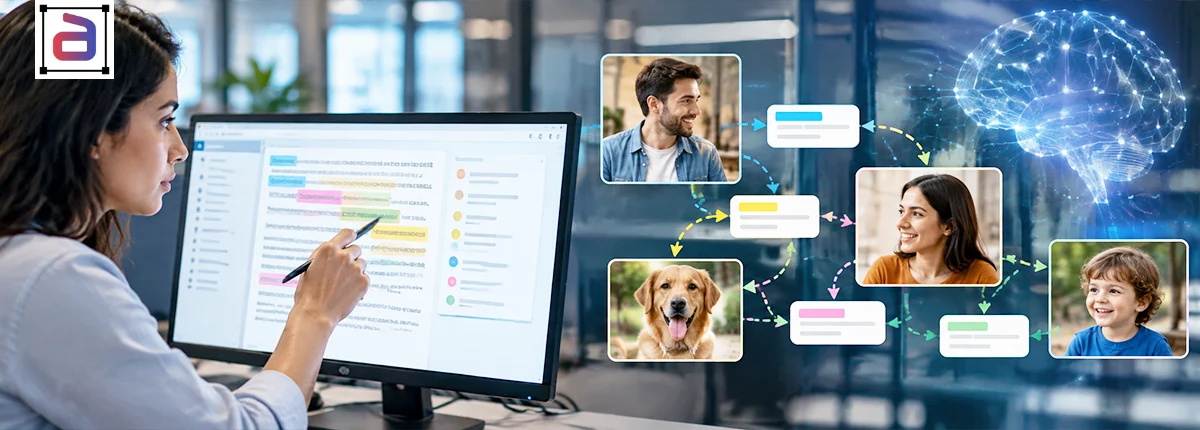
Consider this sentence: “Sarah submitted the proposal to her manager because she believed it would solve the problem.” A human reader can quickly understand that “she” refers to Sarah and “it” refers to the proposal. For an artificial intelligence (AI) model, however, establishing these relationships requires more than recognizing individual words. It requires contextual understanding. This is where coreference resolution annotation becomes essential. By teaching natural language processing (NLP) models to identify expressions that refer to the same person, object, or concept, annotation helps machines interpret language more accurately and consistently.
From conversational AI and intelligent document processing to information extraction and enterprise search, coreference resolution supports applications that depend on understanding relationships across sentences. However, even sophisticated language models can struggle with ambiguous references, long documents, and complex linguistic structures. High-quality training data helps address these challenges. At Annotera, we recognize that effective AI language understanding begins with well-structured data. Through carefully designed text annotation workflows, businesses can develop training datasets that help NLP systems connect the dots between words, references, and meaning.
Key Points
- Improves Contextual Understanding: Coreference resolution annotation helps NLP models connect pronouns, names, and descriptive phrases to the entities they represent across sentences.
- Enhances AI Performance: High-quality coreference annotation supports conversational AI, intelligent document processing, information extraction, and context-aware search.
- Ensures Annotation Accuracy: Clear guidelines, expert review, and rigorous quality assurance help resolve ambiguous references and maintain consistent coreference chains.
- Scales NLP Data Preparation with Annotera: Annotera provides structured text annotation workflows and scalable annotation support to help AI teams build reliable training datasets.
What Is Coreference Resolution Annotation?
Coreference resolution is the process of identifying different expressions in a text that refer to the same entity. Coreference resolution annotation involves labeling these expressions and organizing them into groups, commonly known as coreference chains. Consider the following example: “Microsoft announced a new AI platform last week. The technology company expects it to help enterprises automate complex workflows.” In this example:
- “Microsoft” and “The technology company” refer to the same organization.
- “A new AI platform” and “it” refer to the same product.
An annotated dataset establishes these connections, enabling NLP models to learn how entities are referenced throughout a passage. Unlike named entity recognition (NER), which identifies entities such as people, companies, and locations, coreference resolution determines whether multiple expressions refer to the same entity. These tasks can work together to improve contextual language understanding. The key takeaway: Identifying an entity is only the beginning. Understanding how that entity is referenced throughout a conversation or document is what makes language processing more context-aware.
Why Coreference Resolution Matters for AI Language Models
Modern NLP applications must interpret relationships between words, sentences, and ideas. Without reliable coreference resolution, even a grammatically correct sentence can be misunderstood.
1. Building More Context-Aware Conversational AI
Conversational AI systems must remember previously mentioned entities to respond appropriately to follow-up questions. For example:
- User: “I purchased a new laptop yesterday.”
- User: “Does it support multiple external monitors?”
To answer correctly, an AI assistant must connect “it” with the laptop mentioned earlier. Coreference-aware models can maintain conversational continuity, reduce misunderstandings, and deliver more relevant responses.
“An AI system cannot fully understand a conversation if it cannot reliably connect references to the entities they represent.”
This statement captures an important principle of contextual language understanding: relationships between expressions matter as much as the expressions themselves.
2. Improving Intelligent Document Processing
Enterprise documents frequently refer to the same organization, individual, or product using different names and descriptions. A financial report might mention a company’s full legal name in one paragraph, its abbreviated name in another, and phrases such as “the organization” elsewhere. Coreference resolution helps NLP systems connect these references, supporting more accurate document summarization, information extraction, and knowledge graph development. For industries that process large volumes of contracts, financial statements, insurance claims, or compliance documents, these connections can significantly improve the usefulness of extracted information.
3. Strengthening Search and Information Retrieval
Traditional keyword-based systems may struggle when users search for information using expressions different from those appearing in a document. By understanding how entities are referenced across a passage, NLP systems can establish stronger contextual relationships and support more meaningful retrieval. For example, connecting an executive’s name with references such as “the CEO” or “the company’s chief executive” can help information retrieval systems recognize that these expressions may identify the same individual. The result is a more context-sensitive approach to finding and organizing information.
Common Types of Coreference Relationships
Effective coreference resolution annotation requires consistent treatment of different linguistic patterns.
- Pronoun-Antecedent Coreference: In “Emma completed the report because she had finished the analysis,” the pronoun “she” refers to Emma.
- Named Entity Coreference: In “Apple introduced a new device. The technology company expects strong demand,” the two expressions refer to the same organization.
- Nominal Coreference: In “A researcher presented the findings. The scientist later answered questions,” the phrases may refer to the same individual.
- Cross-Sentence Coreference: In “The delivery vehicle entered the warehouse. It stopped near the loading dock,” the pronoun “It” refers to the delivery vehicle.
- Cataphoric Reference: In “Before she presented the findings, Maria reviewed her notes,” the pronoun “she” refers to Maria, whose name appears later.
These examples illustrate why coreference annotation requires contextual interpretation rather than simple word matching. Annotation guidelines must also address ambiguous cases in which the intended relationship cannot be established confidently.
How High-Quality Annotation Improves Coreference Resolution
Building reliable coreference datasets requires a systematic process that balances linguistic precision, annotation consistency, and scalability.
Step 1: Identify Relevant Mentions
Annotators identify expressions that refer to people, organizations, objects, and concepts. These may include proper names, pronouns, noun phrases, and descriptive references. Accurate mention boundaries are important because incorrectly identified text spans can undermine subsequent coreference decisions.
Step 2: Establish Coreference Chains
Annotators determine which mentions refer to the same entity and group them accordingly. Decisions should reflect the surrounding context, grammatical relationships, and available evidence. For example, “Dr. Williams,” “she,” and “the physician” may belong to one coreference chain when the document establishes that they refer to the same person.
Step 3: Resolve Ambiguity Through Context
Consider the sentence: “Alex spoke to Jordan after he finished the presentation.” Who does “he” refer to? Without additional context, the reference may be ambiguous. Clear annotation guidelines should specify how such cases are handled, including when annotators should flag uncertainty or seek expert review.
Step 4: Apply Quality Assurance
Quality assurance should evaluate mention boundaries, entity relationships, chain consistency, and adherence to project guidelines. Human review, adjudication, and automated validation can help identify inconsistencies before the data is used for model training.
“Reliable language models depend not only on the volume of training data, but also on the consistency and precision of the annotations behind it.”
For AI teams, this means treating annotation quality as a fundamental component of dataset development rather than a final inspection step.
Key Challenges in Coreference Resolution Annotation
Despite its importance, coreference annotation presents several challenges.
- Ambiguous references: A pronoun may have multiple plausible antecedents, requiring careful contextual analysis.
- Long-distance relationships: An entity introduced several paragraphs earlier may be referenced again later in the document.
- Domain-specific terminology: Legal, financial, healthcare, and technical texts often contain specialized language and complex sentence structures.
- Inconsistent annotation decisions: Different annotators may interpret the same reference differently without clear guidelines.
- Scalability requirements: Large datasets require annotation workflows that maintain quality as volumes increase.
Addressing these challenges requires a combination of linguistic expertise, standardized processes, and continuous quality monitoring.
Why Choose Annotera for Text Annotation?
For organizations developing advanced NLP applications, high-quality annotation is a strategic investment in model performance. Annotera helps businesses approach text annotation with a focus on structured workflows, clear guidelines, and quality-oriented dataset preparation. Our annotation capabilities support AI teams seeking training data for language understanding and other text-driven machine learning applications. By working with a specialized text annotation company, organizations can establish annotation processes aligned with their model requirements, domain complexity, and dataset objectives. Annotera can support businesses looking to scale their annotation operations through tailored workflows and text annotation outsourcing services. Outsourcing can help teams access additional annotation capacity while reducing the operational burden of managing large-scale projects internally. A successful annotation partnership should prioritize:
- Clear annotation standards: Consistent definitions for mentions, coreference chains, and ambiguous cases.
- Quality assurance: Structured reviews and feedback to improve annotation reliability.
- Scalable workflows: Processes designed to accommodate growing dataset requirements.
- Domain alignment: Annotation guidelines tailored to the language and terminology of the target application.
- Data confidentiality: Appropriate safeguards for sensitive business documents and training datasets.
At Annotera, our focus is on helping AI teams prepare structured, high-quality text data that supports their development objectives.
Conclusion: Teach AI to Connect the Dots
Understanding language requires more than recognizing words. It requires identifying relationships, tracking entities, and interpreting references across sentences and conversations. Coreference resolution annotation helps NLP models develop these capabilities by connecting pronouns, names, and descriptive expressions to the entities they represent. This supports more coherent conversational AI, improved document intelligence, and more reliable information extraction. However, the effectiveness of these applications depends on accurate annotations, consistent guidelines, and rigorous quality assurance. Annotera helps businesses build a stronger foundation for NLP development through structured text annotation workflows designed around their data requirements.
Ready to Strengthen Your NLP Training Data?
Give your AI models the contextual information they need to understand language more effectively. Partner with Annotera to explore text annotation solutions tailored to your project requirements. Contact Annotera today to discuss your text annotation needs and build a stronger foundation for your next AI initiative.
A closely related read: Why Contextual Text Annotation Matters in Healthcare NLP Systems.