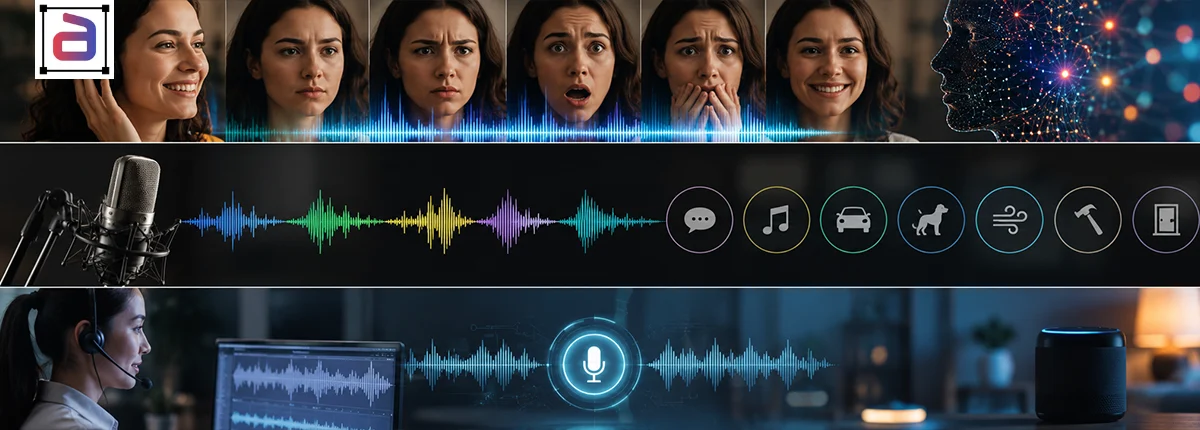
What separates a conversational AI that simply hears words from one that genuinely understands the conversation? The answer increasingly lies in recognizing the emotions behind the voice. A customer can say, “That’s fine,” while sounding frustrated, disappointed, relieved, or genuinely satisfied. A transcript captures the words, but tone, pitch, pauses — and annotating those acoustic signals for sentiment is the focus of audio sentiment labeling., intensity, and speaking patterns reveal the emotional context. Without these signals, even sophisticated conversational AI can misinterpret what a user actually means. Emotion and sentiment tagging in voice data helps bridge this gap. By labeling emotional states, sentiment, and other vocal cues alongside speech transcription, AI teams can build richer training datasets that enable models to recognize not only what users say, but how they say it.
At Annotera, we help transform complex voice recordings into structured, high-quality training data through scalable audio annotation services. From transcription and speaker labeling to sentiment and emotion annotation, our human-in-the-loop workflows give conversational AI systems the contextual data they need to deliver more relevant, responsive, and human-centered interactions. As voice AI evolves from speech recognition toward deeper conversational understanding, accurately annotated emotional data is becoming an essential foundation for building AI that can listen—and respond—with greater context.
Key Points
- Emotion tagging adds context beyond words: Sentiment and emotion labels help conversational AI recognize frustration, excitement, urgency, sarcasm, and other signals that speech transcription alone may miss.
- Human annotation improves emotional accuracy: Skilled annotators can interpret tone, context, cultural nuances, and ambiguous expressions to create more reliable training data for emotion-aware AI.
- Layered voice annotation creates richer datasets: Combining transcription, speaker identification, timestamps, sentiment, emotion, and intensity labels provides stronger ground truth for conversational AI models.
- Scalable annotation accelerates voice AI development: Annotera’s audio annotation services help AI teams efficiently prepare consistent, model-ready voice datasets for conversational AI, speech recognition, and emotion detection applications.
From Speech Recognition to Emotional Understanding
Voice AI has evolved considerably over the past decade. Traditional speech systems primarily focused on converting spoken language into text. Today’s conversational systems are expected to recognize intent, maintain context, respond naturally, and increasingly understand emotional cues. This evolution is happening alongside significant market growth. According to Grand View Research, the global voice and speech recognition market was valued at $20.2 billion in 2023 and is projected to reach $53.7 billion by 2030, growing at a CAGR of 14.6%. The emotion detection and recognition market is expanding even faster. Grand View Research estimates that it will grow from $47.3 billion in 2023 to $136.5 billion by 2030, representing a CAGR of approximately 16%. These numbers point toward an important shift: the future of voice AI is not simply about hearing accurately. It is about understanding intelligently.
“The next generation of conversational AI must understand more than words—it must recognize the human signals behind them.”
For AI teams, that capability starts with accurately annotated voice data.
What Is Emotion and Sentiment Tagging in Voice Data?
Emotion and sentiment tagging involves assigning structured labels to speech recordings based on the emotional characteristics of the speaker. Depending on the application, emotion labels may include:
- Happiness
- Anger
- Frustration
- Sadness
- Excitement
- Anxiety
- Confusion
- Surprise
- Neutrality
Sentiment tagging generally categorizes an utterance as positive, negative, neutral, or mixed, although more granular taxonomies can be developed for specific applications. Advanced datasets can go even further by labeling emotional intensity, sarcasm, hesitation, confidence, urgency, changes in emotional state, and other paralinguistic signals. These annotations provide ground truth that machine learning systems can use to discover relationships between acoustic characteristics and human emotional expression.
Why Speech Transcription Alone Cannot Capture Emotion
Accurate speech transcription answers a fundamental question: What did the person say? Emotion annotation addresses another: How did the person say it? Consider the statement:
“Great. Another ten minutes on hold.”
A conventional transcript contains nothing inherently negative. A human listener, however, might immediately recognize frustration or sarcasm from intonation. This is why sophisticated voice datasets frequently require multiple annotation layers: Audio → Transcription → Speaker → Timestamp → Sentiment → Emotion → Intensity Annotating these layers helps models associate linguistic content with pitch, tempo, volume, pauses, stress, rhythm, and other acoustic features. For AI developers, combining speech transcription and emotion tagging creates richer training data than relying on text alone.
How Emotion Tagging Makes Conversational AI More Empathetic
Empathetic AI does not mean teaching machines to experience emotions. It means giving systems enough contextual information to recognize emotional signals and respond appropriately.
Recognizing Frustration Before It Escalates
Customers rarely announce, “I am becoming frustrated.” Instead, frustration might appear through repeated questions, interruptions, elevated volume, shortened responses, or changes in speaking pace. Emotion-tagged training data helps AI systems learn these patterns and potentially adjust their response or escalate the interaction.
Delivering Context-Aware Responses
Consider two users saying: “I need help with my account.” One sounds calm. The other sounds distressed. Treating both interactions identically may produce technically correct but contextually inappropriate responses. Emotion-aware conversational systems can use additional signals to determine whether an interaction requires reassurance, clarification, urgency, or human intervention.
Improving Human-AI Interactions
Research provides early evidence that emotional sensitivity can influence how users perceive AI. A 2025 study comparing emotion-sensitive and emotion-insensitive LLM-based conversational agents found that participants perceived the emotion-sensitive chatbot as more trustworthy and competent, even though issue-resolution rates were not significantly different. That distinction matters.
“A conversational AI system can provide the correct answer and still deliver the wrong experience.”
Emotion annotation helps bridge that gap.
Why Human Annotation Is Essential for Emotional Voice Data
Emotion is highly contextual. An identical sentence can communicate happiness, disappointment, anger, sarcasm, or indifference depending on vocal delivery and conversational context. Automated labeling can therefore struggle with ambiguous emotional expressions. Sarcasm is an obvious example. Consider:
“Fantastic. The app crashed again.”
The word fantastic appears positive, but its contextual sentiment is clearly negative. Human annotators can evaluate lexical meaning alongside tone, surrounding conversation, speaker behavior, and contextual clues. A specialized data annotation company such as Annotera can establish structured annotation guidelines covering:
- Emotion taxonomies
- Sentiment categories
- Emotional intensity
- Ambiguous utterances
- Sarcasm and irony
- Multi-speaker conversations
- Annotation disagreements
- Quality-control procedures
Multiple annotators and adjudication workflows can further improve consistency when emotional classifications are subjective.
Multilingual Emotion Annotation Adds Another Layer of Complexity
People do not express emotion identically across languages and cultures. Tone, speech rhythm, vocabulary, pauses, politeness conventions, and emotional intensity can differ substantially across linguistic groups. A phrase that communicates mild dissatisfaction in one culture could convey significant frustration in another. Training multilingual conversational AI therefore requires datasets representing diverse languages, accents, dialects, demographics, recording environments, and speaking styles. This is another area where professionally managed audio annotation services become valuable. At Annotera, annotation workflows can be tailored to project-specific language requirements and labeling taxonomies, helping AI teams build datasets that better represent real-world speech.
Scaling Voice AI Through Data Annotation Outsourcing
Production-grade voice models can require enormous datasets containing thousands or millions of utterances. Each recording may need transcription, segmentation, speaker identification, emotion classification, sentiment labeling, timestamps, and quality review. Building and managing an internal annotation operation at this scale can consume substantial time and resources. Data annotation outsourcing gives AI organizations access to dedicated annotation teams and established quality-control processes without requiring them to build the entire labeling infrastructure internally. Annotera’s voice-data workflows can support:
- Speech transcription
- Audio segmentation
- Speaker diarization
- Timestamp annotation
- Sentiment labeling
- Emotion tagging
- Acoustic event labeling
- Custom audio classification
- Quality assurance and annotation review
The objective is not simply to produce more labels. It is to create consistent, representative, AI-ready ground truth.
The Annotera Advantage: Turning Human Expression into AI-Ready Data
Building emotionally intelligent conversational AI starts long before model training. It starts with the dataset. Poorly defined emotion classes, inconsistent sentiment labels, inaccurate transcripts, or missing contextual information can introduce noise into training data and ultimately limit model performance. Annotera provides scalable audio annotation services designed around the requirements of modern AI development. As a specialized data annotation company, we combine human expertise, project-specific annotation guidelines, structured quality assurance, and scalable delivery models to help organizations prepare reliable voice datasets. Whether your project involves conversational AI, contact-center analytics, voice assistants, speech recognition, emotion detection, or multilingual voice applications, Annotera can help convert raw audio into structured training data your models can actually learn from.
Build Conversational AI That Understands More Than Words
Voice AI is moving from recognition to understanding. Tomorrow’s conversational systems will need to recognize not only words and intent but also frustration, enthusiasm, uncertainty, urgency, and other signals that shape human communication. That evolution depends on high-quality annotated voice data. Annotera helps AI teams bridge the gap between human expression and machine understanding through scalable speech transcription, sentiment tagging, emotion annotation, and customized audio annotation workflows.
Ready to Build More Emotion-Aware Conversational AI?
Transform your raw voice data into accurate, structured, model-ready datasets with Annotera’s audio annotation services. Talk to Annotera today to discuss your voice AI training-data requirements and build conversational systems that don’t just hear users—but understand them.
A closely related read: Enhancing Customer Support with Real-Time Sentiment Tagging