Robots can now recognize objects, interpret scenes, navigate environments, and execute increasingly complex tasks. But seeing an object is fundamentally different from understanding how to interact with it. A robot may identify a coffee mug with high confidence, yet still need to determine where to grasp it, how much force to apply, whether its grip is stable, and how its movement will affect the surrounding environment. This gap between perception and physical action is one of the defining challenges of Physical AI. The solution begins with better training data.
For Annotera, this principle sits at the heart of robotics data annotation. By transforming raw robot demonstrations, video, and sensor streams into structured training data, Annotera helps AI teams teach machines the practical physics of interacting with the world.
Key Points
- Annotating contact points, collisions, interaction timing, and object-to-surface relationships helps robots understand where and how physical interactions occur.
- Grasp annotation helps robots learn optimal grip positions and approaches, while object affordance annotation teaches them what actions objects enable, such as pushing, pulling, opening, or grasping.
- Robot preference annotation and RLHF for Physical AI enable human feedback to guide robots toward safer, smoother, more efficient, and task-appropriate behaviors.
- Specialized data annotation outsourcing through an experienced data annotation company like Annotera helps robotics teams build accurate, consistent, scalable datasets for advanced Physical AI systems.
Why Robots Need to Learn Interaction, Not Just Recognition
Traditional computer vision systems are primarily concerned with identifying what is in an image. Physical AI requires a deeper level of understanding. A robot picking up a bottle needs to understand its shape and position, but also its graspable surfaces, orientation, weight distribution, surrounding obstacles, and the consequences of applying force at different points. Similarly, opening a drawer requires more than recognizing a drawer. The robot must identify the handle, determine that it can be pulled, establish an appropriate contact point, and execute a movement that does not collide with nearby objects. This is where contact, grasp, and affordance annotation become essential. High-quality annotation converts unstructured observations into machine-readable signals that help robotic models connect perception with action.
As robots move from controlled laboratories into warehouses, factories, hospitals, homes, and other unpredictable environments, they need datasets that capture not only what objects are present, but also how those objects behave when touched, moved, pushed, pulled, or grasped.
“Robots don’t learn from code alone—they learn from the data we feed them.”
Contact Annotation: Teaching Robots Where Physics Begins
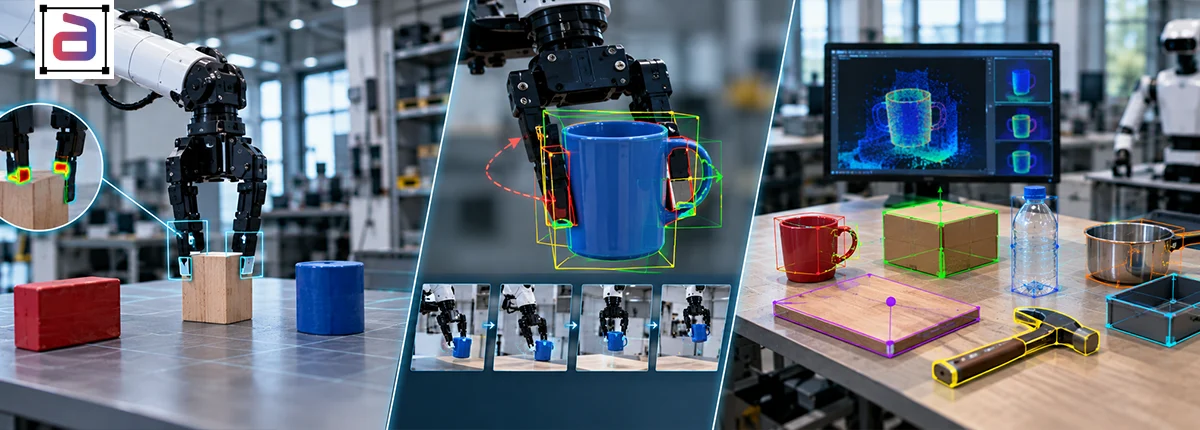
Contact is fundamental to physical interaction. When a robotic gripper touches an object, when a wheel meets the ground, or when an object collides with another surface, that interaction creates information about how the environment behaves. Contact annotation can capture:
- Robot-to-object contact points
- Object-to-object interactions
- Object-to-surface contact
- Contact timing and duration
- Interaction direction
- Collision events
- Successful and unsuccessful contact attempts
These labels provide valuable context for manipulation and control models. For example, identifying the precise moment when a gripper establishes contact with an object can help a model understand the relationship between the robot’s trajectory and the resulting physical response. Annotera’s robotics annotation workflows are designed to capture manipulation semantics, contact events, task progression, and outcomes rather than treating robotics footage as ordinary video data.
Grasp Annotation: Turning Visual Understanding into Physical Action
Grasping may appear simple to humans, but it is an intricate problem for robots. Humans instinctively adjust their grip based on an object’s size, weight, texture, shape, and intended use. Robots must learn these relationships from data. Grasp annotation can identify:
- Optimal grasp locations
- Gripper orientation
- Finger or end-effector placement
- Approach trajectories
- Grasp type
- Grip stability
- Successful and failed grasps
- Relevant force or interaction conditions
Importantly, annotation should account for task context. A robot carrying a fragile glass may require a different grasp from one moving a heavy tool. Similarly, the best grasp for lifting an object may not be the best grasp for rotating or placing it. This means robotics datasets need more than object labels. They need structured representations of how an object can be manipulated and why a particular interaction succeeds or fails.
Object Affordances: Teaching Robots What Objects Allow Them to Do
One of the most powerful concepts in embodied intelligence is the idea of object affordance. An affordance describes an action that an object or surface makes possible. A handle affords pulling. A button affords pressing. A container affords holding. A chair affords sitting. A door affords opening and closing. For robots, learning these relationships can dramatically improve generalization. Instead of memorizing that a particular object belongs to a particular category, a model can learn that certain visual and physical properties indicate possible actions. Affordance annotation can therefore label:
- Graspable regions
- Pushable areas
- Pullable components
- Openable sections
- Movable parts
- Support surfaces
- Functional regions
- Interaction constraints
This approach moves robotics AI closer to genuine physical reasoning.
From Robot Demonstrations to Preference Learning
Physical interaction is rarely binary. Two robot trajectories may both complete a task, but one may be safer, smoother, faster, or more energy-efficient. This creates an important role for human feedback. With robot preference annotation, human evaluators can compare alternative robot behaviors and identify which trajectory better satisfies defined criteria such as safety, task success, efficiency, stability, and naturalness. For example, imagine two trajectories in which a robot places an object on a shelf. Both succeed, but one approaches too quickly and narrowly avoids a collision, while the other uses a smoother and safer path. A simple success/failure label treats these behaviors as equivalent. Preference annotation does not. This distinction is increasingly important for RLHF for Physical AI, where human judgments can become training signals for improving robotic policies.
“The goal isn’t simply to teach a robot what action works. It is to teach the robot which successful action is preferable.”
Annotera supports robot policy evaluation and preference workflows in which human evaluators compare behaviors according to task-specific criteria.
Why Annotation Quality Determines Physical AI Performance
A robotics model cannot reliably learn physical relationships from inconsistent or ambiguous labels. Consider a dataset where one annotator identifies the edge of a graspable region while another labels the entire object. Or where successful grasps are labeled without recording the approach direction. Such inconsistencies can introduce noise into the learning process.
Robotics-grade annotation therefore requires:
- Precision: Interaction points and spatial relationships must be accurately represented.
- Consistency: Similar situations should follow the same annotation rules.
- Context: Labels should account for the task and surrounding environment.
- Temporal accuracy: Actions, contacts, and outcomes need to be aligned across time.
- Quality assurance: Multi-stage review is essential for identifying difficult edge cases.
Annotera addresses these requirements through dedicated, domain-trained annotation teams and multi-layer quality processes. Its robotics services cover teleoperation episodes, egocentric video, manipulation and grasp semantics, multi-sensor data, simulation-to-real validation, and human preference ranking.
Scaling Physical AI with the Right Data Partner
Building these datasets internally can become a major operational challenge as robotics programs scale. Organizations must recruit and train annotators, develop taxonomies, establish quality-control systems, manage large volumes of sensor data, and maintain consistency across evolving model requirements. This is where data annotation outsourcing can provide a strategic advantage. Rather than treating annotation as a one-time labeling exercise, organizations can work with a specialized data annotation company that understands the requirements of robotics and Physical AI. Annotera brings more than 20 years of outsourcing experience and a dedicated workforce of 1,500+ trained annotation specialists. Its robotics workflows are built around the specific requirements of physical AI, including manipulation, grasp quality, object affordances, synchronized sensor streams, and preference evaluation.
Annotera: Building the Data Foundation for Physical AI
The next generation of robots will not be defined solely by better motors, sensors, or algorithms. Their capabilities will increasingly depend on the quality and diversity of the experiences used to train them. Contact annotation teaches robots where interaction occurs. Grasp annotation teaches them how objects can be manipulated. Affordance annotation teaches them what actions the environment enables. Preference annotation teaches them which behaviors are better. Together, these signals create a richer foundation for robots that can perceive, reason, act, and adapt in the physical world. At Annotera, we help robotics and AI teams turn complex real-world experiences into structured, high-quality training datasets designed for the demands of Physical AI.
“Better physical intelligence begins with better representations of physical experience.”
Build Smarter Robots with Annotera
Whether you are developing robotic manipulation systems, humanoid robots, warehouse automation, autonomous machines, or Physical AI foundation models, the quality of your training data can become a decisive competitive advantage. Partner with Annotera to build accurate, scalable, and robotics-ready datasets that teach AI systems not only to see the world—but to understand how to interact with it. Get in touch with Annotera today and start building the data foundation for your next generation of Physical AI.
A closely related read: Spatial Awareness: The Role of 3D Cuboid Video Annotation in Robotics.