Artificial intelligence is changing how healthcare organizations analyze clinical information, and video is emerging as an increasingly valuable source of data. From operating rooms to patient-care environments, video can provide continuous visual information about procedures, movements, interactions, and clinical workflows. But raw video is not inherently useful to an AI model. A system needs structured examples that explain what is happening, where it is happening, and when it occurs. This is where high-quality video annotation becomes critical. For healthcare AI developers, accurately labeled video can support surgical workflow recognition, instrument tracking, patient monitoring, fall detection, rehabilitation analysis, and other computer vision applications. As these use cases become more sophisticated, working with an experienced video annotation company can help organizations build reliable datasets at scale.
Key Points
- Healthcare Video Annotation Enables Smarter Medical AI – Structured video labels help AI understand clinical activities, movements, objects, and events across time.
- Surgical Workflow Recognition Improves AI Understanding – Annotated surgical videos support phase recognition, instrument tracking, and surgical action recognition.
- Patient Monitoring Supports Safer Care – Video annotation enables AI models to identify falls, patient movements, posture changes, mobility patterns, and rehabilitation activities.
- Quality Annotation Drives Reliable Healthcare AI – Data annotation outsourcing with an experienced video annotation company like Annotera helps organizations build accurate, scalable, and consistent healthcare AI datasets.
Why Video Annotation Is Important for Healthcare AI
Healthcare environments are highly dynamic. A single video sequence may include multiple clinicians, patients, instruments, medical devices, anatomical structures, and actions occurring simultaneously. For an AI model, recognizing an object in one frame is often only the beginning. The model may need to understand how that object moves, how an action develops over time, and how one event relates to another. Video annotation transforms these visual sequences into structured training data using techniques such as:
- Bounding box annotation
- Polygon and semantic segmentation
- Object tracking
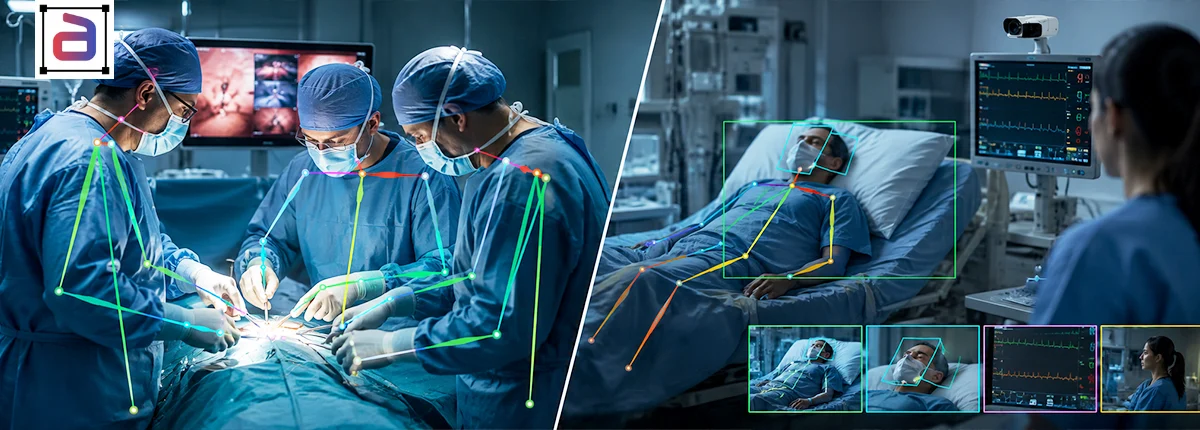
- Keypoint and pose annotation
- Action recognition
- Temporal event annotation
- Surgical phase labeling
- Object and activity classification
The result is a dataset that gives machine learning models the contextual information needed to interpret complex healthcare video.
“AI holds great promise for improving the delivery of healthcare and medicine worldwide, but only if ethics and human rights are put at the heart of its design, deployment, and use.” — World Health Organization
Surgical Workflow Recognition: Understanding Procedures Through Video
Surgical workflow recognition is one of the most promising applications of annotated healthcare video. AI systems can be trained to identify procedural phases, recognize instruments, detect surgical activities, and analyze how procedures progress over time. Research into surgical process modeling highlights the importance of spatial and temporal sequences for recognizing surgical phases. Recent reviews also identify neural networks and transformer-based architectures as important approaches for surgical workflow analysis.
1. Surgical Phase Annotation
A surgical procedure can be divided into meaningful phases, such as preparation, incision, dissection, intervention, suturing, and closure. Annotators can assign temporal labels to these phases across the video timeline. This allows an AI model to learn the sequence and duration of different procedural stages. Accurate temporal labeling is particularly important because the same instrument or movement may have different meanings depending on where it occurs within the procedure.
2. Surgical Instrument Detection and Tracking
Operating rooms contain a wide range of surgical instruments, many of which can move rapidly, overlap with other objects, or temporarily disappear from view. Bounding boxes, segmentation masks, and object tracking can help create datasets for models designed to identify and follow instruments throughout a procedure. These datasets can support applications such as instrument recognition, workflow analysis, surgical education, and intraoperative decision-support research.
3. Surgical Action Recognition
Healthcare AI must move beyond simply recognizing objects. It increasingly needs to understand actions. Video annotation can label activities such as grasping, cutting, suturing, cauterizing, dissecting, or manipulating tissue. Temporal annotations help models learn the beginning, progression, and completion of these actions. This distinction is crucial because healthcare video is inherently sequential: the meaning of an event often depends on what happened immediately before and what happens next.
Patient Monitoring: From Movement Detection to Risk Identification
Video annotation also has important applications outside the operating room. Patient-monitoring systems can use computer vision to recognize movement, posture, mobility patterns, and potentially significant events. Annotated datasets can help train models to identify:
- Standing, sitting, and lying positions
- Walking and mobility patterns
- Bed exits
- Falls and near-falls
- Changes in posture
- Repetitive movements
- Patient-device interactions
- Rehabilitation exercises
The objective is not necessarily to replace clinical staff. Instead, AI can potentially provide continuous monitoring and generate alerts when predefined patterns require attention.
Fall Detection
Fall detection is a particularly relevant computer vision use case. A model must differentiate between routine activities—such as bending down or sitting—and potentially dangerous falls. Video annotation can capture body position, motion trajectories, environmental context, and temporal relationships. Keypoint and pose annotation can further help models learn human movement patterns. High-quality training examples are essential because false positives can create unnecessary alerts, while missed events can reduce the usefulness of the monitoring system.
Rehabilitation and Mobility Analysis
Annotated video can also support AI-assisted rehabilitation. Models can learn to recognize exercises, track body keypoints, and analyze movement sequences. For example, pose annotations can identify the positions of joints across frames, while temporal labels can indicate the start and end of an exercise. Such datasets can support research into automated movement assessment and personalized rehabilitation technologies.
The Role of Data Annotation Outsourcing in Healthcare AI
Building large healthcare video datasets internally can be expensive and operationally demanding. Organizations need trained annotators, annotation guidelines, quality assurance systems, secure infrastructure, and project management capabilities. This is where data annotation outsourcing can provide a strategic advantage. Rather than building a large annotation operation from scratch, healthcare technology companies can work with an experienced data annotation company that has established annotation workflows and scalable resources. However, healthcare data requires additional considerations. Privacy, confidentiality, controlled access, secure data handling, and appropriate governance must remain central throughout the annotation lifecycle. The World Health Organization emphasizes that privacy and confidentiality should be protected in healthcare AI and that human oversight must remain part of responsible AI development.
Why Quality Matters More Than Annotation Volume
Healthcare AI cannot simply be trained on large quantities of poorly labeled video and expected to perform reliably. Inconsistent temporal boundaries, incorrect instrument labels, missed actions, ambiguous classifications, and inconsistent annotation guidelines can introduce noise into training datasets. A strong annotation workflow should therefore include: Clear annotation guidelines: Define every class, event, boundary, and edge case before production begins. Multi-level quality assurance: Use independent reviews, automated checks, and expert validation where appropriate. Temporal consistency: Ensure that actions and procedural phases are labeled consistently across the video timeline. Edge-case coverage: Include variations such as occlusion, unusual movements, lighting differences, and uncommon procedural events. Secure data workflows: Healthcare video should be managed using appropriate privacy and security controls. A systematic review of surgical video AI also highlights a continuing challenge: annotation practices vary considerably across studies, while large, clinically informed annotated datasets remain difficult to establish.
Why Choose Annotera for Video Annotation?
Annotera provides scalable data annotation solutions designed to help organizations convert complex visual information into AI-ready training datasets. As an experienced video annotation company, Annotera can support annotation requirements involving object detection, tracking, segmentation, action recognition, keypoints, pose estimation, and temporal event labeling. For healthcare AI developers, this means datasets can be structured around the specific requirements of surgical workflow recognition, patient monitoring, rehabilitation, and other video-based applications. Annotera combines human annotation expertise with systematic quality-control processes to help organizations improve dataset consistency while scaling production. For organizations considering video annotation outsourcing, the right partner can reduce operational complexity while allowing internal AI teams to concentrate on model development, validation, and clinical application.
The Future of Healthcare AI Is Context-Aware
Healthcare video AI is moving toward systems that can understand not only individual objects but complete sequences of clinical activity. Surgical workflow recognition can help AI systems understand procedural progression. Patient monitoring can help models interpret movement and behavior over time. Rehabilitation applications can analyze complex motion sequences. Across these use cases, one principle remains consistent: better AI starts with better data. As healthcare organizations explore increasingly sophisticated computer vision applications, high-quality annotation will remain a foundational component of responsible AI development.
“AI should be a tool to strengthen public health, not an end in itself.” — PAHO/WHO
Build Better Healthcare AI With Annotera
Developing healthcare AI requires more than collecting video—it requires transforming video into accurate, structured, context-rich training data. Whether you are developing surgical workflow recognition, patient monitoring, fall detection, rehabilitation, or another healthcare computer vision application, Annotera can help you build the annotation pipeline your AI initiative needs. Partner with Annotera for scalable, high-quality video annotation and accelerate your journey toward reliable healthcare AI.
A closely related read: Why Contextual Text Annotation Matters in Healthcare NLP Systems.