
In July 2026, Google published its AI & Economy ATLAS study, a sweeping analysis of 15 million Gemini interactions across 150 countries. The headlines wrote themselves: AI touches 88% of US employment, people use it for a fifth of their tasks, automation is rarer than the hype suggests. Presenting the findings to Axios, Google economist Scott Strand described adoption as very, very broad across occupations, yet “very shallow” within them, with the average worker applying AI to only 21% of their tasks.
But the most useful part of the study isn’t in the headlines or the interviews. It’s in Appendix B of the full paper, which in research papers is traditionally where the interesting confessions get buried. There, Google documents something the industry keeps trying to wish away: when the company with the most compute, the most data, and one of the most capable models on Earth needed to know whether its AI classifications could be trusted, it hired humans to check.
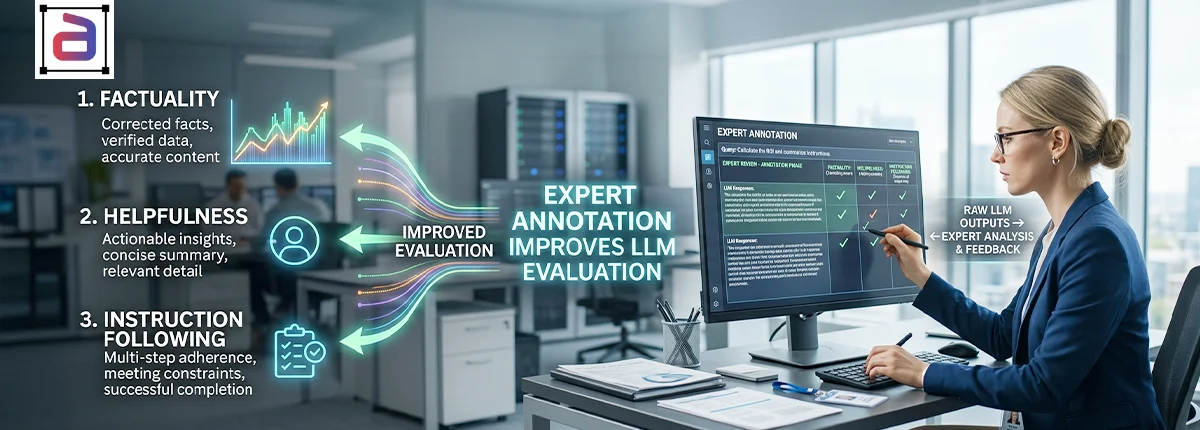
Human evaluation of AI models is not a transitional phase that better models will make obsolete. It is how serious AI teams operate. Google just showed its work, and at Annotera, where grading and teaching AI models is the entire job, we think that appendix deserves a wider audience.
What Is Human Evaluation of AI Models?
Human evaluation of AI models is the practice of using trained people to measure, verify, and correct AI outputs. It includes building ground-truth datasets, scoring model responses against defined criteria, measuring agreement between human raters and the model, and approving or rejecting AI-generated labels. Automated benchmarks tell you how a model performs on a test it may have memorized. Human evaluation tells you whether its output is actually right, and that distinction is worth real money once AI decisions touch customers, patients, or regulators.
What Google Actually Did Behind the Curtain
To build ATLAS, Google’s AI had to read millions of conversation summaries and classify each one into official government taxonomies: over 1,000 occupation titles, nearly 19,000 job tasks, and 456 daily activity codes. Then came the question every AI team eventually faces. How do we know the model got it right? Google’s answer used three separate layers of validation, and every layer needed humans.
- A synthetic ground-truth exam. Google generated more than 18,800 synthetic conversations seeded with known correct answers, deliberately injecting messy fragments, typos, and rambling requests to mimic real users. Then it ran them through the pipeline and measured recovery of the truth.
- Inter-rater agreement. Three trained human annotators independently classified samples of real conversation clusters. Google measured how often the AI agreed with the human consensus, using the same statistical tools (Cohen’s kappa, Fleiss’ kappa) that survey researchers have used for fifty years. The model reached agreement levels of 0.83 to 0.85 against the human majority, and adding the AI as a fourth rater either improved group agreement or left it unchanged.
- Human approval of AI labels. Annotators reviewed the AI’s assigned labels and judged whether each was reasonable. Approval ran from 96 to 98% at broad category levels down to 86% at the most granular task level.
Notice the pattern. Even the synthetic exam, the most automated layer, only exists because humans defined the taxonomies, validated the generated data, and interpreted the errors. Google’s own paper puts the philosophy in five words: “What is understood can be managed.”
The Accuracy Cliff Every AI Buyer Should Know About
Here’s the number that should be pinned above every AI procurement desk. Google’s classifier scored 93.7% on the simple question (is this conversation about work or not?) and 71.6% on sorting into 23 broad occupation groups. Respectable. But at the level of 1,016 specific occupation titles, accuracy fell to 42.5%. At the level of 18,797 individual job tasks, it fell to 22.6%.
That is the accuracy cliff, and it appears in almost every AI deployment we support. Models handle broad categories impressively and stumble as decisions get granular, which is inconvenient, because granular decisions are usually the valuable ones. Nobody pays a premium for an AI that knows a document is “medical.” They pay for one that knows which diagnosis code applies, and the only way to know where your model sits on that cliff is systematic human evaluation with expert-built ground truth.
To Google’s credit, the paper is candid about this, and the researchers adjusted their analysis to lean on the aggregation levels their validation supported. That is exactly the right move. It is also a move you can only make if you measured in the first place.
Humans Disagree Too. That’s Where Annotation Craft Comes In.
The skeptic’s reply is that humans are hardly perfect graders, and the ATLAS paper agrees. It cites labor research showing that 42% of workers disagreed with their own employers about their detailed occupation classification. If a person and their boss can’t agree on what the person does for a living, perfect labels don’t exist.
But this argument favors more human evaluation discipline, not less. Managing disagreement is a craft with known tools: multiple independent raters, calibration sessions that align graders on the rubric, gold-standard test items hidden inside real workloads, and consensus rules for contested cases. Google used three raters, capped review time to avoid overthinking, and reported agreement statistics openly. That is annotation methodology, practiced daily by teams like ours at Annotera, where multi-rater workflows and domain-expert review are how training and evaluation data earns its accuracy targets in the first place.
The craft compounds with complexity. ATLAS spans 140 languages, and a rater grading a Spanish or Arabic conversation against an English taxonomy needs more than a guideline PDF; it takes native-speaker judgment of the kind our multilingual data annotation teams apply across dozens of languages. The stakes climb with the domain too: an evaluation program for medical AI needs clinically trained reviewers, not gig workers with a checklist.
What This Means If You’re Building or Buying AI
Three lessons travel directly from Google’s appendix to your AI roadmap.
- Validate at the granularity you’ll operate at. A model that’s 90% accurate on categories can be 25% accurate on specifics. Test the decision you’ll actually ship.
- Don’t let synthetic data grade itself. Google generated synthetic test data with the same model family it was testing, then openly flagged the biases that creates. Synthetic data is a useful supplement and a dangerous substitute; human-validated ground truth is the anchor.
- Treat “LLM as judge” as a hypothesis, not a verdict. Using AI to evaluate AI scales beautifully and drifts silently. Google earned confidence in its automated judge by benchmarking it against human raters first. Do the same before you trust yours. This is precisely the work our LLM and GenAI annotation services exist for: RLHF preference data, supervised fine-tuning datasets, red teaming, and human evaluation benchmarks that tell you whether your automated judge deserves the gavel.
The AI industry loves to talk about removing humans from the loop. Meanwhile, the company at the center of the industry quietly staffed the loop with annotators, published the agreement statistics, and adjusted its claims to match what the humans could verify. That’s not a limitation of Google’s AI. That’s what rigor looks like.
Models will keep getting better. The need to know how much better, on your tasks, in your domain, will not go away. Someone has to grade the homework. We teach AI models for a living, and we can tell you: the best students are the ones whose work gets checked.