The way we interact with food is changing rapidly. Consumers can now identify meals, count calories, track nutrition, and even receive personalized dietary recommendations simply by snapping a photo. Meanwhile, restaurants are leveraging AI to automate order verification, monitor food quality, reduce waste, and streamline operations. At the center of these innovations lies a powerful technology: image classification. Yet even the most sophisticated Food AI systems are only as good as the data used to train them.
Behind every accurate nutrition app and automated restaurant workflow are thousands—often millions—of expertly annotated images that teach AI models how to recognize food items, ingredients, packaging, and presentation styles. At Annotera, we help organizations build high-performing computer vision systems through high-quality data annotation services that transform raw images into AI-ready datasets. As Food AI continues to evolve, training data has become the competitive advantage separating successful AI deployments from underperforming models.
Key Points
- Food AI models require datasets that cover diverse cuisines, preparation methods, lighting conditions, and plating styles to generalize in production.
- Nutrition apps depend on precise classification labels — a mislabeled ingredient can produce incorrect calorie or allergen information for end users.
- Restaurant automation systems need annotation that distinguishes similar-looking dishes and detects quality defects invisible to standard classifiers.
- Building a robust food classification dataset requires culturally diverse annotators who can correctly identify dishes from cuisines they know firsthand.
Table of Contents
The Rise of AI in the Food Industry
Artificial intelligence is no longer a futuristic concept for the food sector. It is becoming a business necessity. The food industry is rapidly embracing AI to improve efficiency, accuracy, and customer experiences. As a result, businesses are leveraging computer vision and automation technologies. Moreover, AI-powered solutions are helping organizations optimize operations, reduce waste, and make data-driven decisions at scale. From nutrition tracking platforms and food delivery apps to smart kitchens and automated drive-thrus, AI is enabling organizations to make faster, more accurate decisions.
“AI is the new electricity.” — Andrew Ng
Just as electricity transformed every industry in the 20th century, AI is reshaping how food businesses operate in the 21st century. Market analysts predict significant growth in AI adoption across food and beverage operations as organizations seek to improve customer experiences, optimize resources, and increase operational efficiency. Computer vision, particularly image classification, is emerging as one of the most impactful technologies driving this transformation.
What Is Image Classification in Food AI?
Image classification is a computer vision technique that enables AI models to identify and categorize visual content within an image. Image classification in Food AI enables machines to identify and categorize food items from images. For example, nutrition apps can recognize meals automatically. Consequently, businesses gain faster insights, while users receive accurate nutritional information and enhanced digital experiences. For Food AI applications, image classification systems can recognize:
- Individual ingredients
- Fruits and vegetables
- Packaged food products
- Restaurant menu items
- Prepared meals
- Beverages
- Food categories and cuisines
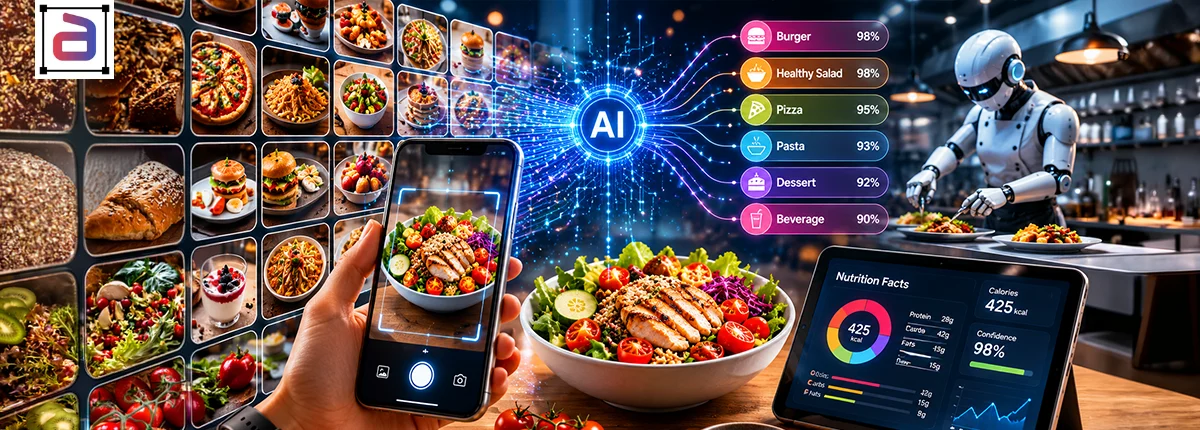
When a user uploads an image of a meal into a nutrition application, the AI model analyzes visual characteristics such as color, shape, texture, and composition to determine what food appears in the image. The challenge is that food is highly variable. The same dish can look dramatically different depending on preparation style, ingredients, lighting conditions, and presentation. This is why robust training data is essential.
Why Training Data Is the Foundation of Food AI
Artificial intelligence learns through examples. To accurately recognize food items in real-world environments, models require large volumes of annotated images representing diverse scenarios. Training data serves as the backbone of Food AI because models learn through labeled examples. Without high-quality datasets, accuracy declines. Therefore, comprehensive and well-annotated training data is essential for reliable food recognition, classification, and decision-making in real-world applications. High-quality Food AI datasets typically include:
- Multiple cuisines and food categories
- Different serving sizes
- Various camera angles
- Diverse lighting conditions
- Regional food variations
- Ingredient-level annotations
- Restaurant-specific menu items
Without comprehensive training data, AI models struggle to generalize beyond controlled environments.
“The best minds of my generation are thinking about how to make computers see.” — Fei-Fei Li
For Food AI, helping computers “see” requires carefully labeled datasets that reflect the complexity of real-world food imagery. This is where an experienced image annotation company becomes indispensable.
How Image Classification Powers Nutrition Apps
Nutrition applications have become one of the most visible uses of Food AI. Modern consumers increasingly expect instant access to nutritional information. Rather than manually searching food databases, users can simply photograph their meals and receive calorie estimates, ingredient breakdowns, and dietary insights. Image classification enables nutrition apps to identify food items from images and estimate nutritional values. As a result, users can track meals more efficiently. Furthermore, AI-driven recognition improves accuracy, delivering faster and more personalized dietary insights. However, achieving this level of accuracy is incredibly challenging. A single image may contain:
- Multiple food items
- Mixed ingredients
- Overlapping objects
- Varying portion sizes
- Diverse presentation styles
To train AI systems effectively, annotation specialists label ingredients, food categories, meal components, and portion boundaries. The resulting datasets enable machine learning models to make increasingly accurate predictions. Organizations developing nutrition platforms frequently partner with a specialized image annotation company to ensure the consistency and quality required for production-grade AI systems.
Transforming Restaurant Operations Through Computer Vision
Food AI extends far beyond consumer-facing applications. Computer vision is transforming restaurant operations by automating order verification, quality control, and inventory management. Consequently, businesses can reduce errors and improve efficiency. Moreover, AI-powered systems help streamline workflows while enhancing customer satisfaction and operational consistency. Restaurants are increasingly deploying image classification technologies to improve operational efficiency and customer satisfaction.
Automated Order Verification
Computer vision systems can compare prepared meals against customer orders, reducing fulfillment errors and improving service quality.
Food Quality Monitoring
AI-powered quality control systems help restaurants maintain consistency by evaluating food appearance, portion sizes, and presentation standards.
Inventory Tracking
Image classification can identify ingredients and inventory levels in real time, helping businesses reduce waste and improve forecasting.
Self-Service Automation
Smart kiosks and AI-powered ordering systems streamline customer interactions while reducing labor-intensive processes. According to the United Nations Environment Programme (UNEP), approximately one-third of food produced globally is lost or wasted. AI-driven monitoring and inventory management solutions can play a significant role in addressing this challenge.
The Growing Demand for Data Annotation Outsourcing
Building Food AI datasets internally can quickly become resource-intensive. Organizations often require thousands of accurately labeled images delivered within tight development timelines. As AI adoption accelerates, the demand for data annotation outsourcing continues to grow. Consequently, organizations can scale dataset creation more efficiently. Furthermore, outsourcing provides access to skilled annotators, ensuring high-quality training data while reducing operational complexity and costs. As a result, many businesses are turning to data annotation outsourcing to accelerate AI development while maintaining quality standards. Key benefits include:
- Faster dataset creation
- Scalable annotation capacity
- Consistent labeling methodologies
- Reduced operational burden
- Access to domain-specific expertise
By leveraging data annotation outsourcing, organizations can focus on model development and innovation while ensuring their training datasets meet rigorous quality requirements.
Why Image Annotation Outsourcing Matters for Food AI
Food datasets require more than basic object recognition. Annotation teams must understand ingredient distinctions, regional cuisines, packaging variations, and restaurant-specific requirements. Image annotation outsourcing provides access to trained specialists who can deliver:
- Image classification annotation
- Bounding box annotation
- Semantic segmentation
- Polygon annotation
- Ingredient-level labeling
- Multi-class food categorization
The result is cleaner, more accurate training data that directly improves model performance. At Annotera, our teams combine domain expertise with scalable annotation workflows to help clients build computer vision systems that perform reliably in real-world environments.
Why Leading AI Teams Choose Annotera
Successful AI projects begin with exceptional data. Food AI requires precise and diverse image annotations to achieve reliable performance. Therefore, image annotation outsourcing helps organizations access specialized expertise and scalable resources. Moreover, it ensures consistent labeling quality, ultimately improving model accuracy and real-world effectiveness. As a trusted data annotation company, Annotera delivers high-quality annotation services that support the development of advanced Food AI solutions. Our expertise includes:
- Food image classification datasets
- Ingredient recognition annotation
- Nutrition app training data
- Restaurant automation datasets
- Semantic segmentation
- Quality assurance and validation
Whether organizations require large-scale image annotation outsourcing solutions, our teams ensure every dataset is accurate, consistent, and AI-ready. We understand that model performance starts long before training begins. It starts with the quality of the data itself.
Conclusion
The future of Food AI depends on the ability of machines to accurately understand visual information. From nutrition applications that simplify healthy living to restaurant automation systems that improve operational efficiency, image classification is becoming a foundational technology across the food ecosystem. However, algorithms alone cannot deliver results. Success depends on high-quality training data, precise annotations, and scalable data preparation processes. At Annotera, we help organizations unlock the full potential of Food AI through expertly annotated datasets that power smarter, more accurate computer vision models.
Ready to Build Better Food AI?
Whether you’re developing a nutrition tracking platform, an automated restaurant solution, or an advanced computer vision application, Annotera can help you create the high-quality training data your AI models need to succeed. Contact Annotera today to discover how our data annotation outsourcing and image annotation outsourcing services can accelerate your AI initiatives and deliver measurable business impact.A closely related read: Retail AI: How Product Image Annotation Drives Better Search and Recommendations.