Artificial intelligence has evolved from understanding static images to interpreting dynamic, real-world scenarios captured in video. Whether it’s autonomous vehicles navigating busy intersections, surveillance systems detecting suspicious activity, or robots identifying moving objects in warehouses, today’s AI models rely heavily on high-quality video datasets. Keyframe interpolation is an intelligent video annotation technique that labels only selected frames while automatically generating annotations for intermediate frames. Combined with human validation, it accelerates annotation workflows, reduces costs, and maintains the accuracy required for high-performance computer vision models. However, annotating video data remains one of the most resource-intensive stages of the AI lifecycle.
Every second of footage can contain dozens of frames requiring accurate labeling, making large-scale projects expensive and time-consuming. According to Grand View Research, the global data collection and labeling market was valued at USD 3.77 billion in 2024 and is expected to grow at a 26.6% CAGR through 2030, driven by the increasing demand for high-quality training data across computer vision and generative AI applications. As enterprises seek faster and more cost-effective ways to build AI, keyframe interpolation has emerged as one of the most efficient techniques in modern video annotation services. By intelligently combining automation with expert human review, organizations can dramatically reduce annotation costs without compromising dataset quality. At Annotera, we leverage keyframe interpolation alongside rigorous quality assurance to help enterprises scale video annotation projects faster while maintaining the precision required for production-ready AI.
Key Points
- Keyframe interpolation minimizes annotation effort by labeling only critical frames while automatically generating annotations for intermediate frames, significantly reducing project costs and turnaround times.
- Combining intelligent interpolation with human-in-the-loop quality assurance ensures high annotation accuracy, temporal consistency, and reliable training data for computer vision models.
- Research from Google shows that interpolation-assisted workflows can reduce manual bounding box creation by up to 60% and cut human annotation effort by nearly 50% without compromising quality.
- Partnering with an experienced data annotation company like Annotera enables businesses to scale video annotation services efficiently through advanced automation, expert validation, and flexible data annotation outsourcing solutions.
Why Video Annotation Becomes Expensive
Unlike image annotation, video annotation involves maintaining temporal consistency across hundreds or even thousands of consecutive frames. Consider this: A single minute of video recorded at 30 frames per second contains approximately 1,800 individual frames. Now multiply that by:
- Multiple object classes
- Bounding boxes or polygons
- Occlusion handling
- Object tracking
- Instance IDs
- Quality reviews
Suddenly, annotating even a relatively small dataset becomes a substantial investment. This challenge is particularly evident in industries such as:
- Autonomous Driving
- Intelligent Surveillance
- Robotics
- Retail Analytics
- Human Activity Recognition
- Healthcare Imaging
- Sports Analytics
Without workflow optimization, annotation costs often become one of the biggest barriers to scaling AI initiatives.
What Is Keyframe Interpolation?
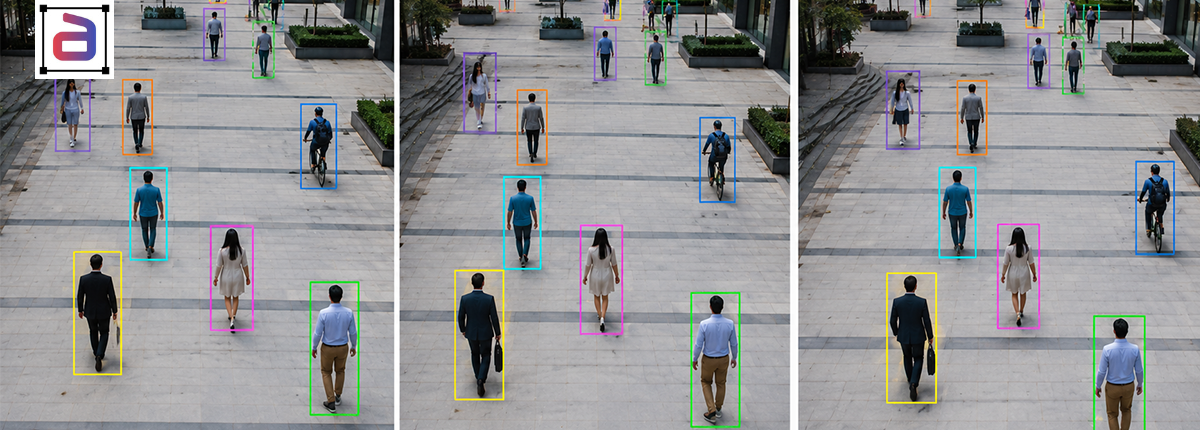
Keyframe interpolation is a semi-automated annotation workflow where human annotators manually label only selected frames—known as keyframes—while annotation software automatically predicts object positions in the intermediate frames. For example:
- Frame 1 → Vehicle labeled manually
- Frame 20 → Vehicle labeled again
- Frames 2–19 → Software interpolates the object’s movement automatically
Instead of manually drawing twenty bounding boxes, annotators only validate and refine the automatically generated annotations. The result is a workflow that dramatically reduces repetitive manual effort while preserving annotation accuracy. As the CVAT Academy explains:
“Interpolation significantly reduces annotation time since annotators don’t have to mark every frame manually.”
The real value, however, lies in combining this automation with expert human verification—a principle that drives every annotation workflow at Annotera.
How Keyframe Interpolation Reduces Annotation Costs
1. Eliminates Repetitive Labeling
Objects moving consistently across video frames do not require manual annotation in every frame. Instead, annotators focus only on moments where:
- Objects change direction
- Speed varies significantly
- New objects enter the scene
- Occlusions occur
- Objects disappear
Everything between those events is automatically generated. This significantly reduces repetitive work while improving productivity.
2. Enables Faster Dataset Creation
Large AI projects frequently involve thousands of hours of video. Manual frame-by-frame annotation can delay model development for months. Interpolation allows annotation teams to complete projects substantially faster by shifting human effort from drawing boxes to validating intelligently generated tracks. For organizations working under aggressive AI deployment timelines, this reduction in turnaround time can become a significant competitive advantage.
3. Optimizes Data Annotation Outsourcing Costs
Many enterprises choose data annotation outsourcing because building internal annotation teams is expensive and difficult to scale. By combining skilled annotators with interpolation-assisted workflows, an experienced data annotation company can:
- Reduce labor hours
- Improve annotation throughput
- Maintain quality consistency
- Scale projects rapidly
- Lower overall project costs
Rather than paying for repetitive manual work, organizations invest in quality-focused human expertise.
Accuracy Is Never Compromised
One of the biggest misconceptions surrounding interpolation is that it replaces human annotators. It doesn’t. Automation works exceptionally well for predictable object movement, but enterprise-grade datasets still require expert validation. At Annotera, every interpolated sequence undergoes rigorous quality checks to ensure:
- Precise bounding boxes
- Accurate polygons
- Temporal consistency
- Correct object identities
- Reliable tracking across frames
- Proper handling of occlusions and motion blur
This human-in-the-loop approach ensures datasets remain accurate enough for mission-critical AI applications. As renowned computer scientist Andrew Ng famously observed:
“AI is the new electricity.”
Just as electricity depends on reliable infrastructure, AI depends on reliable data. Even the most sophisticated models cannot compensate for inaccurate annotations.
Research Confirms the Benefits
Academic research continues to validate the effectiveness of intelligent interpolation. In Google’s research paper, “Efficient Video Annotation with Visual Interpolation and Frame Selection Guidance,” researchers demonstrated impressive productivity improvements:
- 60% fewer manually drawn bounding boxes
- 50% reduction in human annotation effort
- 10% faster annotation workflows while maintaining annotation quality
The research highlights an important industry trend: annotation is evolving from purely manual labor into intelligent human-guided automation. This is precisely the philosophy embraced by leading video annotation services today.
Industries Benefiting from Keyframe Interpolation
Keyframe interpolation delivers measurable value across multiple industries.
Autonomous Vehicles
Continuous vehicle, pedestrian, cyclist, and traffic sign tracking becomes significantly more efficient while maintaining temporal consistency.
Robotics
Warehouse robots and industrial automation systems require accurately tracked moving objects for navigation and manipulation tasks.
Security & Surveillance
People, vehicles, and suspicious activities can be tracked efficiently across extended surveillance footage.
Retail Analytics
Customer movement, shelf interaction, and shopping behavior can be analyzed more quickly using interpolated object tracking.
Sports Analytics
Athlete tracking, ball movement, and tactical analysis benefit from faster annotation without sacrificing precision.
Why Human Expertise Still Matters
Interpolation is powerful—but it isn’t perfect. Certain scenarios still require experienced annotators, including:
- Heavy occlusions
- Rapid camera movement
- Dense crowds
- Sudden object acceleration
- Object deformation
- Low-light environments
- Motion blur
Professional annotators know exactly when to introduce additional keyframes, correct tracking drift, and maintain annotation consistency throughout the video sequence. That combination of intelligent automation and human expertise is what distinguishes enterprise-quality datasets from average ones.
Why Enterprises Choose Annotera
At Annotera, we understand that successful AI projects require more than speed—they require trust. Our video annotation services combine advanced annotation platforms, keyframe interpolation, and multi-stage quality assurance to deliver datasets that meet the highest standards of accuracy and consistency. As a trusted data annotation company, we support organizations across autonomous driving, healthcare, robotics, retail, agriculture, manufacturing, and surveillance by providing scalable data annotation outsourcing solutions tailored to complex AI workflows. Every project benefits from:
- Human-in-the-loop quality assurance
- Experienced domain-specific annotators
- Temporal consistency validation
- Scalable production teams
- Enterprise-grade security and confidentiality
- Flexible engagement models
Our goal is simple: help organizations accelerate AI development while reducing annotation costs without compromising quality.
Final Thoughts
The future of video annotation isn’t about replacing humans with automation—it’s about empowering human expertise with intelligent tools. Keyframe interpolation has fundamentally transformed how enterprises build high-quality video datasets, reducing manual effort, accelerating project delivery, and improving operational efficiency. When implemented alongside rigorous human validation, it offers the best of both worlds: lower costs and uncompromising accuracy. For organizations looking to build scalable computer vision solutions, partnering with an experienced annotation provider can make all the difference. Ready to Scale Your Video Annotation Projects? Whether you’re developing autonomous vehicles, robotics, surveillance systems, or next-generation computer vision applications, Annotera delivers high-quality video annotation services designed for enterprise AI. Partner with Annotera today to reduce annotation costs, accelerate model development, and build AI systems powered by precise, production-ready datasets. Contact our experts today to discuss your video annotation requirements and discover how our scalable data annotation outsourcing solutions can support your next AI breakthrough.
To go deeper on this topic: Best Practices for Outsourcing Video Annotation Services for Large-Scale AI Projects.
A closely related read: Bounding box annotation guide.