A robot can detect a chair. It can identify a person. It can recognize a package sitting on a conveyor belt. But recognition alone does not create intelligence. For robots to operate reliably in warehouses, factories, homes, hospitals, and other dynamic environments, they must understand far more than the objects around them. They need to determine where an object is, how far away it is, how it is moving, what is behind it, what it is interacting with, and how the surrounding environment is changing. This is where multi-sensor annotation becomes essential. Modern intelligent robots increasingly combine RGB cameras, depth sensors, LiDAR, IMUs, radar, and force/torque sensors. Each modality provides a different piece of the perception puzzle. When these streams are accurately synchronized and annotated, they create richer datasets capable of teaching robots spatial relationships rather than simply object identities.
Key Points
- Beyond Object Detection: Multi-sensor annotation enables robots to understand not only what objects are present, but also their position, distance, orientation, movement, and spatial relationships.
- Power of Sensor Fusion: Combining RGB cameras, LiDAR, depth sensors, radar, IMUs, and other modalities creates richer, synchronized datasets for accurate 3D environmental understanding.
- Better Data for Physical AI: High-quality, spatially and temporally aligned physical AI training data helps robots improve navigation, manipulation, perception, and human-robot interaction.
- Annotera’s Robotics Expertise: Annotera provides specialized robotic data annotation services that transform complex multi-sensor data into reliable, structured training datasets for next-generation intelligent robots.
Why Object Detection Is Only the Starting Point
Object detection is one of the most established computer vision tasks. Bounding boxes and class labels can tell a robot that a person, pallet, vehicle, or tool exists. But imagine an autonomous warehouse robot approaching a pallet. Detection can answer: “There is a pallet ahead.” Spatial intelligence needs to answer:
- How far away is the pallet?
- What is its 3D position?
- What is its orientation?
- Which parts of it are obstructed?
- Is a worker standing nearby?
- Is the path around it clear?
- Is the pallet moving?
- Can the robot safely approach and manipulate it?
The difference is significant. Object detection identifies entities; spatial awareness establishes relationships between entities, the robot, and the environment. That distinction is becoming increasingly important as robotics moves from controlled demonstrations toward real-world deployment. For organizations developing embodied AI, this makes high-quality physical AI training data a strategic necessity.
“A robot must do more than recognize the world—it must understand its position within that world.”
What Multi-Sensor Annotation Actually Does
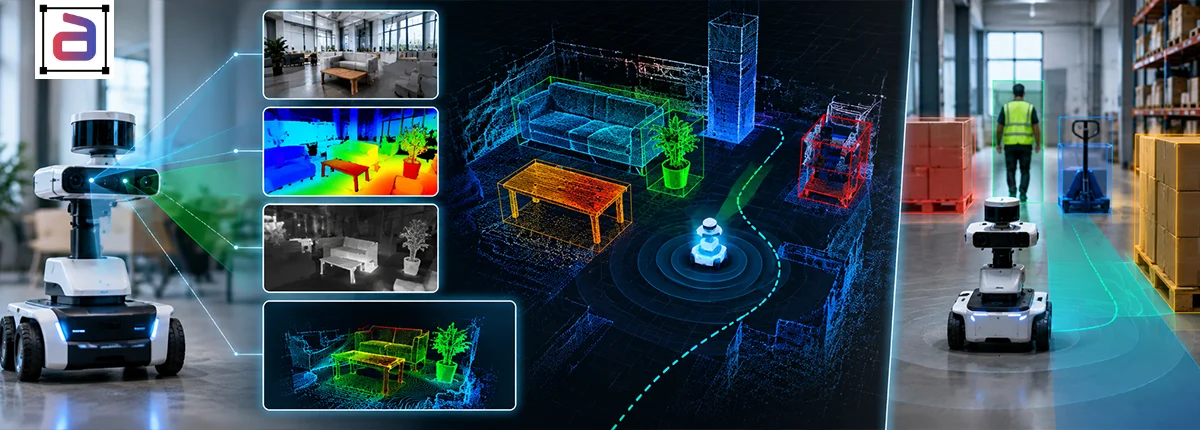
Multi-sensor annotation involves labeling information from multiple sensing modalities while preserving the spatial and temporal relationships between them. A single robotic system may generate:
- RGB camera frames for visual information
- Depth maps for distance and surface geometry
- LiDAR point clouds for 3D spatial representation
- IMU measurements for motion and orientation
- Radar observations for distance and movement
- Force/torque readings for physical interaction
Annotating each stream independently is not enough. The labels need to correspond to the same physical objects and events across modalities. Annotera’s multi-sensor fusion workflows are designed around this principle, supporting synchronized annotation across RGB, depth, LiDAR, IMU, and force/torque streams. This includes 3D bounding boxes, point-cloud segmentation, cross-sensor object correspondence, and event alignment. The goal is simple: transform disconnected sensor outputs into a coherent ground-truth representation of the physical environment.
Creating a 3D Understanding of the World
Robots operate in three-dimensional environments, so their training data must capture three-dimensional relationships. LiDAR annotation, for example, can identify objects and environmental structures within point clouds. 3D bounding boxes can represent an object’s location, dimensions, and orientation, while segmentation can distinguish navigable space, obstacles, floors, walls, and other environmental elements. When camera and LiDAR information are aligned, the robot can connect what an object looks like with where that object physically exists. Consider a cup on a table. A camera may tell the model: “This is a cup.” Depth and LiDAR can add: “The cup is approximately this far away, positioned at this location, with this orientation, and occupying this portion of the available space.” That additional information can become critical for robotic grasping, navigation, and manipulation.
Sensor Fusion Depends on Annotation Precision
Sensor fusion sounds straightforward in theory: combine multiple sensors to obtain a better understanding of the environment. In practice, however, the quality of the fused perception system depends heavily on synchronization and annotation consistency. A camera and LiDAR may observe the same object from different perspectives and at different frequencies. If their timestamps or spatial coordinates are misaligned, the resulting training data can introduce contradictory signals. Recent industry guidance similarly emphasizes that sensor-fusion annotation requires calibrated, time-synchronized labeling across modalities rather than treating each sensor stream as an isolated annotation task. This is why Annotera treats multi-sensor annotation as an integrated workflow rather than simply combining separate annotation projects.
“In sensor fusion, consistency is not a quality bonus—it is the foundation of the training signal.”
From Spatial Perception to Robotic Manipulation
Spatial awareness becomes even more important when robots must physically interact with objects. Consider a robotic arm tasked with picking up a bottle surrounded by other objects. The system needs to understand:
- The bottle’s exact position
- Its orientation
- Its depth relative to the gripper
- The available grasping surface
- Nearby obstacles
- Whether the bottle is moving
- Whether contact has occurred
RGB-D annotation can connect visual appearance with depth information, while 3D point-cloud labels can provide geometric context. Force and torque annotations can further associate physical contact with visual and motion events. This combination helps create training datasets that connect perception with action—a fundamental requirement for physical AI.
Temporal Information Adds Another Dimension
Spatial awareness is not static. A robot navigating a warehouse must understand that a worker who was standing five meters away moments ago may now be directly in its path. Similarly, a robotic arm must understand the sequence of events leading from object detection to approach, contact, grasp, and successful manipulation. Temporal annotation enables models to learn:
- Object trajectories
- Motion patterns
- Entry and exit events
- Object-state changes
- Contact events
- Human-robot interactions
- Task stages
When temporal information is synchronized with multiple sensor streams, models gain a richer understanding of what happened, where it happened, and when it happened.
Why Physical AI Needs Better Training Data
Physical AI systems face a considerably more complex learning environment than conventional software AI. Robots must contend with lighting changes, occlusions, sensor noise, unpredictable human movement, clutter, object variations, and constantly changing physical conditions. That means training datasets need to represent the complexity of the environments where robots will actually operate. Annotera’s approach to physical AI training data focuses on converting raw multimodal sensor streams into structured, high-quality datasets that support robotic perception, navigation, manipulation, and embodied intelligence. The objective is not simply to create more labels. It is to create labels that teach machines how the physical world works.
The Role of a Specialized Data Annotation Company
As robotic datasets become larger and more complex, building every annotation capability internally can become expensive and operationally demanding. This is where data annotation outsourcing can provide strategic value. Instead of maintaining large in-house teams for every modality, robotics organizations can work with a specialized data annotation company that already has processes for quality control, annotation consistency, workforce scaling, and complex multimodal workflows. However, robotics annotation requires specialized expertise. A provider must understand 3D geometry, sensor synchronization, object correspondence, temporal relationships, and robotics-specific labeling requirements. Annotera brings this specialization to robotic data annotation services, helping AI and robotics teams transform complex sensor data into reliable training datasets.
Building Spatially Intelligent Robots with Annotera
The future of robotics will not be defined by machines that merely recognize objects. It will be defined by machines that understand objects in context. They will need to perceive distance, geometry, motion, orientation, interaction, and environmental relationships—and use that information to make intelligent decisions. Multi-sensor annotation is a critical part of making that possible. At Annotera, we help robotics and AI organizations build the high-quality datasets required to move from basic perception toward sophisticated spatial intelligence. By aligning visual, geometric, temporal, and sensor-specific information, our robotic data annotation services help create training data designed for the realities of physical AI.
“Better spatial intelligence begins with better spatial ground truth.”
Ready to Build Smarter Robots?
Whether you’re developing autonomous mobile robots, robotic arms, humanoids, warehouse automation, or next-generation embodied AI systems, Annotera can help you turn complex sensor data into structured, model-ready training datasets. Partner with Annotera to build high-quality physical AI training data and give your robots the spatial intelligence they need to see, understand, and act in the real world. Talk to Annotera today and start building your next-generation robotics data pipeline.