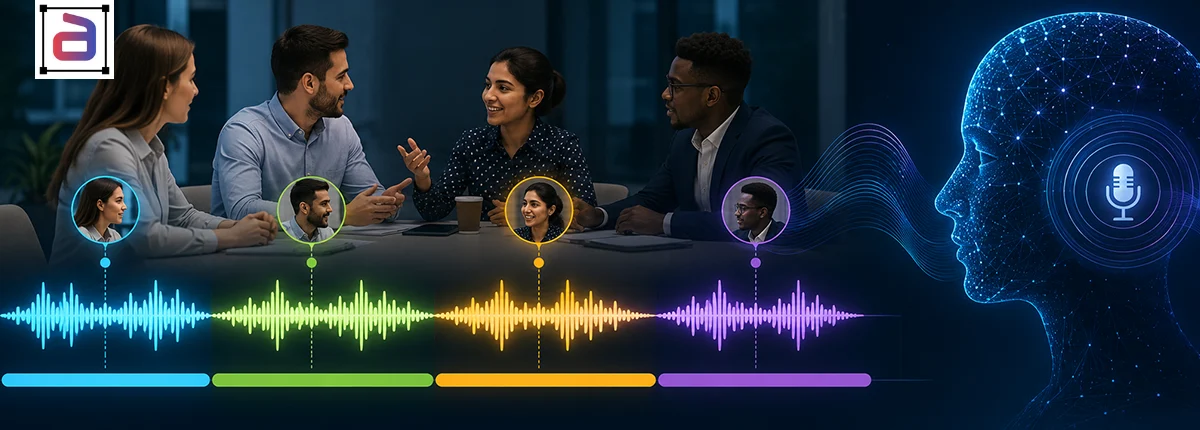
Artificial intelligence has become remarkably good at understanding what people say. The next frontier is enabling AI to understand who is speaking throughout a conversation. Whether it’s a customer support call, a virtual meeting, a legal deposition, or a healthcare consultation, identifying each speaker is critical for extracting meaningful insights.
This capability is known as speaker diarization—the technology that teaches AI to answer one simple yet powerful question: “Who spoke when?”
As enterprises increasingly rely on voice-driven applications, speaker diarization has become a cornerstone of conversational AI, automatic speech recognition (ASR), and voice analytics. However, achieving high accuracy requires much more than sophisticated algorithms. It depends on expertly labelled training data, human quality assurance, and scalable audio annotation services.
At Annotera, we empower AI companies with high-quality annotation solutions that enable speech AI systems to distinguish speakers accurately, improve transcription quality, and perform reliably in real-world environments.
Key Points
- Speaker diarization enables AI to identify “who spoke when,” improving the accuracy of speech transcription, conversational AI, and voice analytics across multi-speaker conversations.
- High-quality audio annotation services are essential for training speaker diarization models, helping AI accurately distinguish speakers, handle overlapping speech, and perform in real-world environments.
- As enterprises increasingly adopt speech AI, partnering with an experienced data annotation company through data annotation outsourcing ensures scalable, high-quality training data and faster AI development.
- Annotera combines expert human annotation, rigorous quality assurance, and multilingual speech transcription capabilities to deliver reliable datasets that power accurate, production-ready speech AI solutions.
Why Speaker Diarization Matters More Than Ever
Voice has rapidly become one of the most valuable sources of business intelligence.
According to Grand View Research, the global speech and voice recognition market surpassed USD 20 billion in 2024 and is expected to grow at a compound annual growth rate (CAGR) of over 14% through 2030. The expansion is driven by increasing adoption of conversational AI, virtual assistants, customer service automation, healthcare documentation, and enterprise voice analytics.
Meanwhile, McKinsey reports that generative AI is accelerating enterprise investment in speech-based applications, creating greater demand for high-quality annotated audio datasets that improve model performance.
Every day, businesses generate millions of hours of recorded conversations. Without accurately identifying who is speaking, valuable context is lost, reducing the effectiveness of analytics, compliance monitoring, sentiment analysis, and automated decision-making.
As Sundar Pichai, CEO of Google, famously said:
“Artificial intelligence is one of the most profound things we’re working on as humanity. It’s more profound than fire or electricity.”
Realising that potential begins with high-quality training data.
What Is Speaker Diarization?
Speaker diarization is the AI process of automatically dividing an audio recording into segments according to individual speakers.
Instead of producing a transcript like this:
Welcome everyone. Let’s begin today’s meeting. Thank you for having me. Let’s review last quarter’s performance.
Speaker diarization produces:
Speaker 1: Welcome everyone. Let’s begin today’s meeting.
Speaker 2: Thank you for having me.
Speaker 1: Let’s review last quarter’s performance.
The technology determines:
-
When each speaker begins talking
-
When they stop speaking
-
Which speech segments belong to the same person
-
How many speakers participated in the conversation
Unlike speaker identification, which determines who the speaker actually is, speaker diarization simply separates speakers consistently throughout the recording.
How Speaker Diarization Works
Modern diarization systems combine machine learning, deep learning, and advanced signal processing into a multi-stage pipeline.
1. Voice Activity Detection (VAD)
The first step identifies speech while removing silence, music, and background sounds.
2. Audio Segmentation
The recording is divided into smaller speech fragments based on pauses and voice activity.
3. Speaker Embedding Extraction
Deep neural networks analyse each speech segment and generate numerical representations known as speaker embeddings, capturing vocal characteristics such as pitch, tone, rhythm, and pronunciation.
4. Speaker Clustering
AI groups similar voice embeddings together, determining which segments belong to the same individual.
5. Timestamp Generation
Finally, timestamps and speaker labels are assigned, creating structured outputs that integrate seamlessly with speech transcription systems.
The result is an accurate transcript that not only captures spoken words but also attributes them to the correct speakers.
Why Audio Annotation Is the Foundation of Accurate Speaker Diarization
Even the most advanced AI models cannot distinguish speakers without high-quality labelled training data.
This is where professional audio annotation services become indispensable.
Expert annotators manually label:
-
Speaker boundaries
-
Speaker changes
-
Timestamp alignment
-
Overlapping speech
-
Interruptions
-
Background sounds
-
Emotional tone
-
Language and accent variations
These annotations become the ground truth that enables AI models to learn complex conversational patterns.
Without accurate annotations, diarization models struggle to perform consistently in real-world environments.
As computer vision pioneer Fei-Fei Li famously said:
“There is no AI without data.”
For speech AI, one could extend that thought further:
There is no reliable conversational AI without high-quality annotated audio.
Challenges That AI Alone Cannot Solve
Although deep learning has dramatically improved speaker diarization, real-world conversations remain highly unpredictable.
Common challenges include:
-
Multiple speakers talking simultaneously
-
Similar-sounding voices
-
Strong regional accents
-
Noisy environments
-
Poor recording quality
-
Remote meetings with varying microphone quality
-
Rapid speaker switching
These situations often confuse automated systems.
Human annotators provide contextual judgement that enables AI models to learn from difficult edge cases, resulting in significantly higher accuracy.
Industry Applications of Speaker Diarization
Speaker diarization powers a wide range of AI applications.
Customer Service
Businesses analyse customer-agent conversations to improve service quality, monitor compliance, and evaluate employee performance.
Healthcare
Medical AI systems distinguish between physicians and patients to generate accurate clinical documentation.
Legal Services
Law firms use diarization for depositions, witness interviews, and courtroom recordings where speaker attribution is essential.
Financial Services
Banks analyse customer interactions for fraud detection, regulatory compliance, and quality assurance.
Media & Entertainment
Podcast platforms automatically generate searchable transcripts with individual speaker labels, improving accessibility and content discovery.
Enterprise Collaboration
Meeting intelligence platforms summarise discussions, assign action items, and analyse participation by identifying each participant accurately.
Why Businesses Choose Data Annotation Outsourcing
Building speech datasets internally requires specialised expertise, infrastructure, and significant operational resources.
This is why many AI companies choose data annotation outsourcing.
Partnering with an experienced data annotation company offers several advantages:
-
Access to trained linguistic experts
-
Scalable multilingual annotation teams
-
Faster project turnaround
-
Consistent quality assurance
-
Lower operational costs
-
Secure enterprise workflows
-
Human-in-the-loop validation
Rather than investing in large in-house annotation teams, organisations can accelerate AI development while maintaining exceptional data quality.
Why Annotera Is the Trusted Partner for Speech AI
At Annotera, we understand that exceptional AI begins with exceptional data.
Our comprehensive audio annotation services help organisations build robust speech AI models capable of handling real-world conversations with confidence.
Our expertise includes:
-
Speaker diarization annotation
-
High-quality speech transcription
-
Timestamp annotation
-
Voice activity detection (VAD)
-
Emotion and sentiment annotation
-
Multilingual audio labelling
-
Quality assurance and validation
-
Custom annotation workflows for enterprise AI
Every annotation project undergoes rigorous quality checks, ensuring consistent, production-ready datasets that improve model accuracy and reduce deployment risks.
Whether you’re developing conversational AI, call analytics, voice assistants, or multilingual ASR systems, Annotera delivers annotation excellence at scale.
Conclusion
As conversational AI continues to reshape industries, speaker diarization has become a mission-critical capability for organisations seeking deeper insights from spoken interactions.
However, even the most sophisticated AI models are only as good as the data used to train them. Accurate speaker identification depends on expertly annotated datasets, rigorous quality assurance, and scalable annotation workflows.
By partnering with an experienced data annotation company like Annotera, businesses gain access to industry-leading audio annotation services, reliable speech transcription, and efficient data annotation outsourcing solutions that accelerate AI development while improving model performance.
From multilingual conversations to complex enterprise recordings, Annotera provides the human expertise that teaches AI not just what was said—but who said it and when.
Ready to Build More Accurate Speech AI?
Whether you’re developing automatic speech recognition, conversational AI, meeting intelligence platforms, or voice analytics solutions, Annotera provides the high-quality annotated datasets your models need to perform with confidence.
Partner with Annotera today to leverage industry-leading audio annotation, speaker diarization, and speech transcription services that improve AI accuracy, reduce time-to-market, and scale effortlessly with your business. Let’s build the next generation of intelligent speech AI—together.
To go deeper on this topic, read more about Audio & Speech Annotation.