
Enterprise LLMs are moving from experimentation to mission-critical applications. From intelligent customer support and document automation to enterprise search, coding assistants, and knowledge management, organizations are increasingly fine-tuning foundation models to perform specialized tasks. But there is a fundamental question that every enterprise AI team should ask before fine-tuning: Is the training data good enough? A powerful foundation model cannot compensate indefinitely for unreliable supervision. Supervised fine-tuning (SFT) teaches an LLM how to respond to specific instructions by exposing it to curated instruction-response examples. The quality of those examples directly affects the behaviors the model is encouraged to learn.
Recent research reinforces this data-centric perspective. A 2025 study published by the Association for Computational Linguistics described SFT as a critical step in aligning LLMs with human instructions and values, while emphasizing that dataset properties can materially influence alignment quality. For enterprises, the message is straightforward: better fine-tuning starts with better data.
Key Points
- High-quality SFT data drives better LLM performance by providing accurate, relevant, consistent, and diverse examples that reinforce desired enterprise behaviors.
- Data quality can matter more than data volume, as inaccurate, duplicated, contradictory, or irrelevant examples can introduce unreliable signals during fine-tuning.
- Strong quality assurance is essential through clear annotation guidelines, annotator training, domain review, consistency checks, and continuous dataset refinement.
- Annotera strengthens enterprise AI data pipelines with LLM & GenAI annotation services and RLHF & fine-tuning data designed to support specialized, reliable, and scalable LLM development.
What Is Supervised Fine-Tuning Data?
Supervised fine-tuning data consists of examples showing an LLM what an appropriate response looks like for a particular instruction or task. A typical enterprise example may contain:
- A user instruction or query
- Relevant business context
- An expected answer
- Required tone, structure, or formatting
- Domain-specific terminology
- Safety, escalation, or compliance requirements
Consider an enterprise customer-service assistant. Training examples might demonstrate how the model should respond to billing questions, troubleshoot products, identify requests requiring human intervention, or decline requests involving restricted information. The objective is not simply to produce thousands of examples. It is to create high-value demonstrations that accurately represent the behaviors the enterprise expects from its model.
Why Data Quality Can Matter More Than Data Quantity
More training data does not automatically mean better model performance. Research on instruction tuning has repeatedly examined data quality, diversity, complexity, and accuracy as important factors in selecting useful training examples. One study explicitly states that “Instruction data quality is pivotal for Large Language Model performance.” Poor-quality SFT data can introduce:
- Incorrect factual information
- Contradictory instructions
- Inconsistent response styles
- Irrelevant examples
- Duplicate or low-value samples
- Inadequate representation of edge cases
- Incorrect domain terminology
When these patterns enter a training dataset, they can create conflicting signals for the model. That is why enterprise AI teams should view fine-tuning datasets as engineered assets—not simply collections of text.
Five Characteristics of High-Quality SFT Data
1. Accuracy
Every response should reflect the expected truth, policy, or business logic. For domain-specific applications, this may require review by subject-matter experts. A customer-service model trained on outdated product information, for example, can reproduce that information even when the underlying foundation model possesses broader knowledge.
2. Consistency
Similar instructions should receive responses that follow consistent principles. Annotation guidelines should define how annotators handle ambiguity, exceptions, sensitive requests, formatting requirements, and escalation scenarios. Consistency reduces contradictory supervision.
3. Relevance
Every example should support the intended model behavior. A dataset designed for financial document analysis should contain examples that represent actual financial workflows rather than unrelated conversational patterns. Relevance ensures that training effort is concentrated on the behaviors that matter.
4. Diversity
Enterprise users rarely communicate in identical ways. High-quality datasets should account for different phrasings, user intents, document formats, complexity levels, terminology, and edge cases. Research on instruction-data selection has identified diversity, complexity, and accuracy as useful dimensions for identifying valuable training examples.
5. Clear Instruction-Response Alignment
An instruction and its expected response should have a logical relationship. The model needs to understand not only the subject of a task but also the expected way of completing it. This is particularly important when enterprises require structured outputs, specific reasoning patterns, controlled language, or defined workflows.
What Happens When SFT Data Quality Breaks Down?
The consequences can appear in subtle ways. An LLM may answer one version of a question correctly but respond inconsistently when the wording changes. It may follow an outdated business rule, misunderstand an unusual request, or produce an answer that sounds convincing but does not follow the organization’s intended process. Recent 2026 ACL research identified a phenomenon in which fine-tuned models can fail to correctly reproduce portions of their own supervised training data. The researchers identified factors including “internal inconsistencies within SFT data” and insufficient optimization for rare or complex patterns among the causes studied. This highlights an important point: even when aggregate evaluation metrics look healthy, specific subsets of training examples may remain problematic. For enterprise deployments, those difficult subsets can matter disproportionately.
Quality Assurance Must Be Built Into the Data Pipeline
High-quality SFT data does not happen by accident. A robust enterprise annotation workflow should combine:
- Detailed annotation guidelines
- Annotator training and calibration
- Domain-specific review
- Multi-stage quality assurance
- Inter-annotator agreement checks
- Duplicate and inconsistency detection
- Edge-case analysis
- Continuous dataset refinement
Automated validation can identify formatting errors, duplicates, and obvious inconsistencies. Human review remains essential for nuanced instructions, specialized terminology, subjective judgments, and business-critical workflows. The goal is to create a dataset in which every example earns its place.
Connecting SFT With RLHF & Fine-Tuning Data
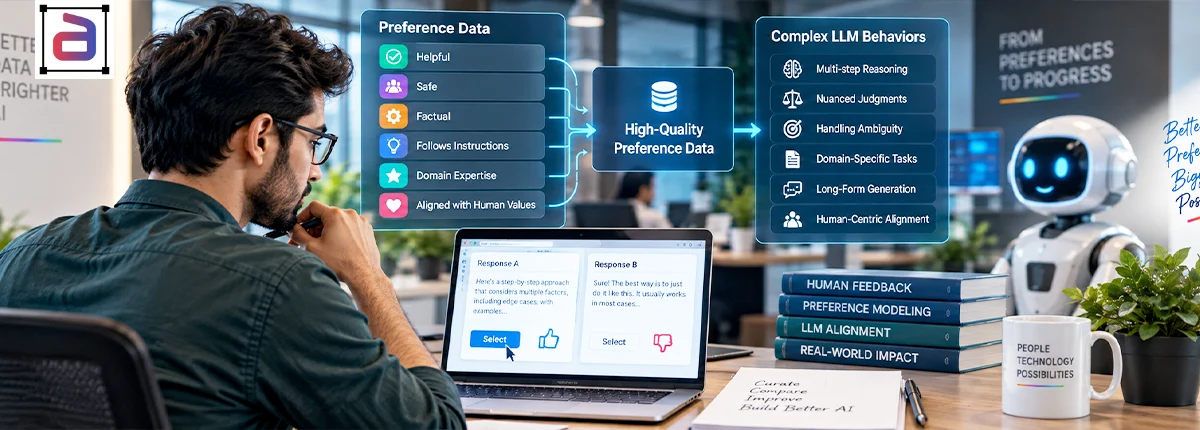
SFT is often one component of a broader post-training strategy. Once a model has learned desired instruction-following patterns through supervised examples, organizations may use preference-based methods to further optimize responses. This is where RLHF & fine-tuning data becomes particularly relevant. Preference datasets can help distinguish between multiple possible responses according to criteria such as helpfulness, relevance, safety, completeness, or enterprise-specific preferences. However, downstream alignment should not be viewed as a substitute for sound supervised data. If foundational examples contain conflicting or unreliable signals, subsequent optimization has a more difficult starting point.
How Annotera Helps Build Better LLM Training Data
At Annotera, we understand that enterprise AI performance is ultimately connected to the quality of the data behind the model. Our LLM & GenAI annotation services are designed to support organizations developing specialized training and evaluation datasets for generative AI applications. From instruction-response datasets and conversational data to classification, preference, and domain-specific annotation, Annotera can help enterprises establish structured workflows around their AI data requirements. Our approach emphasizes clear annotation frameworks, quality control, consistency, and human expertise—key ingredients for building training data that can support demanding enterprise use cases. Because when the objective is a reliable AI system, the dataset should be treated with the same rigor as the model.
Build the Data Foundation for Better Enterprise AI
Enterprise LLM development is no longer simply a race to use larger models. Organizations increasingly need models that understand their terminology, follow their workflows, respond consistently, and operate within defined business requirements. Supervised fine-tuning provides a powerful mechanism for achieving that specialization—but its effectiveness depends heavily on the quality of the supervision. Accurate. Relevant. Consistent. Diverse. Well-reviewed. These are not merely annotation requirements. They are foundations for dependable enterprise AI. With Annotera’s LLM & GenAI annotation services and expertise in RLHF & fine-tuning data, organizations can build structured, quality-focused datasets designed around their unique AI objectives. Ready to strengthen the data behind your enterprise LLM? Partner with Annotera to build high-quality, domain-specific training data that helps your AI models learn the behaviors your business actually needs. Contact Annotera today to discuss your LLM data requirements.
A closely related read: Why RLHF Needs High-Quality Human Annotation.