Key Points
- Temporal continuity in bounding box annotation means maintaining consistent object identity across video frames, even as appearance, position, and occlusion change between consecutive frames.
- Tracking ID assignment is the most error-prone step in temporal bounding box annotation: a track break that assigns a new ID to a continuing object contaminates all temporal training signals for that sequence.
- Annotation tools that support temporal bounding box interpolation must be used with manual keyframe review — interpolated boxes drift from true object position on frames with high motion or rapid scale change.
- Temporal annotation quality metrics must measure ID consistency and track continuity, not just per-frame box accuracy, because single-frame metrics miss the most damaging type of temporal annotation error.
Table of Contents
Why Temporal Continuity Defines Video AI Performance
In video-based machine learning systems, object detection alone is not enough. Models must understand how objects persist, move, disappear, and reappear across time. This ability depends heavily on temporal continuity in video annotation bounding boxes.
When bounding boxes fail to remain consistent across frames, models suffer from identity switches, unstable tracking, and degraded real-world performance. For ML engineers building production-grade video AI, temporal continuity is not a refinement—it is a requirement.
This blog explores the mechanics behind temporal continuity in video annotation bounding boxes, explaining why it matters, how it is implemented, and how high-quality annotation directly impacts model reliability.
What Is Temporal Continuity in Video Bounding Boxes?
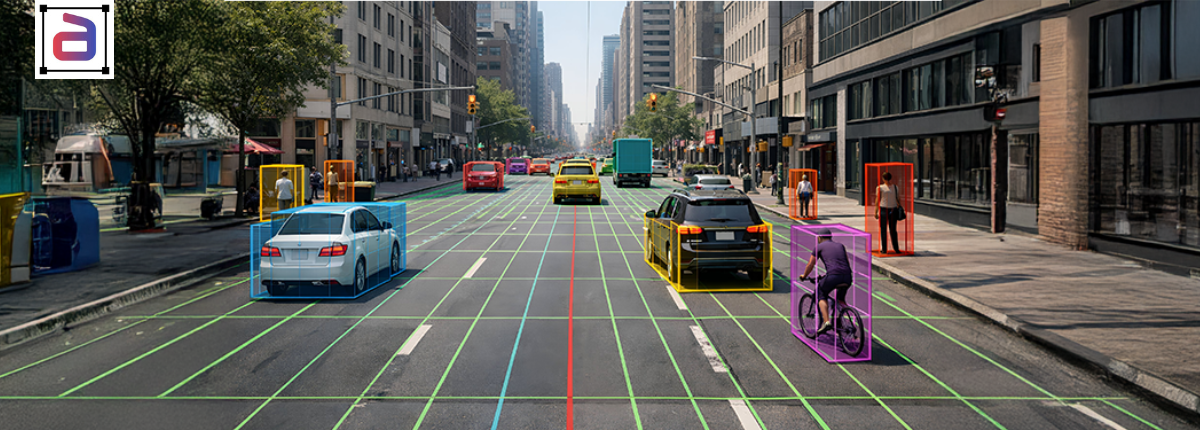
Temporal continuity refers to the consistent labeling and tracking of the same object across consecutive video frames. Instead of treating each frame independently, temporally continuous annotation preserves object identity throughout its lifecycle in the video.
Key components of temporal continuity include:
- Persistent object IDs across frames
- Smooth bounding box transitions as objects move
- Consistent handling of occlusion and reappearance
- Clear logic for object entry and exit
Without temporal continuity, video annotation becomes a series of disconnected snapshots, limiting a model’s ability to learn motion patterns and object behavior.
Why Temporal Continuity Matters for ML Models
For ML engineers, the practical consequence of poor temporal continuity shows up in tracking metrics. Identity switches occur when a model assigns a new track ID to an object it was already following, typically because a bounding box annotation broke the object trajectory with an inconsistent position or missing frame. Every identity switch corrupts the temporal training signal for that entire sequence, not just the frame where it occurred. A model trained on sequences with frequent identity switches learns that objects can teleport, which is the opposite of the spatial-temporal understanding video annotation is meant to build.
The downstream effects are predictable: reduced multi-object tracking accuracy, degraded trajectory prediction, and models that behave well on lab benchmarks and poorly in deployment where objects move in complex, unpredictable ways. Temporal continuity is the annotation property that most directly determines whether a video AI model generalizes beyond the training distribution.
Technical Challenges in Maintaining Temporal Continuity
Maintaining temporal continuity across long video sequences is technically challenging, especially in unconstrained environments. Maintaining temporal continuity across video frames presents several technical challenges. Rapid object motion, occlusion, lighting variations, and camera movement can disrupt consistent bounding box tracking. robust annotation workflows and advanced tracking algorithms are essential. For deeper insights into video annotation methodologies, you can explore external resources that discuss modern computer vision and tracking techniques.
Common challenges include:
- Occlusion: Objects partially or fully hidden by other objects
- Motion blur: Fast movement causing unclear boundaries
- Camera movement: Shifts, zooms, or vibrations
- Object similarity: Multiple objects with similar appearance
- Scene complexity: Crowded or cluttered environments
Addressing these challenges requires both robust annotation guidelines and human validation beyond automated tracking tools.
Annotation Techniques That Support Temporal Consistency
Professional video annotation workflows use several techniques to maintain temporal continuity. To maintain temporal consistency, annotators use techniques such as frame interpolation, object ID tracking, and keyframe-based labeling. quality checks and automated tracking tools help ensure smoother transitions between frames, thereby improving annotation accuracy and model training reliability.
These include:
- Object ID assignment that persists across frames
- Keyframe-based annotation with interpolation
- Manual correction of automated tracking drift
- Explicit rules for occlusion, re-identification, and exits
These techniques ensure that video annotation bounding boxes remain logically consistent, even when visual conditions change significantly. Bounding box video labeling maintains temporal continuity by tracking objects across consecutive frames, enabling AI models to understand motion, maintain identity, and improve video-based object detection accuracy.
Impact on Model Training and Inference
Temporally consistent bounding boxes improve both training efficiency and inference reliability. When temporal continuity is preserved, model training becomes more reliable and context-aware. AI systems learn consistent object behavior across frames. improved annotations support more stable inference, thereby enhancing tracking accuracy in real-world video analytics applications.
From a training perspective, models benefit from:
- Cleaner supervision signals
- Faster convergence
- Reduced overfitting to frame-level noise
During inference, temporal continuity enables:
- Stable object tracking
- More accurate behavior analysis
- Fewer false positives and tracking errors
For applications such as surveillance, retail analytics, and autonomous systems, this stability is critical.
Quality Metrics for Temporal Bounding Box Annotation
The standard per-frame metric for bounding box quality is Intersection over Union (IoU) against a ground truth reference. IoU is necessary but not sufficient for temporal annotation: a program that hits 0.85 IoU on every frame can still produce training data that destroys model tracking performance if the track IDs are inconsistent across those frames. IoU measures how well a single box fits; it does not measure whether the same object is being tracked coherently across time.
The metrics that actually capture temporal annotation quality are ID consistency rate (what percentage of tracks maintain a single ID from first detection to last), track break frequency (how often a track is interrupted and reassigned), and interpolation drift rate (how far auto-interpolated boxes deviate from true object position on high-motion frames). These three metrics, tracked per batch and reported alongside per-frame IoU, give annotation teams and ML engineers an accurate picture of temporal quality rather than just frame-level box accuracy.
Integrating Temporal Annotation into ML Pipelines
Temporally annotated video sequences must be delivered in formats that training pipelines can consume directly. The most common failure mode is a format mismatch: the annotation team delivers frame-level bounding box files with no consistent track ID, and the ML team has to reconstruct tracking associations in post-processing. That reconstruction step introduces errors and defeats the purpose of having annotators maintain track continuity in the first place.
The right integration approach is to agree on the output schema before annotation begins: track ID format, frame timestamp alignment, handling of occluded frames, and the encoding for track breaks versus true object exits. Validation scripts that check track ID consistency, detect orphaned frames, and flag interpolation drift should run on every delivered batch before it enters the training pipeline, not after the first model run reveals a data quality issue.
Annotera Technical Approach to Temporal Video Annotation
Annotera runs temporal bounding box annotation through a workflow that treats track continuity as a first-class quality requirement. Tool-assisted interpolation generates candidate boxes for frames between keyframes, and annotators review every interpolated frame on high-motion sequences rather than accepting them automatically. Track IDs are assigned at sequence ingestion and locked through the full annotation lifecycle, with any proposed track break requiring supervisor review and documented justification.
QA runs ID consistency checks and interpolation drift audits on every batch before delivery, alongside the standard per-frame IoU review. Output is delivered in the schema agreed with the ML team at project start, with validation scripts confirming format compliance before transfer. For programs with ongoing model retraining cycles, Annotera runs annotation on a sprint-aligned cadence so new sequences enter the training pipeline on a predictable schedule.
Conclusion: Temporal Precision Is the Difference Between Demo and Deployment
Temporal continuity is what separates experimental video models from reliable, real-world AI systems. Without consistent video annotation bounding boxes, even advanced architectures struggle in dynamic environments.
By prioritizing temporal precision and partnering with a specialized video annotation service provider, ML engineers can build video AI systems that perform reliably beyond controlled demos. In conclusion, maintaining temporal continuity in bounding boxes ensures consistent object tracking across video frames. AI models gain reliable motion context, reduced annotation noise, and improved performance. Partner with Annotera for precise video annotation that strengthens AI model accuracy.
A closely related read: Efficient Video Labeling and Bounding Box Services for Large-Scale Surveillance.