Conversational AI is transforming how businesses interact with customers. From virtual assistants and customer support chatbots to banking bots and voice-enabled applications, modern AI systems are expected to understand what users mean—not simply recognize the words they type. This is where text classification for intent detection becomes critical. Intent detection enables an AI system to determine the purpose behind a user’s message and select the most appropriate response or action. A customer saying “Where is my order?”, “Can you track my package?”, or “I need to know when my delivery arrives” may use different language, but each expresses essentially the same intent. As conversational AI becomes more sophisticated, the quality of the data used to train intent classification models becomes equally important. High-quality text annotation gives AI models the structured examples they need to understand language, context, and user objectives.
Key Points
- Sentiment is more than positive or negative: Advanced sentiment annotation captures mixed feelings, emotional intensity, sarcasm, irony, and contextual meaning.
- Aspect-based annotation delivers deeper insights: It identifies exactly which product, feature, service, or topic a customer feels positively or negatively about.
- Human-led annotation handles language complexity: Expert annotators can accurately interpret negation, ambiguity, slang, domain terminology, and implied sentiment.
- Annotera delivers scalable, high-quality annotation: Through data annotation outsourcing and text annotation outsourcing, Annotera helps AI teams build reliable, context-rich datasets for NLP and LLM applications.
What Is Text Classification for Intent Detection?
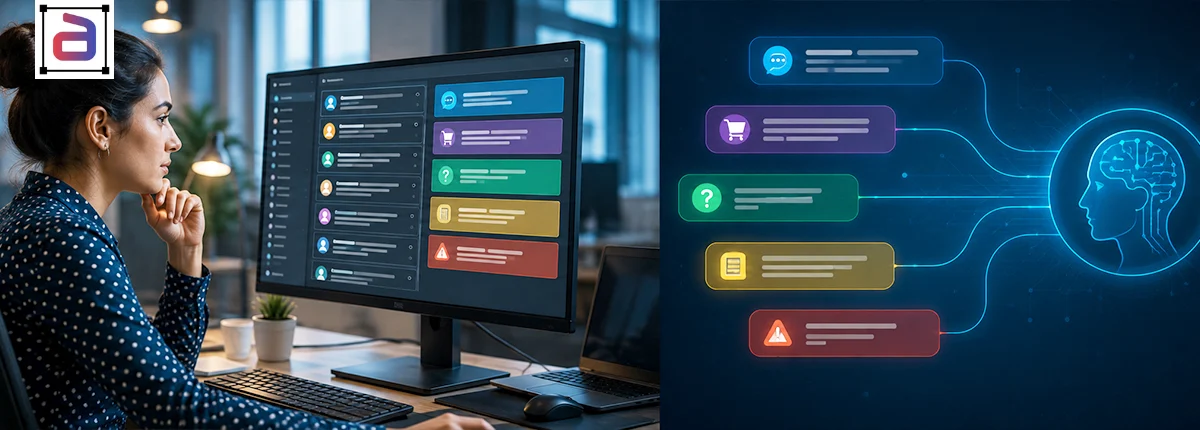
Text classification is an NLP technique that assigns predefined categories or labels to text based on its meaning. In conversational AI, these categories typically represent specific user intentions. For example, an e-commerce chatbot might classify messages into:
- Order Tracking: “Where is my package?”
- Order Cancellation: “I want to cancel my order.”
- Product Return: “How can I return this item?”
- Payment Issue: “My payment did not go through.”
- Product Inquiry: “Is this available in blue?”
Once trained on sufficient examples, an intent classification model can analyze new messages and predict the most relevant intent. However, real users rarely communicate in perfectly structured sentences. They use abbreviations, slang, incomplete phrases, spelling variations, regional expressions, and indirect requests. Training datasets must therefore capture this linguistic diversity.
Why Intent Detection Is Essential for Conversational AI
A chatbot can recognize keywords without understanding the user’s objective. Intent detection adds the layer of semantic understanding required to determine what the user actually wants. Accurate intent classification helps conversational AI systems:
- Route queries to the correct workflow
- Provide more relevant responses
- Automate repetitive customer interactions
- Reduce unnecessary escalation to human agents
- Improve customer experience
- Support personalized conversations
- Identify emerging customer requirements
For example, the statement “My card isn’t working” could indicate a payment failure, card activation issue, damaged card, or account restriction. A robust intent classification system needs training examples that distinguish these closely related scenarios. This is why intent detection cannot be treated simply as a keyword-matching exercise.
The Role of Text Annotation in Intent Detection
Before an intent classification model can make reliable predictions, it needs labeled training examples. This is where text annotation becomes fundamental. Human annotators review conversational data and assign predefined intent labels according to carefully developed annotation guidelines. The resulting dataset teaches the model how different expressions correspond to specific user goals. For example:
| Customer Message | Intent Label |
|---|---|
| “Can I check my order status?” | Order Tracking |
| “Please cancel my purchase.” | Order Cancellation |
| “I want to send this back.” | Product Return |
| “Why was my transaction declined?” | Payment Issue |
At Annotera, intent classification is one of the core capabilities within our text annotation services. Our teams support intent, sentiment, entity, semantic, and other NLP annotation requirements, helping organizations convert unstructured language into structured, AI-ready datasets.
“A conversational AI system is only as effective as its ability to understand the user’s underlying goal.”
Challenges in Intent Classification
1. Ambiguous Queries
Some user messages do not clearly communicate a single intent. For example, “I need help with my account” provides insufficient information to determine what the user wants. Annotation guidelines must define how ambiguous examples should be handled so that annotators remain consistent.
2. Similar Intent Categories
Closely related labels can be difficult to distinguish. “Cancel subscription” and “downgrade subscription,” for instance, may appear similar but trigger completely different workflows. A clearly designed intent taxonomy is therefore essential.
3. Multi-Intent Messages
Users may express multiple requirements in one message:
“My payment failed, and I also want to change my billing address.”
Should this be assigned one primary intent or multiple labels? The answer depends on the conversational AI architecture and business requirements. Annotation guidelines must establish the appropriate labeling strategy before large-scale annotation begins.
4. Multi-Turn Conversations
Intent often depends on previous dialogue. A user might say: User: “Can I change my booking?” Assistant: “Yes. What would you like to change?” User: “The date.” The final statement has little meaning without conversational context. Context-aware annotation helps models learn how intent evolves across multiple turns. Annotera’s research on context-aware intent datasets emphasizes that isolated utterances can be insufficient when meaning depends on dialogue history.
Building High-Quality Intent Classification Datasets
Successful intent detection begins with a well-defined taxonomy. Businesses should identify the specific user goals their conversational AI needs to recognize. Next, annotation guidelines should define:
- Intent descriptions
- Inclusion and exclusion criteria
- Positive and negative examples
- Ambiguous cases
- Multi-intent handling
- Context requirements
- Escalation or fallback categories
Annotators should then be trained against these guidelines before production annotation begins. Quality assurance is equally important. Multiple annotators can label a calibration sample, discrepancies can be reviewed, and guidelines can be refined before scaling. Regular quality checks can also identify annotation drift. As Annotera notes, high-quality intent annotation requires more than simply assigning labels—it requires context-aware workflows and consistent quality controls.
Why Data Annotation Outsourcing Can Improve Scalability
Large conversational AI initiatives can generate millions of customer interactions. Managing such volumes internally can place considerable pressure on AI and data teams. Data annotation outsourcing enables businesses to access specialized annotation resources without building an extensive internal labeling operation. An experienced data annotation company can provide trained annotators, established quality assurance processes, scalable workflows, and domain-specific expertise. For organizations developing NLP applications, text annotation outsourcing can also accelerate dataset preparation while allowing internal machine learning teams to focus on model development and deployment. The right text annotation company should be able to scale with changing data volumes while maintaining consistency across labels, languages, domains, and conversational scenarios.
Why Choose Annotera for Intent Annotation?
Annotera combines human expertise, structured workflows, and scalable delivery to support enterprise AI training requirements. Its text annotation services include intent classification, named entity recognition, sentiment annotation, semantic annotation, text categorization, and other NLP tasks. Our approach emphasizes contextual accuracy, consistent labeling, quality assurance, and scalability. Annotera also supports multilingual text annotation, making it suitable for organizations building conversational AI systems for diverse markets. Whether you are training a customer service chatbot, virtual assistant, voice AI system, or enterprise NLP application, accurately labeled intent data can provide a stronger foundation for model development.
The Future of Intent Detection
Conversational AI is moving toward systems capable of handling increasingly complex, contextual, and multi-turn interactions. As these systems evolve, intent detection will need to move beyond simple single-label classification. Future datasets will increasingly need to capture context, conversational state, multiple simultaneous intents, emerging user language, multilingual variations, and domain-specific terminology. This makes continuous annotation and dataset refinement essential.
“Better conversational AI begins with better understanding—and better understanding begins with better data.”
Conclusion
Text classification for intent detection is a fundamental component of conversational AI. It enables systems to move beyond recognizing words and toward understanding the goals behind user interactions. But sophisticated algorithms cannot compensate for inconsistent or poorly labeled training data. Clear intent taxonomies, diverse examples, context-aware annotation, and rigorous quality assurance are essential for building dependable conversational AI. For organizations looking to scale these initiatives, data annotation outsourcing offers a practical way to access specialized expertise and high-volume annotation capabilities. With an experienced data annotation company such as Annotera, businesses can develop structured, high-quality datasets designed around their specific conversational AI requirements. Ready to build smarter conversational AI? Partner with Annotera for scalable, high-quality intent classification and text annotation services that turn complex language data into AI-ready training datasets.
A closely related read: Text Classification Annotation for Trust & Safety AI Moderation Pipelines.