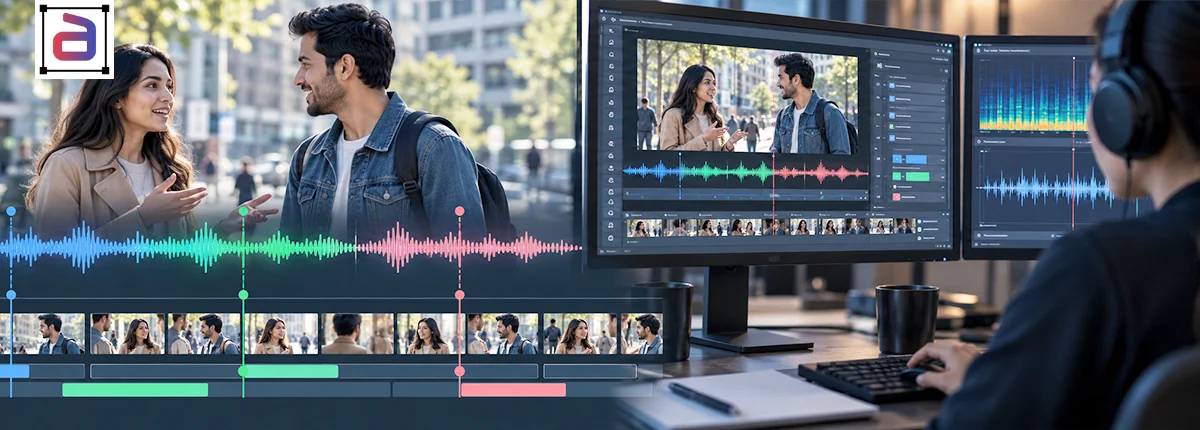
Artificial intelligence is moving beyond simply identifying people in videos. Modern computer vision systems are increasingly expected to understand what people are doing, how they are moving, and how those movements change over time. From analyzing an athlete’s technique to monitoring rehabilitation exercises, recognizing gestures, and enabling human-robot interaction, AI needs highly detailed visual data to interpret human movement accurately. This is where video keypoint annotation becomes critical.
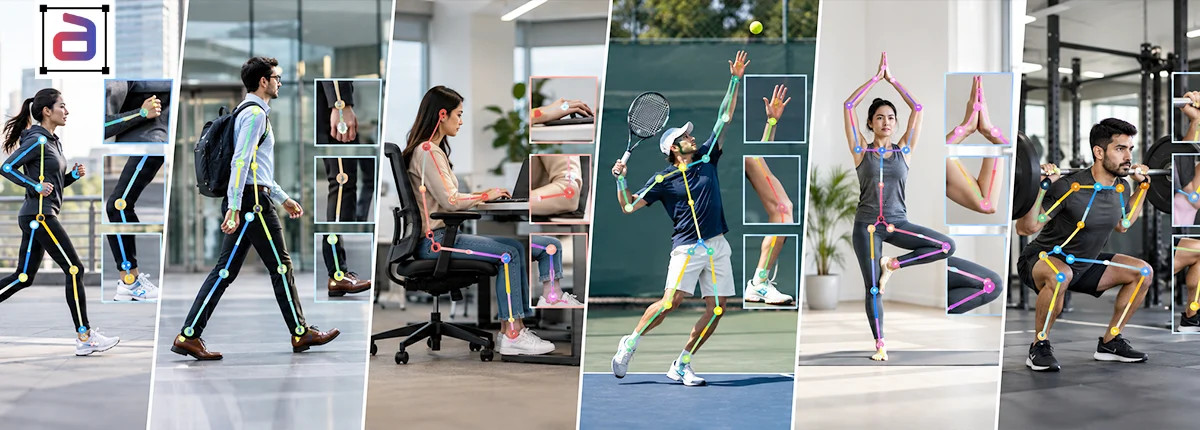
By marking anatomical landmarks such as shoulders, elbows, wrists, hips, knees, and ankles across successive video frames, annotation teams can transform raw footage into structured training data. For organizations developing advanced computer vision models, video annotation outsourcing services provide a scalable way to build these datasets while maintaining annotation consistency and quality.
“AI can only learn the patterns that its training data enables it to see.”
Key Points
- Video keypoint annotation enables AI to understand fine-grained human movements by tracking anatomical landmarks such as shoulders, elbows, wrists, hips, knees, and ankles across video frames.
- Accurate movement data supports diverse AI applications, including sports analytics, healthcare and rehabilitation, fitness technology, robotics, AR/VR, and human-computer interaction.
- High-quality annotation requires rigorous quality control to address occlusion, rapid motion, complex poses, multiple people, and temporal consistency across video sequences.
- Video annotation outsourcing helps AI teams scale efficiently, with Annotera providing structured annotation workflows, trained teams, and quality assurance for complex human movement datasets.
What Is Video Keypoint Annotation?
Video keypoint annotation is the process of identifying and labeling specific anatomical points on a person’s body throughout a video sequence. Depending on the application, these keypoints can include:
- Head and facial landmarks
- Shoulders and elbows
- Wrists and hands
- Hips and torso
- Knees
- Ankles and feet
- Other application-specific body landmarks
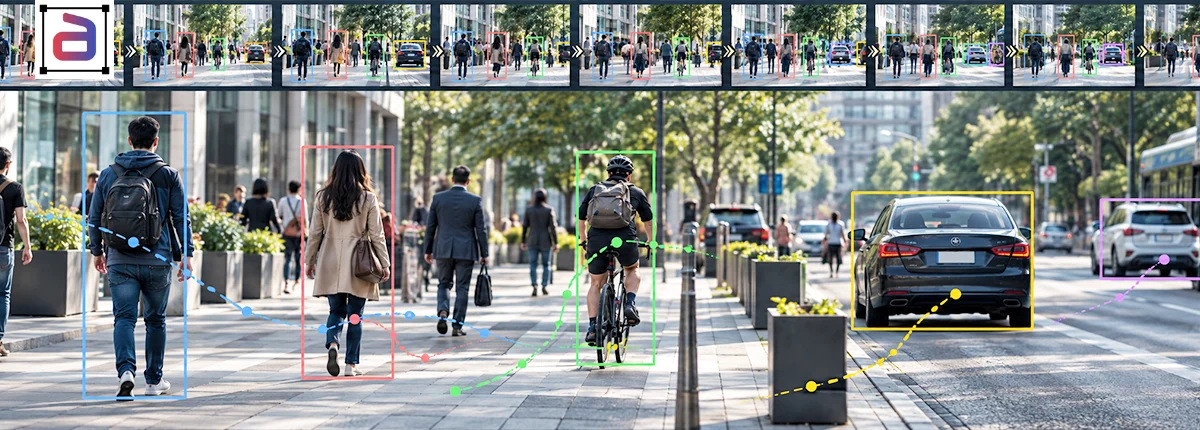
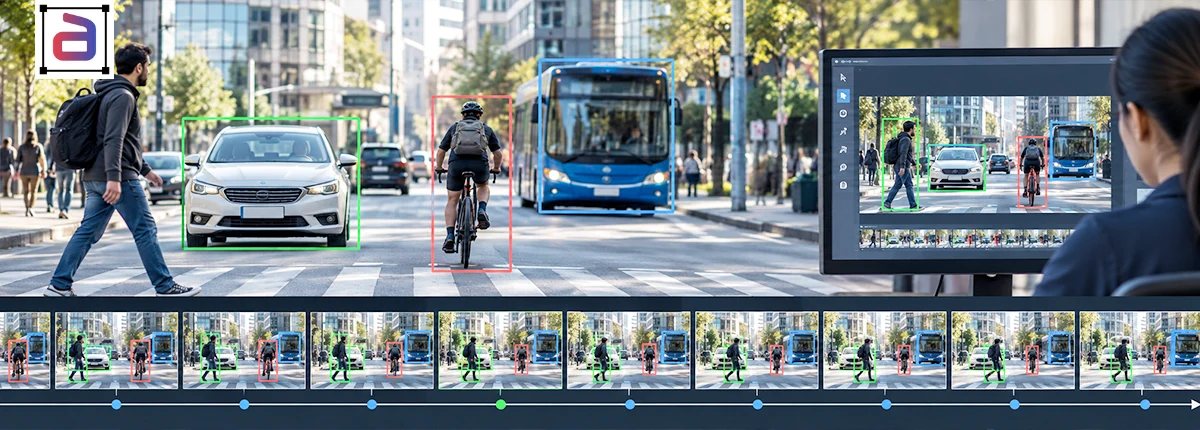
Unlike basic bounding-box annotation, which identifies where a person is located within a frame, keypoint annotation captures the structural configuration of the human body. When these landmarks are tracked across multiple frames, AI models can learn how individual body parts move in relation to one another. For example, an AI model analyzing a tennis player can use keypoints to understand shoulder rotation, elbow positioning, wrist movement, and lower-body coordination throughout a serve.
Why Fine-Grained Human Movement Recognition Matters
Human activities are rarely defined by a single static pose. Movement unfolds over time. Consider the difference between walking, running, jumping, and changing direction. At an individual-frame level, some poses may look remarkably similar. The distinction becomes clearer when the AI analyzes the sequence and trajectory of body movements. Fine-grained movement recognition can support numerous applications.
Sports Analytics
Sports organizations can use annotated video to analyze player movement, posture, technique, and biomechanics. Keypoint data can help identify movement patterns associated with different sporting actions.
Healthcare and Rehabilitation
AI-powered rehabilitation systems can analyze whether patients are performing prescribed exercises correctly. Keypoints can help identify joint positions and movement trajectories that may indicate whether an exercise is being performed according to predefined parameters.
Fitness Technology
Fitness platforms can use human pose data to develop systems that provide real-time feedback on exercises such as squats, lunges, push-ups, and yoga movements.
Human-Robot Interaction
Robots operating around people need to interpret human actions and body movements. High-quality movement datasets can help train models to recognize gestures, poses, and activity sequences.
Augmented and Virtual Reality
AR and VR systems depend on accurate body tracking to create responsive and immersive experiences. Keypoint annotation can support models designed to estimate human poses and movements.
“The objective is not simply to detect a person in a frame—it is to capture the movement relationships that give an action its meaning.”
How Keypoint Annotation Helps AI Understand Movement
A video consists of a sequence of visual snapshots. Keypoint annotation adds structured information to those snapshots. Imagine a video showing an individual performing a squat. Annotators can identify the person’s major joints in each frame. When those annotations are connected temporally, the dataset captures the progression of the movement. This allows AI systems to learn:
- Body position: Where individual joints are located.
- Joint relationships: How different body parts are positioned relative to one another.
- Movement trajectory: How keypoints move from one frame to the next.
- Temporal patterns: How an action begins, develops, and ends.
- Pose transitions: How the body changes between different movement states.
The resulting dataset can become valuable training material for pose estimation, action recognition, movement classification, and other computer vision applications.
The Biggest Challenges in Video Keypoint Annotation
Fine-grained human movement annotation requires considerably more precision than conventional image labeling.
Occlusion
Hands may move behind the body. Legs can overlap. Objects may temporarily block parts of the person. Annotation guidelines need to define how visible, partially visible, and occluded keypoints should be handled.
Rapid Motion
Fast movements can introduce motion blur, making anatomical landmarks difficult to identify accurately. Sports footage and high-speed activities can be especially challenging.
Complex Poses
People can bend, rotate, crouch, jump, or adopt unusual body configurations. Annotators need clear instructions to maintain consistent landmark placement across these situations.
Multiple People
When multiple individuals appear in the same scene, every person’s keypoints must remain correctly associated across frames. Identity switches can introduce significant noise into training datasets.
Temporal Consistency
A keypoint should not suddenly shift from one location to another without a corresponding physical movement. Maintaining temporal consistency is essential when datasets are intended for motion analysis.
Quality Control Is Critical
The value of a video annotation dataset depends heavily on annotation accuracy. For fine-grained movement recognition, even relatively small inconsistencies can affect model performance. A strong quality-control process should therefore include:
- Detailed annotation guidelines
- Annotator training and qualification
- Multiple levels of review
- Random quality audits
- Automated validation checks
- Edge-case analysis
- Inter-annotator agreement monitoring
- Continuous feedback and correction
At Annotera, quality is treated as an integral part of the annotation workflow rather than a final-stage checkpoint. Our approach combines trained annotation teams, defined labeling protocols, quality assurance processes, and project-specific requirements to help organizations develop dependable computer vision datasets.
Why Video Annotation Outsourcing Can Accelerate AI Development
For AI companies working with large video collections, building and managing an internal annotation operation can consume significant time and resources. This is one reason organizations increasingly consider video annotation outsourcing. A specialized annotation partner can help scale labeling operations while supporting complex requirements such as:
- Human pose estimation
- Body keypoint annotation
- Multi-person tracking
- Action recognition
- Gesture annotation
- Sports movement analysis
- Exercise recognition
- Rehabilitation datasets
- Human-robot interaction
- Temporal activity labeling
However, successful outsourcing is about more than increasing annotation volume. The annotation workflow must be aligned with the model’s objectives, labeling taxonomy, edge cases, quality thresholds, and downstream evaluation requirements.
Beyond Keypoints: Building Richer Movement Datasets
Advanced AI applications often require multiple annotation layers. Keypoint labels can be combined with:
- Bounding boxes
- Object tracking
- Action labels
- Temporal segmentation
- Visibility attributes
- Occlusion labels
- Pose classifications
- Movement trajectories
This creates a richer representation of human activity. For example, a dataset designed for sports analytics could combine player bounding boxes, skeletal keypoints, ball tracking, action labels, and temporal segments. Such multimodal annotation can give AI systems a more comprehensive understanding of what is happening in a scene.
How Annotera Supports Human Movement AI
At Annotera, we recognize that high-performing computer vision models begin with precisely structured training data. Our video annotation capabilities can support organizations working on human pose estimation, movement recognition, sports analytics, healthcare applications, robotics, and other computer vision use cases. From frame-level keypoint labeling to complex multi-person video datasets, our annotation workflows can be customized around project-specific requirements. Our focus is simple: help AI teams turn complex visual information into structured, reliable, and model-ready training data.
“Better annotation is not simply about labeling more data. It is about creating data that teaches an AI model the right patterns.”
The Future of AI-Powered Human Movement Understanding
As computer vision systems become more sophisticated, AI will increasingly need to understand human activity at a much finer level. Recognizing that a person is present in a video is only the beginning. Future applications will require AI to understand posture, joint relationships, movement trajectories, gestures, and subtle changes in physical behavior. Video keypoint annotation provides an important foundation for this evolution. With the right annotation strategy, rigorous quality assurance, and scalable video annotation outsourcing services, organizations can transform raw video into structured datasets capable of supporting increasingly sophisticated AI models.
Build Better Human Movement Datasets with Annotera
Developing an AI system that understands human movement starts with the quality of the data behind it. Whether you are building a sports analytics platform, healthcare AI solution, robotics application, fitness technology, or advanced computer vision model, Annotera can help you create structured video datasets designed around your specific requirements. Ready to transform your video data into high-quality AI training data? Connect with Annotera today to discuss your video annotation requirements and build a scalable annotation workflow for your next computer vision project.
A closely related read: Mastering Pose Estimation with Keypoint Annotation.