Computer vision models are only as dependable as the training data behind them. A video dataset may contain thousands or millions of frames, but volume alone does not guarantee quality. Missing objects, inaccurate bounding boxes, inconsistent labels, broken tracking IDs, and poorly handled occlusions can introduce noise into the training pipeline and ultimately affect model performance. This makes frame-level validation in video annotation a critical quality-control step for organizations developing computer vision systems. Unlike image annotation, video annotation introduces a temporal dimension. Objects move, disappear behind obstacles, change appearance, and interact with other objects from one frame to the next. A label that appears correct in isolation may become problematic when viewed across a sequence.
“Reliable computer vision begins with reliable visual data. Every validated frame strengthens the foundation on which an AI model learns.”
For organizations managing large-scale datasets, video annotation outsourcing services can provide access to trained annotation teams, structured quality-assurance workflows, and scalable validation capabilities without requiring an extensive in-house operation.
Key Points
- Frame-level validation improves annotation accuracy by identifying incorrect labels, bounding boxes, segmentation errors, and missing objects before training.
- Temporal consistency strengthens video datasets by maintaining accurate object tracking, IDs, and annotations across consecutive frames.
- Human-in-the-loop validation handles complex scenarios such as occlusion, motion blur, low-light conditions, overlapping objects, and other real-world edge cases.
- Video annotation outsourcing enables scalable quality control, helping AI teams access specialized annotation and validation expertise while focusing on computer vision model development.
What Is Frame-Level Validation in Video Annotation?
Frame-level validation is the systematic review of annotations on individual video frames to verify that labels accurately represent the visual information present in the footage. Depending on the computer vision application, a frame may contain annotations such as:
- Bounding boxes
- Polygon and segmentation masks
- Keypoints and landmarks
- Object tracking IDs
- Activity or action labels
- Object attributes
- Occlusion and visibility labels
- Temporal event markers
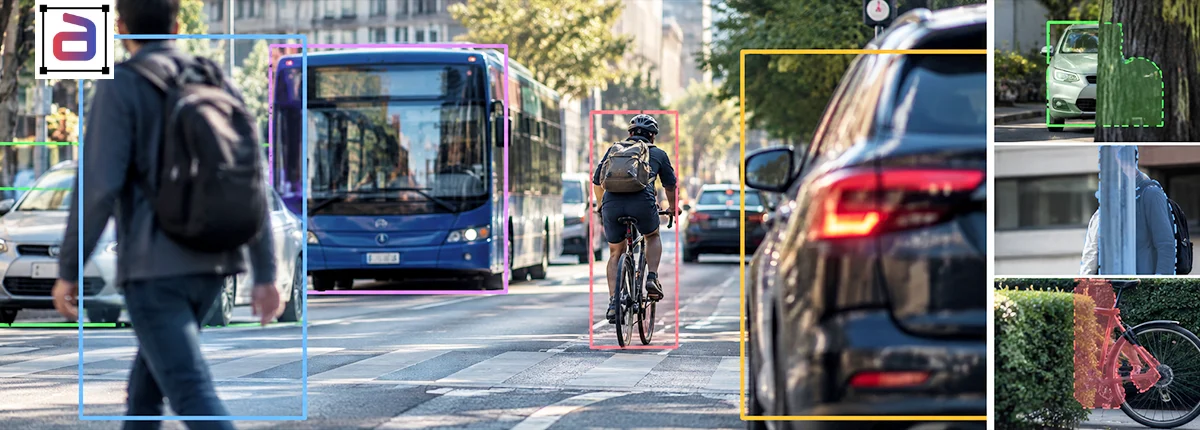
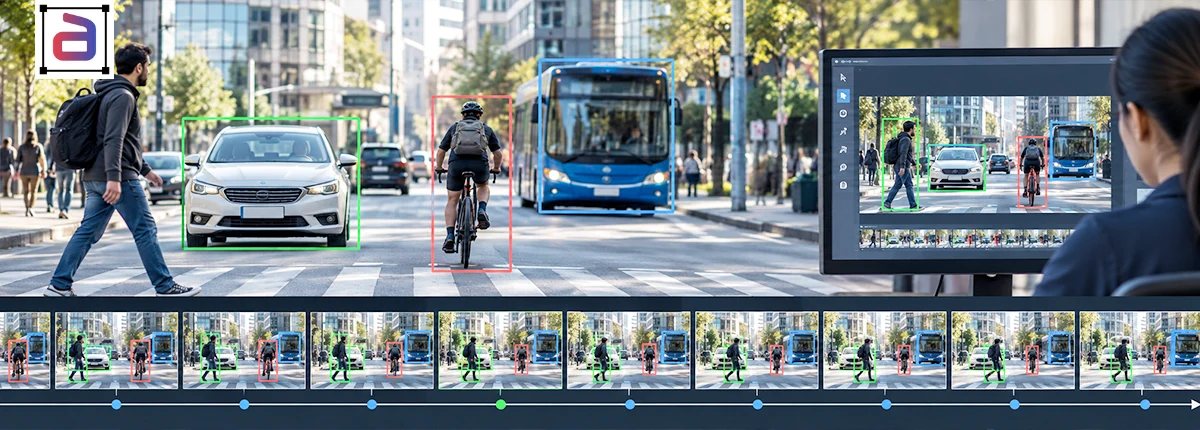
Validation teams examine these annotations against predefined project guidelines. They also compare adjacent frames to ensure that annotations remain consistent throughout the video sequence. Consider an autonomous driving dataset. A vehicle may be correctly identified and bounded in one frame, but its bounding box could become misaligned several frames later. Its tracking ID could also unexpectedly change. Without proper validation, these errors can become part of the training dataset.
Why Frame-Level Validation Matters for Computer Vision
1. Prevents Annotation Errors From Contaminating Training Data
Annotation mistakes are inevitable in large-scale data operations. Even trained annotators may occasionally miss an object, select an incorrect class, or draw an imprecise boundary. Frame-level validation introduces an additional quality layer before annotated data reaches the model-training pipeline. Reviewers can identify and correct:
- Missing objects
- Incorrect classifications
- Inaccurate bounding boxes
- Poor segmentation boundaries
- Duplicate annotations
- Incorrect attributes
- Missing tracking information
The objective is not simply to increase the number of labeled frames, but to increase the number of usable and trustworthy frames.
“The goal of validation is not to make every frame look perfect. It is to make every annotation meaningful for the model it is intended to train.”
2. Maintains Temporal Consistency
Video is inherently temporal. Objects move from one position to another, and their characteristics may change throughout a sequence. For example, a pedestrian walking across a road should generally retain the same tracking identity as they move through consecutive frames. If the identity changes unexpectedly, the dataset may provide confusing signals to an object-tracking model. Frame-level validation can detect:
- ID switching
- Broken object tracks
- Sudden bounding-box jumps
- Missing annotations
- Inconsistent object classes
- Incorrect frame-to-frame transitions
This temporal consistency is particularly important for autonomous vehicles, robotics, sports analytics, surveillance, and activity-recognition systems.
3. Improves Annotation Quality in Difficult Visual Conditions
Real-world video contains far more complexity than controlled laboratory footage. Objects may be partially hidden, blurred by movement, affected by poor lighting, or obscured by other objects. Weather conditions such as rain, fog, and snow can further complicate annotation. A robust validation workflow evaluates how these conditions have been handled according to project-specific guidelines. For example, when a pedestrian is partially hidden behind a vehicle, validators may need to determine whether the visible portion should be annotated, whether an occlusion attribute should be applied, or whether the object should continue to be tracked. Other challenging conditions include:
- Motion blur
- Low-light scenes
- Heavy traffic
- Crowded environments
- Reflections
- Camera movement
- Partial visibility
- Overlapping objects
Proper validation ensures that difficult frames do not automatically become low-quality training examples.
4. Creates Consistency Across Annotation Teams
Large annotation projects often involve multiple teams working simultaneously. Without systematic quality control, different annotators may interpret the same guidelines differently. For instance, one annotator might draw a tight bounding box around a vehicle, while another includes surrounding pixels. One person may annotate a partially visible object, while another may exclude it. These inconsistencies can reduce dataset uniformity. Frame-level validation helps establish a common annotation standard across the entire dataset. Repeated errors can also reveal where annotation guidelines need clarification or where annotators require additional training.
What Should an Effective Validation Process Check?
A comprehensive frame-level validation workflow should examine several dimensions of annotation quality.
Label Accuracy
Is the object, action, or event assigned the correct category?
Spatial Precision
Does the bounding box, polygon, segmentation mask, or keypoint accurately correspond to the target?
Temporal Continuity
Does the annotation remain logically consistent across consecutive frames?
Tracking Accuracy
Does the correct object retain its tracking identity throughout the sequence?
Attribute Accuracy
Are attributes such as visibility, pose, color, state, or occlusion correctly assigned?
Edge-Case Handling
Have difficult situations such as blur, overlap, partial visibility, and unusual object behavior been handled according to the project’s rules? Together, these checks provide a more comprehensive picture of dataset quality than simply measuring annotation completion rates.
Combining Automated Quality Checks With Human Validation
Technology can make frame-level validation significantly more scalable. Automated checks can flag potential problems such as:
- Missing annotations
- Empty frames
- Invalid class IDs
- Abnormally large or small bounding boxes
- Sudden object movement
- Duplicate labels
- Broken tracking sequences
However, automated systems may struggle to understand context. A sudden change in an object’s position could indicate an annotation error—or it could reflect a legitimate camera movement or object interaction. This is where human-in-the-loop validation becomes valuable.
“Automation can identify where something looks unusual; trained human reviewers determine whether unusual means incorrect.”
Combining automated quality checks with expert human review allows organizations to improve scalability without sacrificing contextual judgment.
The Role of Video Annotation Outsourcing
Managing large-scale video annotation internally requires more than an annotation workforce. Organizations may need specialized tools, quality analysts, project managers, annotation guidelines, infrastructure, and ongoing training. This is where video annotation outsourcing can provide operational flexibility. A specialized partner can support the complete annotation and validation workflow, including:
- Frame-level annotation
- Object detection labeling
- Video segmentation
- Object tracking
- Keypoint annotation
- Action recognition
- Occlusion labeling
- Multi-stage quality assurance
- Edge-case review
- Dataset consistency monitoring
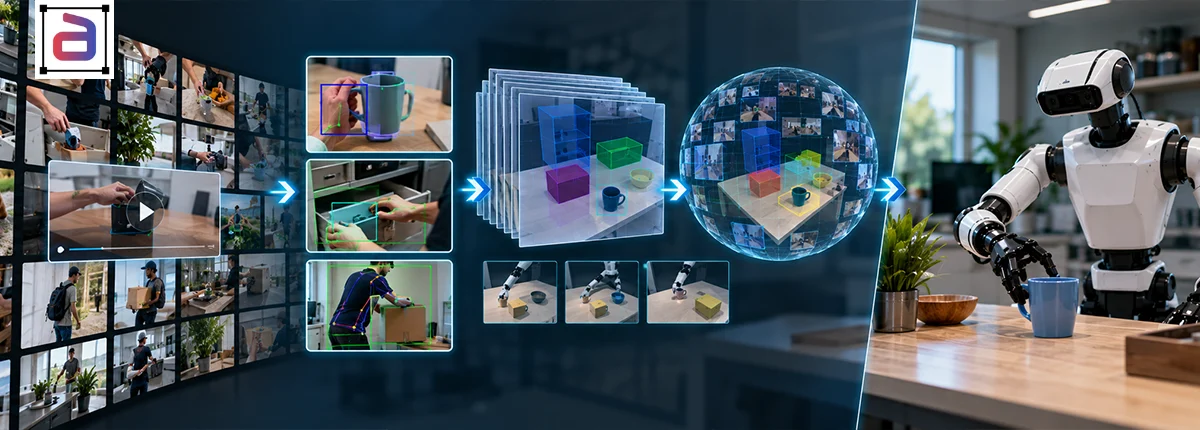
Outsourcing can allow AI teams to focus on model development while an experienced annotation operation manages the data preparation layer.
How Annotera Builds Quality Into Video Annotation
At Annotera, we view video annotation as a data-quality discipline rather than a simple labeling exercise. Our approach combines structured annotation guidelines, trained human reviewers, quality-control checkpoints, and project-specific validation requirements to help organizations create reliable computer vision datasets. Whether the requirement involves autonomous driving, robotics, retail analytics, surveillance, sports analytics, or general computer vision, Annotera can structure validation workflows around the characteristics of the dataset and the intended machine-learning application. Our video annotation outsourcing services are designed to help organizations manage complex datasets while maintaining consistency, accuracy, and scalability. From validating individual frames to reviewing temporal sequences, the objective remains the same: transform raw video into training data that AI teams can confidently use.
Building Better AI Starts With Better Validation
The success of a computer vision model cannot be separated from the quality of its training data. Frame-level validation provides a practical mechanism for detecting annotation errors, maintaining temporal consistency, and improving the reliability of video datasets. As computer vision systems move into increasingly complex real-world environments, organizations need annotation workflows that can account for movement, occlusion, environmental variability, and edge cases. A scalable video annotation outsourcing strategy can help bridge this requirement by combining trained human expertise with structured quality assurance and technology-assisted validation. At Annotera, we help businesses turn complex video into structured, quality-focused training data built around their computer vision objectives.
Ready to Build More Reliable Computer Vision Training Data?
Partner with Annotera to strengthen your video annotation workflow with scalable annotation, frame-level validation, and quality-focused data services. Contact Annotera today to discuss your video dataset requirements and discover how our video annotation outsourcing services can support your next AI project.