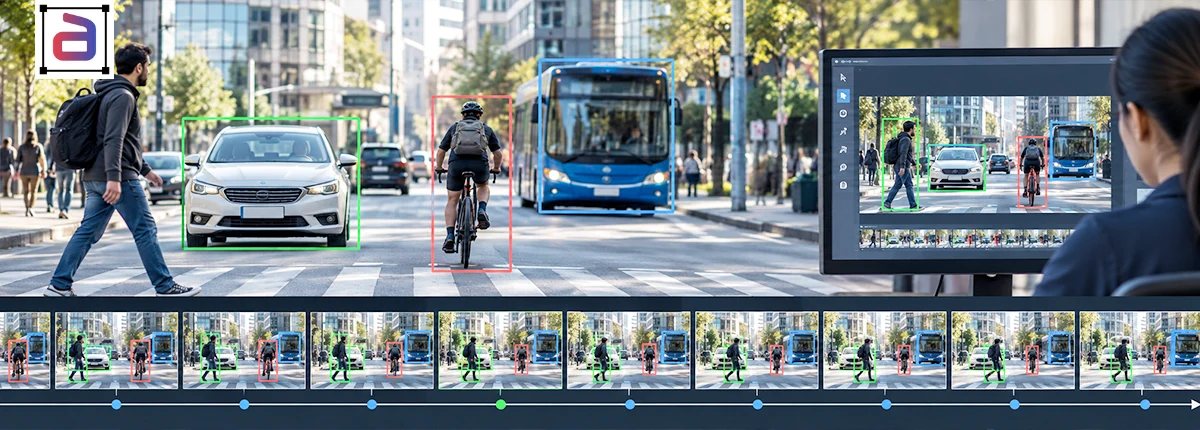
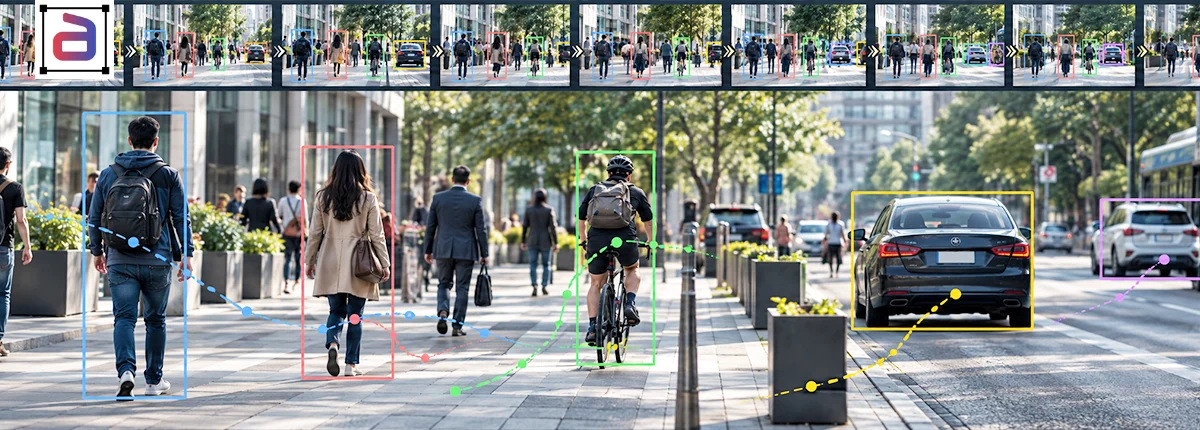
A video is not simply a collection of individual frames. For AI systems, the real value often lies in understanding what changes between frames and whether the same object remains present throughout a sequence. Consider a pedestrian crossing a road, a vehicle changing lanes, or a warehouse robot moving around workers and equipment. An AI model may detect these objects in individual frames, but detection alone does not establish continuity. The model needs to understand that the person in frame 20 is the same person in frame 80, even if their position, orientation, or visibility has changed. This is where video object identity labeling becomes critical.
By assigning persistent identities to objects across frames, annotation teams create datasets that allow AI models to learn temporal relationships rather than treating every frame as an isolated image. For organizations developing advanced computer vision systems, this additional layer of information can significantly improve the usefulness of long-sequence training data. As the computer vision industry moves toward more context-aware AI, the goal is no longer simply to answer “What is in this frame?” but increasingly “What is happening to this object over time?”
“The quality of temporal AI depends not only on what the model sees, but on how consistently the training data connects what it sees over time.”
Key Points
- Object identity labels create temporal continuity, helping AI models recognize and track the same object consistently across long video sequences.
- Persistent IDs reduce identity switches and improve occlusion handling, producing more reliable training data for complex real-world environments.
- Identity-aware annotation transforms video into behavioral data, supporting applications such as autonomous vehicles, robotics, retail analytics, sports, and surveillance.
- Video annotation outsourcing enables scalable, quality-controlled datasets, with Annotera supporting tracking, re-identification, identity labeling, and temporal consistency validation.
What Are Video Object Identity Labels?
Video object identity labeling involves assigning a unique identifier to an object and maintaining that identity across the frames in which it appears. For example, imagine a traffic video containing several cars. Instead of labeling each frame simply as “car,” an identity-aware annotation workflow could assign:
- Vehicle 01 → Car A
- Vehicle 02 → Car B
- Vehicle 03 → Car C
If Vehicle 01 changes lanes, becomes partially obscured, and then reappears, its identity remains Vehicle 01. This creates a temporal connection between multiple observations of the same object. The distinction is particularly important for multi-object tracking, autonomous driving, robotics, surveillance, sports analytics, and retail intelligence, where understanding an object’s trajectory can be as important as identifying the object itself.
Why Object Detection Alone Is Not Enough
Traditional object detection is primarily concerned with identifying objects within individual frames. It can tell an AI system that a frame contains a pedestrian, vehicle, bicycle, or product. However, long-sequence AI applications require considerably more context. Without identity labels, a model may have difficulty learning:
- How an object moves across a scene
- Whether observations belong to the same entity
- How objects interact over time
- What happens before and after an occlusion
- Whether an object has left and re-entered a scene
- How an object’s behavior changes throughout a sequence
For example, detecting five vehicles in 100 frames could produce hundreds of object instances. Persistent identity labels transform those individual observations into meaningful trajectories. That is the difference between recognizing objects and understanding object continuity.
How Identity Labels Strengthen Long-Sequence AI Training
1. Creating Temporal Continuity
AI models designed for video need temporal context. Persistent object IDs connect observations across consecutive frames and help create a coherent representation of movement. Instead of treating every appearance as a new data point, the training dataset tells the model that multiple observations belong to the same entity. This is especially valuable when developing systems that must predict future movement or understand sequences of actions.
“For long-sequence learning, continuity is data. Every correctly maintained identity adds context that an isolated frame cannot provide.”
2. Reducing Identity Switching
Identity switching occurs when an object is mistakenly assigned another object’s identity during a sequence. Consider two pedestrians wearing similar clothing who cross paths. If the identities are accidentally exchanged, the resulting dataset contains an incorrect movement trajectory. Repeated identity switches can introduce noise into training data and make it harder for models to learn reliable object behavior. Carefully defined annotation guidelines and temporal quality checks help reduce these errors.
3. Making Occlusion Data More Valuable
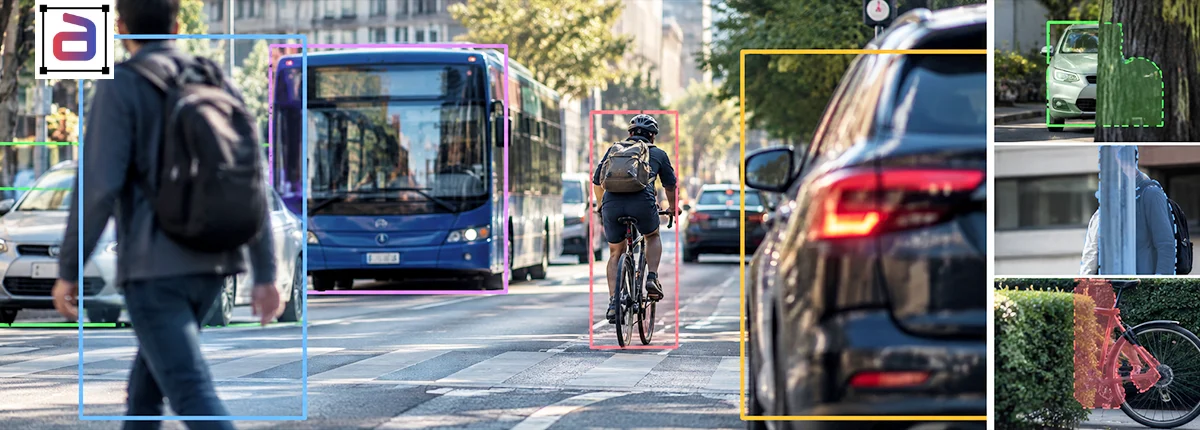
Objects frequently disappear from view. A pedestrian may walk behind a vehicle. A car may pass behind a truck. A robotic arm may become partially obscured by equipment. A frame-by-frame annotation approach may treat the object’s reappearance as a new instance. Identity-aware annotation attempts to preserve the object’s identity when the available visual evidence supports continuity. This teaches AI systems an important real-world principle: Objects do not cease to exist simply because they temporarily disappear from view. That makes identity labels particularly valuable for autonomous systems operating in environments where occlusion is unavoidable.
Identity Labels Turn Video Into Behavioral Data
Persistent identities enable video datasets to capture more than object presence. They create a foundation for understanding movement and behavior. In sports analytics, the same player can be followed throughout a match. For retail environments, shopper movement can be analyzed across different areas. The case of autonomous driving, surrounding vehicles and pedestrians can be tracked as they change position and interact with other road users. In robotics, the system can associate people and objects with their movements across an operational environment. The common requirement is temporal consistency.
“A bounding box tells AI where an object is. An identity label helps explain where that object has been and how its current state fits into the sequence.”
The Challenges of Identity-Aware Video Annotation
Maintaining object identity across long sequences is considerably more complex than drawing bounding boxes. Annotation teams must account for:
- Occlusion: Determining whether a partially or temporarily hidden object remains the same identity.
- Similar appearances: Distinguishing between objects that look nearly identical.
- Camera movement: Maintaining object continuity when the camera pans, tilts, zooms, or moves.
- Appearance changes: Handling changes caused by lighting, pose, weather, viewpoint, or distance.
- Crowded scenes: Preventing identity switches when multiple objects overlap or cross paths.
- Long sequences: Maintaining consistent identities across hundreds or thousands of frames.
- Re-entry: Determining whether an object returning to the scene is an existing identity or a new object.
These challenges demonstrate why high-quality identity annotation requires more than a labeling tool. It requires clear annotation protocols, trained teams, continuous validation, and application-specific quality standards.
How Video Annotation Outsourcing Supports Scale
As video datasets become larger and more complex, organizations often face a difficult balance between annotation volume, turnaround time, consistency, and internal resources. This is where video annotation outsourcing can provide a scalable approach. Through specialized video annotation outsourcing services, AI teams can work with trained annotation professionals who follow predefined identity-labeling protocols and quality-control processes. A structured workflow may include:
- Object detection and classification
- Initial identity assignment
- Frame-by-frame identity propagation
- Occlusion handling
- Re-identification
- Identity-switch detection
- Temporal consistency validation
- Multi-level quality assurance
For organizations building large datasets, outsourcing can also provide greater flexibility when annotation requirements change as models evolve.
Why Annotera for Video Object Identity Annotation?
At Annotera, we understand that high-quality video annotation is not simply about labeling more frames. It is about creating structured, consistent, and AI-ready training data. Our video annotation workflows can support object tracking, persistent identity labeling, occlusion-aware annotation, re-identification, temporal consistency, and quality validation. Annotera works with AI teams across applications such as:
- Autonomous vehicles
- Robotics and Physical AI
- Retail intelligence
- Sports analytics
- Security and surveillance
- Industrial computer vision
Our focus is on building annotation workflows around the specific requirements of the AI model, rather than applying a one-size-fits-all labeling process.
“Better video AI starts with better temporal data—and temporal data becomes more powerful when object identity is preserved.”
The Future of Video AI Is Temporal
As AI systems become increasingly capable of interpreting complex environments, the importance of temporal understanding will continue to grow. Object detection answers what is present. Tracking answers where it moves. Identity labeling adds another critical layer: whether the object observed now is the same entity observed earlier. That continuity can transform disconnected video frames into structured sequences that provide substantially richer training signals for AI. For organizations developing next-generation computer vision systems, object identity should therefore be considered a fundamental component of long-sequence dataset design—not merely an extension of conventional tracking.
Build Better Long-Sequence Training Data With Annotera
Your AI model is only as reliable as the data used to train it. If your application depends on persistent object identity, long-range tracking, or temporal understanding, inconsistent labels can become a major source of training noise. Annotera helps businesses create high-quality, identity-aware video datasets designed for advanced computer vision and AI applications. From multi-object tracking and persistent IDs to occlusion handling and quality validation, our annotation workflows are designed to help AI teams turn complex video into structured training data at scale. Ready to build more reliable long-sequence AI training data? Contact Annotera today to discuss your video annotation requirements and develop an identity-labeling workflow tailored to your project.