Artificial intelligence can recognize a car, pedestrian, cyclist, or product when it is clearly visible. The real challenge begins when that object is only partially visible. A pedestrian may disappear behind a parked vehicle. A cyclist may move behind another road user. A warehouse robot may become hidden behind a pallet. In surveillance footage, people can overlap or temporarily disappear from a camera’s field of view. For humans, these situations are relatively easy to interpret because we naturally understand that an object can remain present even when we cannot see all of it. For AI models, however, partial visibility creates a complex perception problem.
“An object does not stop existing simply because part of it disappears from view.”
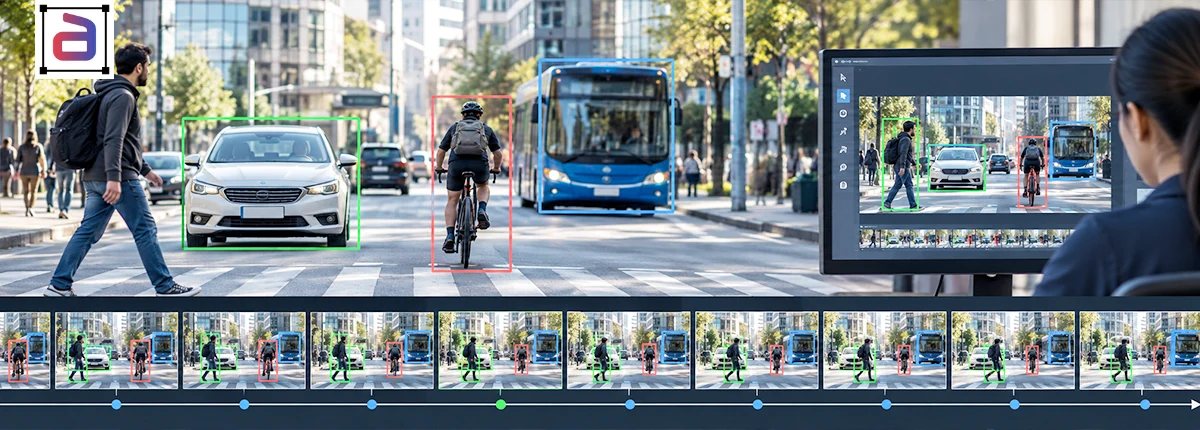
This principle is at the heart of effective occlusion and visibility annotation. By explicitly labeling what is visible, what is hidden, and how visibility changes across frames, annotation teams can create richer training data for computer vision systems. At Annotera, we provide scalable video annotation solutions designed to help AI teams transform complex video footage into structured, production-ready training datasets. Our video annotation capabilities include multi-object tracking, event tracking, frame-level validation, and occlusion and visibility tagging.
Key Points
- Occlusion and visibility labels help AI recognize partially hidden objects instead of treating them as missing or new objects.
- Frame-to-frame annotation consistency improves object tracking, identity preservation, and re-identification when objects disappear and reappear.
- Distinguishing occlusion from truncation creates cleaner training data and helps computer vision models learn more accurate object boundaries.
- Annotera provides scalable video annotation outsourcing services with occlusion, visibility, tracking, and quality-validation workflows for complex AI applications.
What Are Occlusion and Visibility Labels?
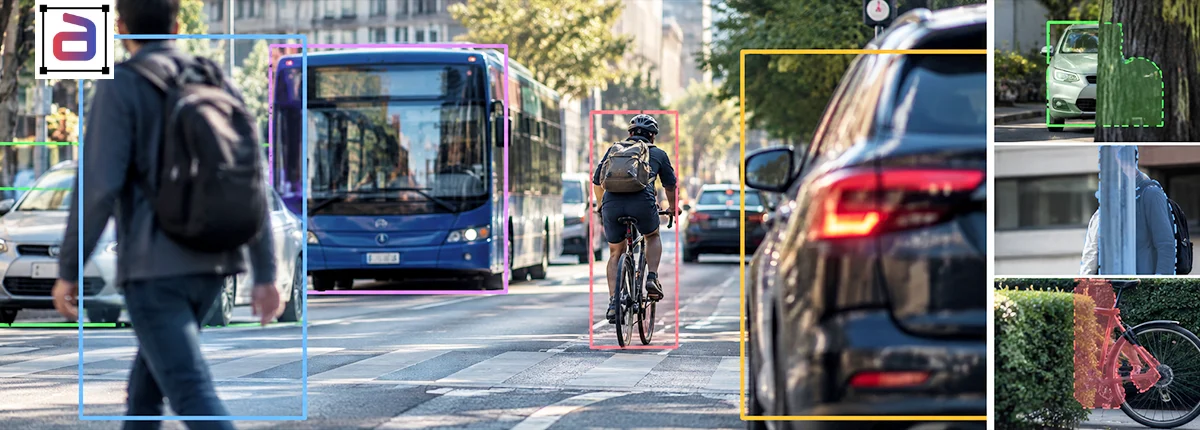
Occlusion occurs when one object or environmental element blocks another object from view. Visibility labeling captures how much of an object remains visible in a particular frame. For example, an annotation taxonomy may classify an object as:
- Fully visible
- Partially occluded
- Heavily occluded
- Fully hidden
- Truncated by the image boundary
- Reappearing after occlusion
These labels provide information beyond a basic bounding box. A bounding box tells an AI model where an object is located. Visibility information provides additional context about how much of that object can actually be observed. This distinction becomes particularly important when training models for real-world environments where objects frequently overlap, disappear, and reappear.
Why Partially Hidden Objects Are Difficult for AI
Computer vision models learn patterns from examples. If training data primarily contains clearly visible objects, the model may struggle when only a small portion of the object appears in the frame. Consider a pedestrian walking across a busy road. In one frame, the entire person is visible. A few frames later, a car blocks the lower body. Later, the pedestrian is almost completely hidden. After the car moves away, the pedestrian becomes visible again. Without consistent temporal annotation, an AI system may interpret these frames as unrelated objects—or conclude that the pedestrian disappeared and a new pedestrian appeared. This can lead to problems such as:
- Identity switching
- Lost object tracks
- Duplicate detections
- Incorrect bounding boxes
- Poor segmentation
- Reduced re-identification accuracy
“For video AI, visibility is not just a visual property—it is a temporal signal.”
By labeling visibility consistently across consecutive frames, training datasets can better represent the way objects behave in dynamic environments.
How Occlusion Labels Support Multi-Object Tracking
Multi-object tracking requires AI to maintain an object’s identity as it moves through a scene. Suppose a surveillance camera tracks three people. One person walks behind another and is visible only from the shoulders upward. A few seconds later, the person emerges from behind the other individual. A strong annotation workflow can maintain the same object identity throughout the sequence while recording the changing visibility state. This allows models to learn that: Visible → Partially Occluded → Heavily Occluded → Visible Again represents one continuous object trajectory rather than multiple independent detections. For applications such as autonomous driving, surveillance, robotics, and retail analytics, this temporal consistency can be particularly valuable.
Occlusion vs. Truncation: Why the Difference Matters
One of the most important aspects of high-quality annotation is distinguishing occlusion from truncation. Imagine a vehicle that is entirely within the camera’s field of view but is partially blocked by another vehicle. That is an occlusion event. Now imagine a vehicle entering the scene from the edge of the camera frame, where part of the vehicle lies outside the captured image. That is truncation. Although both situations result in incomplete visual information, they represent different circumstances. Clear annotation guidelines should therefore define how each condition is labeled. Otherwise, inconsistent labeling can introduce noise into the training dataset and make it harder for models to learn reliable object boundaries and visibility patterns.
Why Frame-to-Frame Consistency Matters
Video annotation is fundamentally different from annotating isolated images. An annotation that looks correct in one frame may become problematic when compared with the surrounding frames. For this reason, video datasets require temporal consistency. A robust annotation workflow can include:
- Identifying the object.
- Assigning a persistent tracking ID.
- Creating the required bounding box or segmentation.
- Assigning the appropriate visibility state.
- Recording occlusion events according to project guidelines.
- Maintaining the object’s identity through hidden frames where appropriate.
- Updating labels when the object becomes visible again.
- Validating the sequence for tracking and labeling consistency.
Annotera’s video annotation workflows are designed around frame-level accuracy and quality validation, helping identify issues such as label inconsistency, tracking errors, and temporal gaps before datasets are delivered.
Where Occlusion and Visibility Annotation Matters Most
Occlusion-aware datasets can support a wide range of AI applications.
Autonomous Vehicles
Vehicles, pedestrians, cyclists, and road infrastructure frequently overlap. Visibility labels can help perception models learn to handle partially hidden road users and changing scene conditions.
Robotics
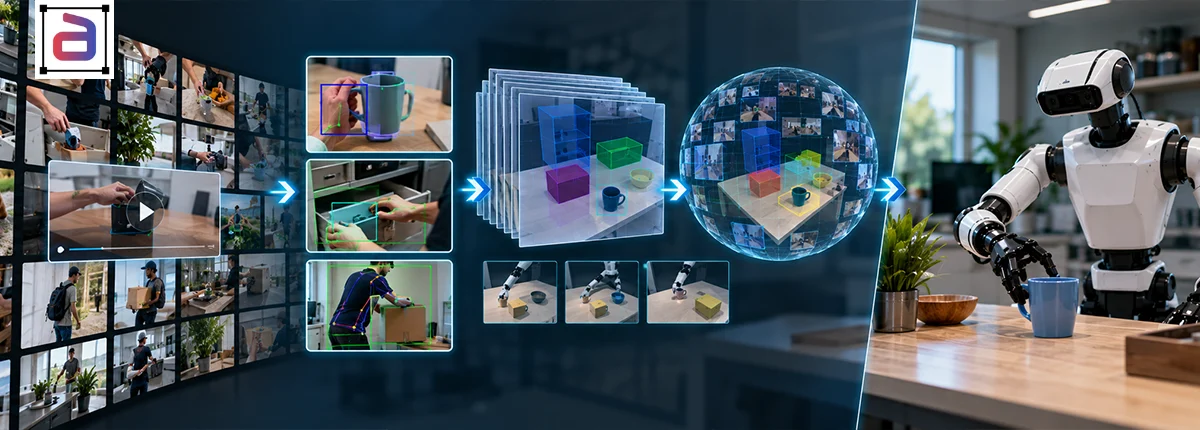
Robots operating in warehouses, factories, and other environments often encounter objects hidden behind equipment, shelves, or other objects. Occlusion-aware training data can support better scene understanding.
Security and Surveillance
Crowded environments create frequent overlaps between people and objects. Tracking individuals through temporary occlusion can be important for video analytics systems.
Retail Analytics
Customers may move behind shelves, displays, shopping carts, or other customers. Visibility-aware annotation can help models interpret movement more consistently.
Sports Analytics
Players frequently overlap during gameplay. Tracking and visibility labels can help models maintain player identities despite temporary obstruction.
How Annotera Approaches Occlusion-Aware Video Annotation
At Annotera, we recognize that high-quality video annotation requires more than drawing boxes around visible objects. Our video annotation services support techniques including 2D bounding boxes, polygons, 3D cuboids, keypoints, object classification, multi-object tracking, event tracking, and occlusion and visibility tagging. Our workflows combine trained human annotators with structured quality assurance processes. Annotera states that its video annotation operations use frame-level validation and multi-layer quality controls to support consistent, production-ready datasets. For businesses considering video annotation outsourcing, this approach can provide the operational capacity required to process large video volumes without treating complex edge cases as simple labeling tasks.
“Better video AI begins with better representations of what the camera cannot fully see.”
Build More Reliable Video AI With Better Training Data
Real-world video is rarely perfect. Objects overlap. People move behind vehicles. Products disappear behind shelves. Robots operate around obstacles. Targets leave and re-enter camera views. AI models need training data that reflects these realities. Occlusion and visibility labels give computer vision systems a structured way to learn from partially hidden objects rather than treating incomplete visibility as missing information. When these labels are combined with consistent tracking IDs, frame-level validation, and clearly defined annotation guidelines, they can create datasets that better represent the complexity of real-world video. For AI teams scaling computer vision development, the quality of these underlying labels can make a significant difference to the usefulness of the resulting dataset.
Train AI to See Beyond the Visible
Need high-quality datasets for object tracking, autonomous systems, surveillance, robotics, or video intelligence? Annotera provides scalable video annotation outsourcing services tailored to complex computer vision requirements—from object detection and multi-object tracking to occlusion, visibility, and frame-level validation. Partner with Annotera to transform challenging video footage into structured training data built for real-world AI. Contact our team today to discuss your video annotation requirements and start building a more reliable computer vision dataset.
A closely related read: Video Annotation for Sports Analytics: From Frame-by-Frame Labeling to Winning Strategies.