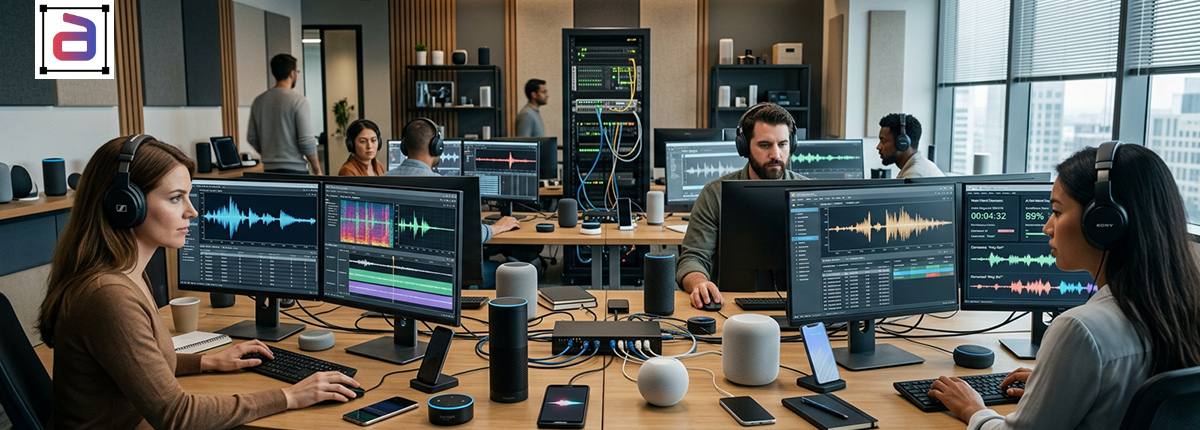
Voice assistants have become an integral part of modern life. From smartphones and smart speakers to connected vehicles and industrial IoT systems, users now expect hands-free interactions that are instant, accurate, and natural. Whether it’s saying “Hey Siri,” “Alexa,” or “Hey Google,” every successful interaction begins with one crucial capability—accurate wake word detection. Behind this seemingly effortless experience lies a sophisticated AI training process powered by high-quality annotated speech data. Wake word annotation teaches machine learning models exactly when a voice assistant should activate and, equally important, when it should remain silent. As conversational AI continues to evolve, organizations are increasingly turning to experienced providers of audio annotation services to build reliable datasets that improve voice recognition accuracy, reduce false activations, and enhance user trust.
Understanding Wake Word Annotation
Wake word annotation is the process of labeling audio recordings that contain predefined trigger phrases used to activate voice-enabled systems. Unlike traditional speech transcription, wake word annotation focuses on teaching AI models to detect specific keywords under diverse real-world conditions. Wake Word Annotation involves labeling trigger phrases that activate voice-enabled devices and virtual assistants. Moreover, accurate annotation helps AI distinguish intended commands from background speech, thereby improving wake word detection accuracy, reducing false activations, and enhancing user experience. A comprehensive wake word annotation workflow typically includes:
- Precise start and end timestamps for wake phrases
- Speaker identification and demographics
- Accent and dialect labeling
- Background noise categorization
- False activation examples
- Non-trigger speech samples
- Audio quality assessment
- Environmental context
These annotations enable keyword spotting models to distinguish intended activation commands from everyday conversations, television audio, overlapping speakers, and environmental noise.
The Growing Importance of Voice AI
Voice technology is no longer limited to consumer electronics. Today, it powers customer service automation, healthcare assistants, automotive infotainment systems, industrial equipment, banking applications, and smart home ecosystems. According to Juniper Research, the number of digital voice assistants in use worldwide is expected to exceed 8.4 billion devices, surpassing the global population. This remarkable growth underscores the increasing reliance on voice-first interfaces across industries. Meanwhile, Grand View Research projects that the global speech and voice recognition market will continue expanding rapidly as enterprises adopt AI-powered conversational technologies across customer service, healthcare, automotive, and enterprise automation. As AI adoption accelerates, organizations need high-quality annotated datasets capable of supporting increasingly sophisticated speech models. As Voice AI adoption continues to expand, businesses increasingly rely on intelligent speech technologies to automate interactions and improve user experiences. Furthermore, high-quality annotated voice data enables more accurate speech recognition, natural conversations, and context-aware AI applications.
Why Wake Word Annotation Matters
A voice assistant has only one opportunity to make a positive first impression. When wake word detection fails, users immediately notice. There are two primary performance challenges. Accurate Wake Word Annotation is essential for building responsive and reliable voice assistants. Furthermore, it helps AI distinguish activation phrases from everyday conversations, thereby reducing false triggers, improving recognition accuracy, and delivering a smoother, hands-free user experience.
False Rejections
False rejections occur when a Voice AI system fails to recognize a valid wake word from an authorized user. Consequently, users experience interrupted interactions and frustration. Therefore, accurate wake word annotation is essential for improving detection sensitivity and overall system reliability. The assistant ignores the intended wake word. This leads to:
- Frustrating user experiences
- Repeated voice commands
- Reduced customer engagement
- Lower product satisfaction
False Acceptances
The assistant activates unexpectedly. False acceptances occur when a Voice AI system mistakenly activates after detecting unintended words or background sounds. Consequently, unnecessary responses and privacy concerns may arise. Therefore, accurate wake word annotation helps minimize false activations and improves overall system reliability. Consequences include:
- Privacy concerns
- Increased cloud processing costs
- Battery drain
- Interrupted conversations
- Loss of consumer trust
As renowned computer scientist Andrew Ng observed:
“AI is the new electricity.”
Just as electricity transformed every industry, AI is reshaping how humans interact with technology. But AI systems are only as effective as the quality of the data used to train them.
The Role of High-Quality Audio Annotation
Reliable wake word detection requires much more than simply labeling audio clips. Every annotation must capture linguistic nuance and real-world variability. High-quality audio annotation forms the backbone of accurate Voice AI systems. Moreover, it enables precise speech recognition, wake word detection, and sound classification. As a result, AI models become more reliable, responsive, and effective across diverse real-world environments.
Diverse Speakers
Voice assistants must understand users of different:
- Ages
- Genders
- Accents
- Languages
- Speaking styles
- Speech speeds
A diverse dataset significantly improves model generalization.
Real-World Acoustic Conditions
People rarely interact with voice assistants in perfectly quiet environments. Training datasets should include recordings captured amid:
- Traffic
- Household appliances
- Television
- Office conversations
- Restaurants
- Wind
- Music
- Public transportation
Carefully labeled environmental conditions help models remain accurate under challenging circumstances.
Precise Temporal Annotation
Millisecond-level timestamp accuracy enables keyword spotting models to identify wake words quickly while minimizing latency. This creates the fast response users expect from premium voice assistants.
Hard Negative Examples
Perhaps the most valuable training data consists of phrases that resemble—but are not—the wake word. Examples include:
- Similar pronunciations
- Partial trigger words
- Television dialogue
- Background conversations
- Music lyrics
These negative samples dramatically reduce accidental activations. At Annotera, we help AI innovators develop production-ready speech datasets through scalable, human-in-the-loop annotation workflows that deliver the precision modern voice assistants demand.
Common Challenges in Wake Word Annotation
Developing enterprise-grade wake word datasets presents several complexities. Wake Word Annotation involves challenges such as background noise, overlapping speech, diverse accents, and pronunciation variations. Consequently, consistent annotation guidelines and expert human review are essential to improve detection accuracy, reduce false activations, and ensure reliable Voice AI performance.
Accent Diversity
Global products must recognize speakers from different linguistic backgrounds while maintaining consistent performance.
Whispered Speech
Many users intentionally speak quietly during nighttime interactions. Models require carefully annotated whisper datasets to improve sensitivity.
Far-Field Audio
Smart speakers often receive commands from several meters away. Distance introduces echo, reverberation, and lower signal quality, making precise annotation essential.
Overlapping Conversations
Multiple simultaneous speakers create ambiguity that only experienced human annotators can accurately resolve. These challenges highlight why organizations increasingly rely on specialized audio annotation outsourcing partners rather than attempting large-scale annotation internally.
Why Businesses Choose Data Annotation Outsourcing
Creating production-quality speech datasets requires experienced annotators, robust quality assurance processes, scalable infrastructure, and domain expertise. As AI projects become increasingly complex, businesses choose data annotation outsourcing to access skilled annotation experts and scalable resources. Moreover, outsourcing reduces operational costs, accelerates project timelines, and ensures consistent, high-quality training data for reliable AI model development. Partnering with a trusted data annotation company enables organizations to:
- Accelerate AI development
- Scale annotation capacity on demand
- Reduce operational costs
- Access multilingual annotation experts
- Improve dataset consistency
- Maintain stringent quality standards
- Shorten model development cycles
Instead of investing heavily in internal annotation teams, businesses benefit from the efficiency and flexibility of data annotation outsourcing, allowing engineering teams to focus on model innovation while annotation specialists prepare high-quality training data.
Why Annotera Is the Trusted Partner for Voice AI
At Annotera, we recognize that exceptional AI begins with exceptional data. As a leading data annotation company, we combine skilled human expertise with rigorous quality assurance methodologies to deliver enterprise-ready speech datasets tailored to your AI objectives. Annotera combines experienced human annotators with rigorous quality assurance to deliver high-quality Voice AI training data. Moreover, our scalable, multilingual annotation services help businesses build accurate, responsive, and reliable voice-enabled AI solutions with greater confidence. Our comprehensive audio annotation services include:
- Wake word annotation
- Keyword spotting annotation
- Speech segmentation
- Speaker diarization
- Emotion annotation
- Audio event labeling
- Speech transcription
- Multilingual speech annotation
- Conversational AI dataset preparation
Every project benefits from standardized annotation guidelines, multi-stage quality reviews, experienced linguistic specialists, and scalable delivery models that support startups and global enterprises alike. Whether you’re building next-generation smart speakers, automotive voice assistants, healthcare applications, or industrial AI solutions, Annotera provides the high-quality annotated data that powers reliable, production-ready voice intelligence.
As AI pioneer Fei-Fei Li aptly stated:“The strength of AI is not the algorithm alone—it is the data that teaches it to understand the world.”
That principle is especially true for conversational AI, where every accurately labeled audio sample contributes directly to better user experiences.
Conclusion
Wake word annotation forms the foundation of every successful voice assistant. Accurate annotations enable AI systems to recognize activation phrases across different accents, environments, recording devices, and speaking styles while minimizing false activations and missed commands. As conversational AI becomes central to customer engagement, smart devices, automotive technology, and enterprise automation, investing in professional audio annotation outsourcing is no longer just an operational decision—it is a competitive advantage. Organizations that prioritize high-quality training data consistently build voice assistants that are faster, smarter, and more trustworthy.
Build Reliable Voice Assistants with Annotera
The performance of your voice AI begins with the quality of your training data. Whether you’re developing wake word detection systems, multilingual speech models, or next-generation conversational AI, Annotera delivers the expertise, scalability, and precision required to accelerate your success. Our expert annotators, advanced quality assurance framework, and flexible delivery model ensure every audio sample contributes to stronger, more accurate AI models. Partner with Annotera today to leverage industry-leading audio annotation services and scalable data annotation outsourcing solutions that transform raw audio into intelligent, production-ready AI datasets. Let’s build the future of voice AI—together.
A closely related read: Why Your AI Project Needs A Human Partner, Not Just A Platform.
A closely related read: The ROI of Data Annotation Outsourcing for AI and ML Projects.