Artificial intelligence is redefining how cities function and how industries optimize operations. While computer vision has long been at the forefront of AI innovation, sound is rapidly emerging as an equally powerful source of actionable intelligence. From detecting emergency sirens in bustling urban centers to identifying subtle machine anomalies on factory floors, AI-powered acoustic event detection is enabling faster, safer, and more informed decision-making. However, these intelligent systems don’t learn from sound alone—they learn from meticulously labeled audio data. Without high-quality annotations, AI models struggle to distinguish meaningful acoustic events from background noise, reducing their effectiveness in real-world environments. This is where Annotera makes the difference.
As a trusted data annotation company, Annotera delivers scalable, high-precision audio annotation services that empower organizations to build smarter AI solutions for smart cities, industrial automation, public safety, transportation, and beyond. For AI, that principle goes one step further: without accurately annotated data, even the most advanced algorithms cannot reach their full potential.
Why Acoustic Event Annotation Matters
Acoustic event annotation is the process of identifying, labeling, and timestamping non-speech sounds within audio recordings so machine learning models can recognize and interpret them accurately. Unlike speech transcription, which converts spoken language into text, acoustic event annotation focuses on environmental and operational sounds, including:
- Emergency sirens
- Gunshots
- Glass breaking
- Vehicle horns
- Construction noise
- Machine vibrations
- Engine sounds
- Industrial alarms
- Footsteps
- Animal sounds
- Weather events
- Crowd activity
Each labeled sound teaches AI models to detect, classify, and respond to real-world events with greater confidence. Whether the goal is predictive maintenance in manufacturing or real-time threat detection in urban environments, high-quality annotations are the foundation of reliable acoustic AI.
“Without data, you’re just another person with an opinion.” — W. Edwards Deming
The Growing Demand for Acoustic AI
The rapid expansion of IoT devices, edge computing, and connected infrastructure has led to an explosion of machine-generated audio data. According to IDC, the global datasphere is projected to grow to 394 zettabytes by 2028, fueled largely by IoT sensors, connected devices, and industrial systems. Much of this data includes valuable environmental and operational audio that can train next-generation AI models. At the same time, MarketsandMarkets forecasts the global Smart Cities market to exceed USD 1 trillion by 2030, driven by investments in intelligent transportation, public safety, utilities, and urban infrastructure. These advancements are increasing demand for expertly curated datasets supported by specialized audio annotation services.
“Artificial Intelligence is the new electricity.” — Andrew Ng
Just as electricity transformed every industry, AI powered by high-quality annotated data is becoming an essential utility for the modern world. As voice-driven technologies continue to evolve, the demand for Acoustic AI is rapidly increasing. Consequently, businesses require accurately annotated speech data to improve voice recognition, emotion detection, and conversational intelligence. Therefore, high-quality emotion annotation has become essential for developing reliable, human-centric AI applications.
Powering Smarter Cities Through Sound
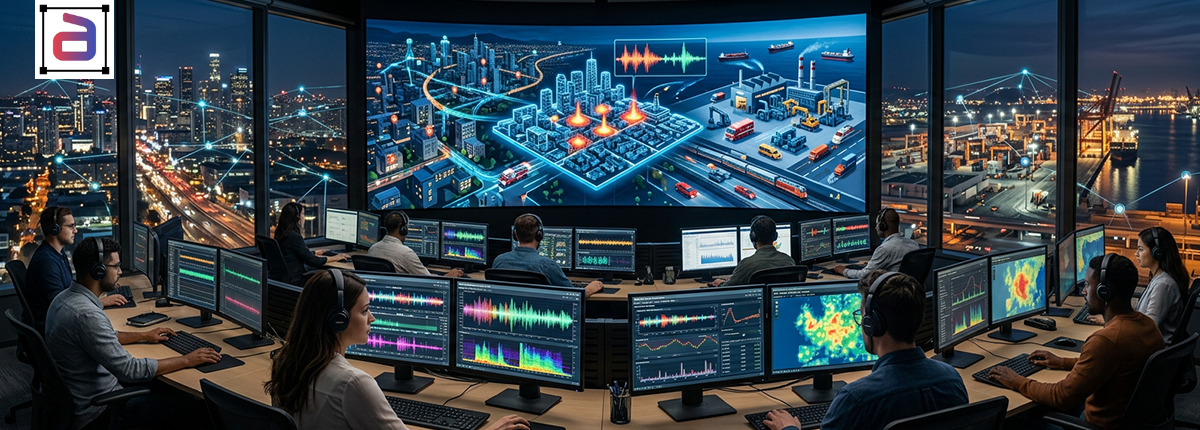
Smart cities are increasingly deploying distributed acoustic sensors that continuously monitor urban environments. As smart cities become increasingly connected, Acoustic AI plays a vital role in monitoring urban environments. Moreover, accurately annotated audio data enables AI systems to detect emergencies, manage traffic, improve public safety, and support faster, data-driven decision-making. With accurate acoustic event annotation, AI systems can identify:
Emergency Events
AI models recognize:
- Police sirens
- Ambulance sirens
- Fire truck alarms
- Gunshots
- Explosions
These systems help emergency responders react more quickly while improving public safety.
Traffic Intelligence
Acoustic AI detects:
- Vehicle congestion
- Motorcycle traffic
- Heavy trucks
- Honking patterns
- Construction equipment
These insights support traffic optimization and infrastructure planning.
Environmental Monitoring
Cities also use sound analytics to identify:
- Noise pollution
- Illegal construction
- Public disturbances
- Wildlife activity
- Weather-related events
Because urban environments are filled with overlapping sounds, accurate annotation is essential for minimizing false positives and improving AI reliability.
Industrial AI Begins with High-Quality Audio Data
Factories, warehouses, and manufacturing facilities generate thousands of unique acoustic signatures every day. As industrial automation advances, high-quality audio data becomes increasingly important for intelligent AI systems. Furthermore, accurately annotated sound recordings enable predictive maintenance, equipment monitoring, anomaly detection, and safer industrial operations through more reliable machine learning models. Subtle changes in equipment sounds often indicate:
- Bearing wear
- Motor failures
- Air leaks
- Pump degradation
- Compressor issues
- Mechanical imbalance
Rather than waiting for costly breakdowns, AI systems trained on annotated audio datasets can detect these anomalies early. According to McKinsey, predictive maintenance powered by AI can:
- Reduce maintenance costs by 10–40%
- Decrease equipment downtime by 30–50%
- Extend equipment lifespan by 20–40%
These improvements depend on accurately labeled audio datasets capable of distinguishing normal operational sounds from early warning signals.
Why High-Quality Annotation Makes All the Difference
Acoustic data presents unique challenges that require human expertise. High-quality annotation forms the foundation of reliable AI performance. Moreover, accurate labeling improves model precision, reduces bias, and enhances real-world decision-making. As a result, organizations can develop more trustworthy, scalable, and efficient AI solutions across diverse applications.
Overlapping Sound Sources
A single recording may include machinery, voices, alarms, vehicles, and environmental sounds occurring simultaneously. Each event must be identified independently.
Background Noise
Wind, echoes, static, and microphone interference often obscure important sounds. Experienced annotators distinguish relevant acoustic events from ambient noise.
Precise Timestamping
AI models require frame-level accuracy that identifies exactly when each sound begins and ends. Even small labeling inconsistencies can reduce model accuracy.
Complex Taxonomies
Industrial AI applications frequently classify hundreds of unique sound categories, requiring standardized guidelines and rigorous quality assurance throughout the annotation process.
Why Businesses Choose Data Annotation Outsourcing
Building an in-house annotation operation requires significant investments in hiring, training, infrastructure, and quality management. As AI initiatives grow, organizations increasingly rely on data annotation outsourcing to accelerate development while maintaining high-quality datasets. As AI projects continue to scale, many businesses choose data annotation outsourcing to improve efficiency and reduce operational costs. Furthermore, outsourcing provides access to skilled annotators, faster project delivery, and consistent quality, enabling quicker AI development and deployment. The advantages include:
- Faster project delivery
- Lower operational costs
- Access to experienced annotation specialists
- Scalable workforce capacity
- Consistent quality assurance
- Rapid support for large datasets
Partnering with an experienced data annotation company allows businesses to focus on AI innovation while trusted experts manage complex annotation workflows.
Why Annotera Is the Trusted Partner for Acoustic AI
At Annotera, we understand that every sound carries valuable information—but only when it is accurately labeled. Our dedicated annotation teams combine human expertise, AI-assisted workflows, and multi-stage quality assurance to create datasets that deliver measurable improvements in model performance. At Annotera, we combine expert human annotation with rigorous quality assurance to deliver reliable Acoustic AI training data. Moreover, our scalable workflows, multilingual expertise, and customized annotation solutions help businesses build accurate, high-performing AI models with confidence. Our comprehensive audio annotation services include:
- Acoustic event annotation
- Environmental sound labeling
- Multi-label audio classification
- Timestamp annotation
- Machine sound annotation
- Industrial anomaly labeling
- Emergency sound detection datasets
- Urban acoustic dataset preparation
- Human-in-the-loop validation
- Quality assurance and dataset auditing
Whether you’re developing smart city platforms, predictive maintenance systems, autonomous robotics, security applications, or industrial monitoring solutions, Annotera provides scalable audio annotation outsourcing tailored to your project’s complexity, volume, and quality requirements. Every annotation project is backed by standardized workflows, domain-trained annotators, secure data handling, and rigorous validation processes—ensuring your AI models are trained on datasets you can trust.
“The quality of an AI system is fundamentally limited by the quality of the data used to train it.”
At Annotera, this principle guides every annotation project we deliver.
The Future of Acoustic Intelligence
The next generation of AI will be inherently multimodal, combining computer vision, sound, sensor data, and language understanding into unified intelligence systems. As Acoustic AI continues to evolve, intelligent systems will better understand sounds, speech, and emotions in real time. Consequently, high-quality annotated audio data will remain essential for developing smarter, more adaptive, and context-aware AI solutions across industries.
Acoustic AI will play a pivotal role in:
- Autonomous transportation
- Smart manufacturing
- Connected healthcare
- Intelligent surveillance
- Public safety
- Environmental monitoring
- Edge AI applications
Organizations that invest today in high-quality annotated audio datasets will be better positioned to build scalable, reliable, and trustworthy AI solutions tomorrow.
Build Smarter AI with Annotera
As industries and cities become increasingly connected, the ability to understand sound in real time is becoming a strategic advantage. High-quality acoustic event annotation enables AI systems to detect critical events, improve operational efficiency, enhance safety, and make faster decisions. Success, however, begins with accurate training data. As a leading data annotation company, Annotera delivers industry-leading audio annotation services that combine human expertise, scalable operations, and uncompromising quality. Whether you’re exploring data annotation outsourcing for enterprise-scale AI initiatives or seeking dependable audio annotation outsourcing for specialized acoustic datasets, our experts are ready to help. Partner with Annotera to transform raw audio into high-quality training data that powers next-generation AI applications. Contact our annotation specialists today to discover how our scalable, secure, and precision-driven annotation solutions can accelerate your AI development while ensuring exceptional model performance.
This connects closely with sound event detection at the consumer, in-home level.
This connects closely with scene recognition built into consumer smart devices.