
How RLHF Works: Human Feedback Loops that Make LLMs Safer

As enterprises accelerate their adoption of large language models (LLMs), one reality is becoming unavoidable: AI is only as safe as the human feedback that shapes it. Reinforcement Learning from Human Feedback (RLHF) has emerged as the industry-standard method for aligning LLMs with real-world expectations, ethical norms, and safety guardrails. Learn more about reducing hallucinations […]
How To Build A Data-Centric AI Roadmap Around Annotation Quality

The data-centric AI movement shifts focus from model architecture to data quality. Instead of tuning hyperparameters and adding layers, teams improve models by fixing, enriching, and curating their training data. Annotation quality sits at the center of this approach. The ethical dimension ethical AI in data annotation covers bias control, fairness, and human oversight in […]
Data Annotation vs Data Labeling: What’s the Real Difference For AI Teams?
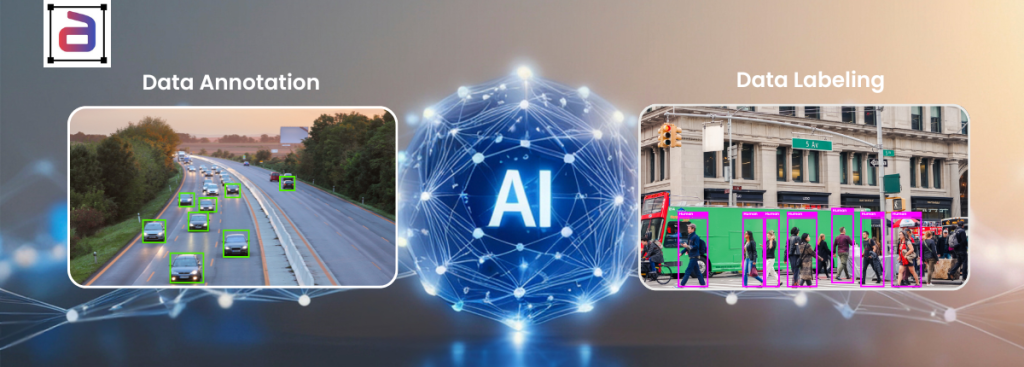
In the world of AI and machine learning, the terms data annotation and data labeling are often used interchangeably. While they are related, they are not the same. Understanding the real difference helps AI teams make better decisions about data preparation, tool selection, and overall project strategy. Key Points Data labeling assigns a category or […]
How to Evaluate Training Data for Trustworthy AI Vision

A computer vision model can score well during development and still fail when it encounters the real world. The reason is often not the model architecture. It is a gap between the data used during training and the conditions the system faces after deployment. That makes trustworthy AI vision a training-data problem as much as […]
Quality Over Quantity: The Unbreakable Link Between Training Data and AI Vision Performance

When it comes to computer vision, the biggest performance gains often don’t come from bigger models or more compute — they come from better training data. High-quality, carefully annotated datasets consistently outperform larger but lower-quality ones in real-world applications. Key Points Computer vision model performance gains from better training data consistently outperform gains from model […]
Accuracy Guaranteed: Proven Methods To Overcome Data Annotation Pitfalls

High-quality annotations are the invisible scaffolding beneath every reliable AI model. Yet even teams with the best intentions stumble: inconsistent labels, edge-case drift, ambiguous guidelines, and scaling problems quietly erode model performance. This blog explains the most common annotation pitfalls and — crucially — the proven methods Annotera, a leading data annotation company, uses to […]
From Pixels to Predictions: How Data Annotation Fuels Computer Vision With Deep Learning

Computer vision is transforming industries — from autonomous vehicles and medical imaging to retail analytics and industrial inspection. At the heart of every successful computer vision system is high-quality training data. Raw images and videos must be carefully labeled before models can learn to detect objects, recognize patterns, or make accurate predictions. Key Points Computer […]
The Ultimate Roadmap To Successful Data Annotation Outsourcing

High-quality labeled data is essential for training effective AI models. As AI projects scale, many teams find that data annotation becomes a major bottleneck — not due to model limitations, but because building and managing large-scale, accurate labeling pipelines internally is complex and resource-intensive. Outsourcing data annotation has become a strategic decision that helps companies […]
Why High-Quality Data Annotation Is the Driving Force Behind AI Innovation Across Sectors

In the race to build smarter AI, raw data is only half the story. The other half—the part that decides whether a model reaches production—is high-quality annotation. Labels are the ground truth that teaches AI how the world looks and behaves. That applies from pinpointing a pedestrian in a driving video to marking sentiment in […]
Human-in-the-Loop (HITL) Approaches For Higher-Quality LLM Fine-Tuning Data

Fine-tuning large language models depends on data that is not only large but also correctly labeled. For a broader look at how generative AI is transforming how that labeling gets done in the first place, see generative AI and the future of annotation., debiased, and aligned to the target task. The impact of LLMs […]