
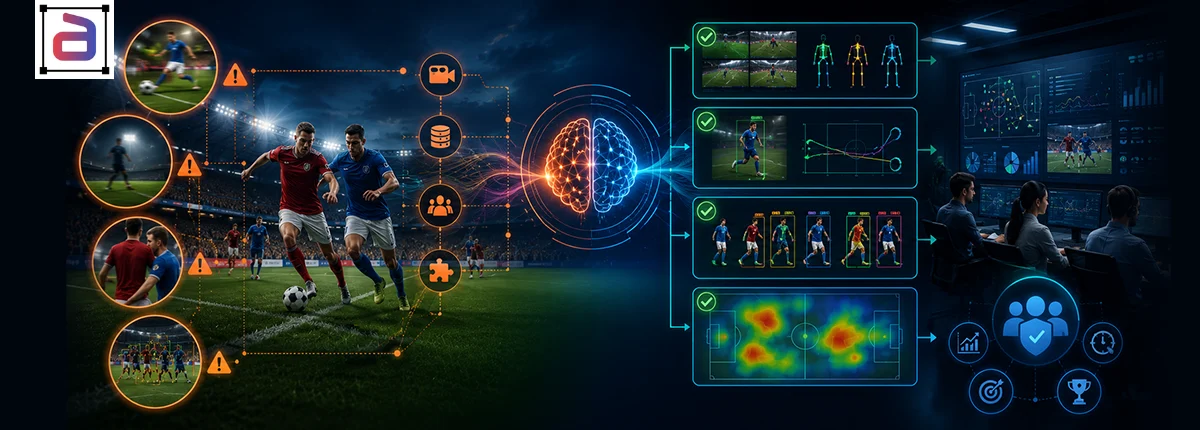
Artificial intelligence is reshaping the sports industry faster than ever before. From real-time player tracking and automated match analysis to injury prediction and tactical intelligence, AI-powered technologies are becoming essential for professional teams, broadcasters, and sports analytics companies. However, behind every intelligent sports AI system lies one critical element: high-quality annotated video data. Sports environments are fast, unpredictable, and visually complex. Training AI models to accurately interpret these environments requires precision-driven annotation workflows capable of handling massive video datasets with exceptional consistency. This is where partnering with an experienced data annotation company becomes crucial. At Annotera, we help AI teams overcome the toughest sports video annotation challenges through scalable, high-accuracy annotation services designed specifically for advanced computer vision applications.
Key Points
- Sports video annotation tracks players, ball positions, and actions across frames.
- Fast motion, occlusion, and crowd backgrounds make sports annotation more complex.
- AI coaching and broadcast analytics rely on high-accuracy sports annotation data.
- Expert annotators use sport-specific taxonomies to maintain label consistency.
Table of Contents
The Growing Demand for Sports Video Annotation
The sports analytics market is experiencing explosive growth. According to MarketsandMarkets, the global sports analytics market is expected to surpass USD 8.4 billion by 2027 as organizations increasingly rely on AI-driven performance analysis and fan engagement technologies. As sports organizations increasingly adopt AI-driven analytics, the demand for sports video annotation continues to grow rapidly. Moreover, accurate video labeling enables better player tracking, tactical analysis, and performance prediction, thereby helping AI systems deliver more reliable and intelligent insights. Modern sports AI systems require enormous volumes of accurately labeled video data to train models for:
- Player tracking
- Pose estimation
- Ball detection
- Event recognition
- Tactical analysis
- Automated highlights generation
- Referee decision support systems
However, creating these datasets is far from simple. A professional video annotation company must manage complex visual environments where speed, precision, and temporal consistency are critical.
“Excellence is the gradual result of always striving to do better.” – Pat Riley
Challenge 1: Fast-Paced Gameplay and Motion Blur
Sports are inherently dynamic. In football, basketball, hockey, and tennis, athletes move rapidly across frames, often causing motion blur and visual distortion. Fast-paced sports gameplay often creates motion blur, making accurate object tracking and player identification extremely challenging. Consequently, AI teams must implement advanced video annotation techniques and temporal tracking methods to maintain annotation precision and improve overall model performance. This creates major difficulties for annotation teams because AI systems require precise object labeling frame-by-frame. Even a small annotation error can negatively impact model accuracy during training.
How AI Teams Overcome It
AI teams increasingly combine automation with human expertise to improve efficiency and precision. At Annotera, we use AI-assisted annotation workflows supported by expert human validation to ensure superior data quality. Our annotation specialists carefully track player movement across frames while maintaining temporal consistency throughout the dataset. We also implement:
- AI-assisted object tracking
- High-frame-rate video processing
- Keypoint annotation
- Multi-frame interpolation
- Quality assurance checkpoints
This hybrid approach accelerates annotation speed while preserving annotation accuracy.
Challenge 2: Player Occlusion and Overlapping Objects
In team sports, players frequently overlap, collide, or move into crowded formations. During corner kicks, rebounds, or defensive formations, athletes may become partially or fully hidden from view. Player occlusion and overlapping objects frequently occur during fast-moving sports sequences, making accurate tracking increasingly difficult. Therefore, AI teams rely on advanced annotation methods and multi-object tracking techniques to preserve object continuity and improve computer vision model accuracy. This phenomenon, known as occlusion, creates serious challenges for computer vision models attempting to maintain player identity across frames.
How AI Teams Overcome It
Overcoming occlusion requires advanced annotation strategies and experienced annotators. As a trusted data annotation company, Annotera uses sophisticated techniques such as:
- Multi-object tracking
- Polygon annotation
- Skeletal keypoint labeling
- Persistent identity tracking
Our annotation teams ensure continuity even when objects temporarily disappear from view. This level of precision is especially important for sports analytics platforms that depend on uninterrupted player tracking and behavioral analysis.
Challenge 3: Complex Camera Angles and Dynamic Environments
Sports broadcasts involve constantly changing camera perspectives, zoom levels, lighting conditions, and environmental variables. Outdoor stadiums introduce additional complexity through weather changes, shadows, and varying field conditions. Complex camera angles, changing lighting conditions, and dynamic sports environments often reduce annotation consistency and model accuracy. Consequently, AI teams must use diverse training datasets and advanced video annotation strategies to ensure reliable object detection across varying gameplay scenarios. These inconsistencies can confuse AI models if training datasets lack sufficient diversity.
How AI Teams Overcome It
To build robust AI systems, annotation datasets must represent a wide range of real-world conditions. Annotera helps organizations create highly diverse training datasets that include:
- Multiple camera angles
- Different lighting environments
- Indoor and outdoor gameplay
- Variable weather conditions
- Crowd-heavy scenes
- High-motion sequences
This diversity improves AI model generalization and real-world reliability. According to Stanford University researchers, AI systems trained on diverse visual datasets consistently outperform models trained on limited environmental conditions. This is one reason many organizations choose data annotation outsourcing to scale annotation projects efficiently while maintaining dataset diversity.
Challenge 4: Maintaining Temporal Consistency
Sports AI models rely heavily on temporal understanding. Actions unfold over sequences of frames, not isolated images. Maintaining temporal consistency across video frames is essential for accurate sports AI training. Moreover, inconsistent annotations can disrupt motion tracking and action recognition, thereby requiring AI teams to implement rigorous quality assurance and frame-to-frame validation processes. If annotations shift inconsistently during movement sequences, AI models may struggle with:
- Motion prediction
- Action recognition
- Tactical analysis
- Pose estimation
Temporal inconsistency is one of the most overlooked problems in sports video annotation.
How AI Teams Overcome It
At Annotera, quality assurance is embedded into every stage of the annotation pipeline. Our video annotation outsourcing workflows include:
- Sequence-level validation
- Frame continuity reviews
- Human-in-the-loop verification
- Automated anomaly detection
This ensures that annotations remain stable and accurate across entire gameplay sequences.
“The real bottleneck of AI is not algorithms anymore — it’s data.” – Fei-Fei Li
Challenge 5: Massive Volumes of Sports Data
Professional sports organizations generate enormous quantities of video content every season. Training sessions, match footage, practice drills, and performance recordings can quickly become overwhelming for internal AI teams. Manual annotation alone is often too slow and resource-intensive.
How AI Teams Overcome It
Many organizations now rely on data annotation outsourcing to scale annotation operations efficiently. Annotera provides scalable annotation solutions capable of handling large enterprise-level video datasets without compromising quality. Our scalable infrastructure supports:
- Rapid project turnaround
- Distributed annotation workflows
- AI-assisted pre-labeling
- Enterprise-grade quality control
- Flexible project scaling
This enables AI teams to accelerate model development while controlling operational costs.
Challenge 6: Understanding Complex Sports Actions
Sports actions are highly contextual. A fake pass, defensive feint, or tactical movement may appear visually similar to another action while carrying completely different meanings. Accurately labeling these actions requires both technical expertise and sports-specific understanding.
How AI Teams Overcome It
At Annotera, our annotation specialists follow customized project guidelines tailored to specific sports applications. We combine domain expertise with advanced annotation protocols to deliver highly accurate action recognition datasets for:
- Football analytics
- Basketball tracking
- Tennis AI systems
- Combat sports analysis
- Fitness and biomechanics applications
This human-centered approach ensures that subtle gameplay nuances are accurately captured for AI training.
Why Leading AI Teams Choose Annotera
Sports AI companies need more than basic labeling services. They need a strategic annotation partner capable of delivering precision, scalability, and consistency. Annotera stands out as a reliable video annotation company by combining advanced AI-assisted workflows with experienced human expertise. Our services include:
- Video bounding box annotation
- Semantic segmentation
- Polygon annotation
- Keypoint and pose estimation
- Multi-object tracking
- Action recognition labeling
- Temporal video annotation
Whether organizations require large-scale video annotation outsourcing or specialized sports datasets, Annotera delivers enterprise-grade annotation solutions tailored for modern AI development.
The Future of Sports AI Starts with Better Annotation
The next generation of sports intelligence systems will depend heavily on high-quality training data. As AI adoption accelerates across professional sports, the demand for accurate and scalable video annotation will continue growing. Organizations that invest in better annotation today will gain a significant competitive advantage tomorrow. At Annotera, we help AI innovators transform raw sports footage into intelligent, actionable training data that powers advanced computer vision systems. The future of sports AI depends on high-quality multi-object tracking annotation that enables accurate tracking of players, officials, and the ball. Precise annotations help build intelligent models that deliver deeper performance insights, tactical analysis, and enhanced fan experiences.
Partner with Annotera
Looking to build smarter sports AI models with precise, scalable training datasets? Annotera delivers industry-leading annotation solutions designed for complex sports video workflows. From player tracking and pose estimation to action recognition and temporal annotation, our experts help AI teams accelerate development with confidence. Contact Annotera today to discover how our video annotation outsourcing solutions can support your next sports AI initiative.
A closely related read: How Video Annotation Supports AI-Powered Smart City Infrastructure.
Read also : Building Action Recognition Models with High-Quality Video Annotation