“Hey, can you move my appointment to Friday afternoon?” For a human listener, the request is straightforward. For a voice assistant, however, those few words contain multiple layers of information: speech sounds, individual words, speaker characteristics, intent, a date reference, sentence boundaries, tone, and potentially background noise. For clinical and medical settings, medical audio transcription for AI covers the specific transcription and annotation challenges that healthcare audio presents. Before conversational AI can respond intelligently, it must first learn how people actually speak. That is where conversational audio annotation becomes critical. Slot filling Customer support chatbots are one of the primary applications. See how annotation is revolutionizing customer support chatbots. Slot filling — extracting structured parameters from natural speech — is one of the hardest parts of that pipeline, and its specific challenges in real conversational speech are explored in the nuances of slot filling in conversational speech. Through accurate speech transcription, speaker labeling, timestamps, intent classification, acoustic-event tagging, and other annotation techniques, raw conversations can be transformed into structured training data that AI models can understand.
As businesses accelerate their adoption of voicebots, virtual assistants, and AI-powered customer support, high-quality annotated audio is becoming a foundational component of conversational AI development. According to Gartner, 85% of customer-service leaders planned to explore or pilot customer-facing conversational generative AI in 2025. The same research found that 44% were exploring GenAI voicebots, 11% were piloting them, and 5% had already deployed the technology.
Key Points
- The hidden crisis of poor annotation quality is its invisibility: annotation errors produce confident, wrong model outputs that appear correct until the model encounters the real-world scenarios that expose the gap between what it learned and what is true.
- Poor annotation quality is more expensive to fix after training than before: retraining on corrected labels requires re-running the full model training pipeline, while fixing annotation before training requires only updating the labels.
- Data quality in annotation is a preventable crisis: the practices that prevent annotation quality failures — precise guidelines, structured calibration, continuous quality sampling — are known and established; the crisis occurs when teams treat annotation as a commodity rather than as a precision activity.
- Annotation quality failures compound across the AI development lifecycle: a model trained on poor labels fails evaluation, triggers re-annotation, requires retraining, and delays deployment in ways that each add cost beyond the original annotation program.
What Is Conversational Audio Annotation?
Conversational audio annotation is the process of labeling recorded speech with metadata that helps machine learning models recognize, interpret, and respond to spoken language. Imagine a customer saying: “I ordered the blue one, but you sent me black. Can I replace it?” An annotated version could include:
- Transcript: the exact spoken words
- Speaker ID: Customer
- Intent: Product exchange
- Entity: Blue / Black
- Sentiment: Negative
- Timestamp: Beginning and end of the utterance
- Acoustic event: Background traffic
Together, these annotations turn an unstructured audio recording into machine-readable training data. For organizations developing voice assistants, contact-center AI, speech analytics, or multimodal conversational systems, working with an experienced data annotation company can help establish consistent annotation guidelines across thousands—or potentially millions—of conversations. As Gartner’s Kim Hedlin noted:
“More than seventy-five percent of customer service and support leaders said they feel pressure from executive leadership to implement GenAI.”
The opportunity is substantial—but conversational AI can only perform reliably when its training data reflects the complexity of real conversations.
What Goes Into Annotating Conversational Audio?
Conversational audio is rarely labeled using a single technique. Production-grade datasets typically combine several annotation layers depending on the model’s intended use.
1. Speech Transcription: Giving AI the Words
Speech transcription converts spoken language into written text and provides the fundamental ground truth used to train many automatic speech recognition (ASR) systems. But conversational transcription is not simply typing what someone says. Real conversations contain fillers such as “um” and “uh,” incomplete sentences, repetitions, mispronunciations, slang, technical vocabulary, and code-switching between languages. Depending on the project, Annotera can help structure transcription workflows that preserve these linguistic details rather than artificially cleaning them away. Accurate ground truth matters because an ASR model trained on inconsistent transcripts can learn inconsistent relationships between acoustic signals and language.
2. Speaker Diarization: Teaching AI Who Spoke When
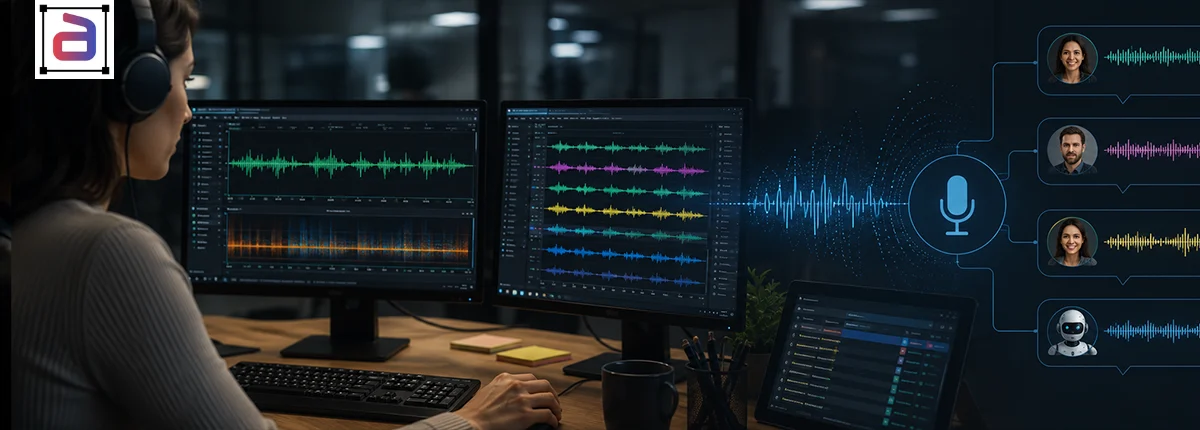
Consider a customer-service call: Customer: “My payment failed twice.” Agent: “Let me check the transaction.” Customer: “Sure.” The words alone are insufficient for understanding the interaction. The system also needs to distinguish between speakers. Speaker diarization identifies who spoke when, enabling models to reconstruct conversational turns. Diarized audio can support call analytics, meeting intelligence, customer-service automation, conversational search, and multi-speaker transcription systems.
3. Timestamp Annotation: Connecting Words to Audio
Timestamp annotation identifies precisely when speech segments, individual words, or acoustic events occur. Depending on the application, annotators can create: Segment-level timestamps for sentences or utterances. Word-level timestamps for precise speech alignment. Event timestamps for laughter, coughing, alarms, music, silence, or other relevant sounds. These annotations can be particularly useful for conversational search, subtitle synchronization, voice analytics, and speech model evaluation.
4. Intent and Entity Annotation: Moving From Hearing to Understanding
A useful voice assistant must do more than recognize words—it must determine what the speaker wants. Consider: “Book a table for four in Manhattan tomorrow evening.” An annotated dataset might identify: Intent: Restaurant reservation Party size: Four Location: Manhattan Date: Tomorrow Time: Evening This additional semantic layer helps connect speech recognition with natural language processing understanding. When combined with high-quality audio annotation services, intent and entity labeling can help AI systems move from simply transcribing conversations toward taking contextually appropriate actions.
The Real Challenge: People Don’t Speak Like Training Scripts
Laboratory-quality recordings are relatively straightforward. Real-world audio is not. People whisper, shout, hesitate, interrupt one another, change subjects mid-sentence, use regional expressions, speak over background music, or switch between languages. Accents and dialects introduce another important consideration. Stanford research examining major speech-recognition systems found an average word error rate of 35% for Black speakers compared with 19% for white speakers in the study’s dataset, illustrating how speech-recognition performance can vary substantially across speaker groups. Google researchers have similarly emphasized the importance of datasets representing different language varieties when developing more inclusive speech-recognition systems. Their research captures an essential lesson for conversational AI development:
“ASR systems must work for everybody independently of the way they speak.”
The implication for AI teams is clear: diversity in conversational training data is not optional when models are expected to serve diverse users.
Why High-Quality Audio Annotation Services Matter
A conversational AI model might perform impressively on clean benchmark recordings yet struggle once deployed in noisy homes, vehicles, offices, retail environments, or contact centers. Robust training datasets therefore need to represent conditions such as:
- regional accents and dialects,
- different speaking speeds,
- overlapping conversations,
- background music and environmental noise,
- microphone and compression variations,
- domain-specific terminology,
- multilingual and code-switched speech,
- incomplete or interrupted sentences.
Google research on personalized ASR demonstrated how additional training data can materially improve recognition for underrepresented speech. In one study, personalized models achieved a 35% relative word-error-rate improvement for accented speech. These findings reinforce why carefully curated and annotated datasets matter for real-world voice AI performance. Read more about scaling autonomous shopping AI with high-quality data annotation.
Human Expertise Remains Critical to Conversational Data Quality
Automation can accelerate transcription and preliminary labeling, but difficult conversational data often requires contextual judgment. Was that word “fifteen” or “fifty”? Did the customer sound frustrated, or were they simply speaking loudly because of background noise? Was that silence meaningful, or was it caused by a network interruption? Human annotators can review ambiguous segments, interpret contextual cues, validate automated labels, and apply complex project-specific annotation guidelines. For enterprises handling large audio volumes, however, building and managing an internal annotation operation can require significant recruitment, training, infrastructure, quality assurance, and project management. This is one reason data annotation outsourcing can become a strategic component of AI development.
Why AI Teams Choose Annotera for Conversational Audio Annotation
At Annotera, we understand that conversational AI is only as reliable as the training data behind it. Our human-centered annotation workflows help transform complex real-world audio into structured, AI-ready datasets designed around each project’s specific requirements. Annotera’s audio annotation services can support workflows involving speech transcription, speaker diarization, timestamp annotation, acoustic-event labeling, intent classification, sentiment labeling, and customized annotation taxonomies. More importantly, we approach annotation as a data-quality process—not simply a labeling task. From defining annotation guidelines and handling edge cases to implementing multi-stage quality checks, Annotera helps AI teams create consistent datasets capable of supporting voice assistants, ASR systems, contact-center intelligence, conversational AI, and other speech-enabled applications.
Better Conversations Start With Better Training Data
Voice AI ultimately faces the same challenge humans do: understanding people who communicate differently. Accents change. Background environments change. Speakers interrupt one another. Words carry context, emotion, and intent that cannot always be captured through transcription alone. Training models to navigate that complexity requires datasets built around real human conversations. Annotera helps AI teams turn raw conversational audio into structured, high-quality training data through scalable, human-led audio annotation.
Ready to Build Voice AI That Understands More Than Words?
Whether you’re developing a voice assistant, conversational chatbot, ASR model, speech analytics platform, or next-generation customer-support system, Annotera can help you build the training datasets behind more accurate and context-aware conversations. Partner with Annotera for scalable audio annotation services and transform complex human conversations into AI-ready data. Talk to Annotera today to discuss your conversational audio annotation requirements.
A closely related read: Intent Annotation in Conversational AI: Building Smarter Virtual Assistants.