
“Great, another error message” is sarcasm. The user is frustrated, but they are saying “great.” A keyword-based system marks it positive. An annotator trained on linguistic nuance marks it as “frustration_expression.” The difference determines whether the chatbot escalates or responds casually.
Slang and regional variations compound the problem. “Fix my issue” (US English) and “sort out my problem” (British English) have the same intent but different syntax. “Prepone my booking” (Indian English) means reschedule earlier, but would confuse most NLU systems.
Solution: annotator diversity. Teams should include native speakers of all languages and regions the system will support, and they should be trained on the linguistic variations specific to your customer base. A finance chatbot annotates differently than an e-commerce chatbot — the domain matters as much as the language.
From Annotation to Model Training
The output of intent annotation is a labelled conversation dataset. Each message gets an intent label and ideally entity labels too. The model learns from these examples to predict the intent of new messages it has never seen.
Quality matters at scale. A dataset of 1,000 high-quality intent examples (where annotators agreed) is more useful than 10,000 examples with low agreement. Before training, compute inter-annotator agreement on a held-out sample. If agreement is below 0.75, annotator training or guideline revision is needed. If agreement is high, confidence in the training data is justified.
Real-World Applications Across Industries
E-commerce: Intent taxonomy includes “product_search,” “product_comparison,” “purchase,” “order_tracking,” “return_request,” “complaint.” High-quality annotation ensures the chatbot routes product questions to recommendations and purchase questions to transaction processing. Banking: “Account_inquiry,” “transfer_request,” “fraud_report,” “loan_application,” “card_issue.” Misclassification here has legal consequences — a fraud report routed to a general support queue is a failure. Healthcare: “Appointment_booking,” “symptom_check,” “prescription_refill,” “billing_question.” Intent boundaries matter because triaging matters — a symptom check might need escalation to a nurse, while a prescription refill can be automated.
Scaling Intent Annotation
Annotating thousands of conversations requires workflow discipline. Best practices: establish clear, documented guidelines before any annotation begins. Have two annotators label the same 100–200 examples to calibrate. Compute agreement. Refine guidelines if needed. Then scale to the full dataset with single annotation (now calibrated). Spot-check regularly — every 500–1,000 examples, pull a random sample and re-annotate to make sure quality has not drifted.
For multilingual datasets, annotate each language separately with native speakers. Do not try to annotate all languages in a single pass with mixed teams — language-specific nuances get lost.
How Annotera Supports Intent Annotation
Annotera provides intent annotation for conversational AI systems across e-commerce, banking, healthcare, and telecommunications. Our teams establish clear intent taxonomies, annotate with full conversation context, compute inter-annotator agreement to calibrate quality, and deliver labelled datasets ready for model training. We handle ambiguity through multi-annotator review and guideline refinement — the same discipline that production systems require.
Conclusion
Intent annotation is the foundation of conversational AI. Get the intent labels right, and the model learns to understand what users want. Get them wrong, and the best generator cannot recover. The difference between a chatbot that frustrates users and one that delights them is often in the quality of the intent annotation it was trained on.
Building a conversational AI system? Partner with Annotera for expert-led intent annotation that powers production-grade chatbots and voice assistants.
Scaling your conversational AI? Annotera delivers specialist intent classification annotation for virtual assistants, chatbots, and dialogue systems. Get a free 48-hour pilot.
This connects closely with how sentiment and intent work together in chatbots.
A closely related read: Text Annotation for NLP: Entity Recognition, Sentiment, Intent & More.
A closely related read: Text Annotation For NLP And Intelligent Document Processing At Scale.
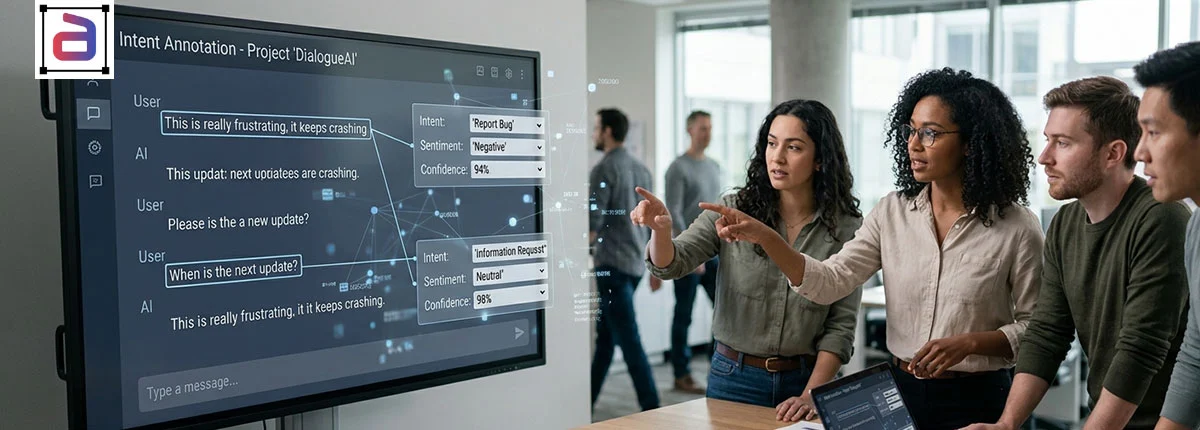
Conversational AI systems — chatbots, voice assistants, virtual agents — only work if they understand what the user wants. That understanding starts with intent annotation. By labeling customer queries with the action categories that map to system responses, annotation enables chatbots to serve customers reliably. See how annotation is revolutionizing customer support chatbots. By labeling customer queries with the action the user is requesting (“Book a hotel,” “Cancel subscription,” “Track my order”), teams teach models to recognize patterns and respond intelligently. Without intent annotation, a chatbot is just a pattern matcher with no idea what to do. But intent alone is not enough — slot filling extracts the parameters that turn intent into action, and its nuances in real conversational speech are explored in slot filling in conversational AI.
This guide covers how to annotate intent for production conversational AI systems. It addresses intent vs entity distinction, ambiguity handling, multi-turn context, and scaling annotation without losing quality.
Key Points
- Intent annotation is the foundation of conversational AI: without correctly labeled user intent, even well-designed dialogue systems respond to the wrong goal.
- Intent taxonomy design is as important as annotation itself — overlapping or ambiguous intent categories produce classifiers that cannot reliably distinguish similar requests.
- Multi-intent utterances (one message containing two requests) are the most common annotation failure point in virtual assistant training datasets.
- Regularly updating intent annotation as user language evolves prevents conversational AI from becoming brittle to new phrasings of familiar requests.
Table of Contents
What Intent Annotation Is and Why It Matters
Intent is the action the user wants the system to perform. “Book a hotel in Mumbai for Friday” has the intent “hotel_booking.” “My payment failed” has the intent “payment_issue.” “How do I reset my password?” has the intent “password_reset.” Each maps a user message to a distinct action.
Why this matters: a conversational AI system cannot respond correctly without knowing the user’s intent. If a user says “My account is locked,” the system must recognize the intent as “account_access_issue,” not “general_inquiry.” The difference determines whether the system escalates to a specialist or offers generic help.
Intent vs Entity: The Critical Distinction
Intent and entity are often confused. They are complementary but different. Intent is the action or goal. Entity is the data the action operates on.
A single user message can have one intent but multiple entities. Example: “Book a flight from New York to London on Friday for two passengers.” Intent: “flight_booking.” Entities: departure_city (New York), arrival_city (London), date (Friday), passenger_count (2). The model needs to extract all of them to fulfill the request correctly. Annotators must label both the intent (what the user wants to do) and the entities (the parameters the action needs).
The Ambiguity Problem in Intent Annotation
The hardest part of intent annotation is ambiguity. Many user messages can map to multiple intents, and which one is correct depends on context or business policy, not grammar.
Example 1: Contextual ambiguity. “I want to change my plan.” This could map to “upgrade_plan” or “downgrade_plan” or “switch_plan_type.” Without the conversation history, the annotator cannot know which. The solution is to always annotate with full conversation context, including the previous three to five turns. A user asking “What’s my current plan?” followed by “I want to change my plan” is likely downgrading or switching. A user asking “What are my options?” then “I want to change my plan” might be upgrading.
Example 2: Policy-dependent ambiguity. “Do you have this product in red?” Could be “product_inquiry” or “product_availability_check.” The business needs to decide: do we annotate these as the same intent or different? Does the chatbot route them to the same action? The annotation guidelines must be clear before work begins. Ambiguous guidelines produce inconsistent labels, which produces a model that cannot decide either.
The standard solution is inter-annotator agreement. Have two annotators label the same sample. If agreement is above 0.80 (Cohen’s kappa), the guidelines are clear and the team can confidently annotate the rest. If agreement is below 0.80, the guidelines need revision — the distinction between intent categories is ambiguous and must be clarified before scaling.
Multi-Turn Intent Annotation
Most real conversations span multiple turns. A user might ask three related questions before making a request. Intent annotation must account for this. A single message like “Yes, that works” only makes sense if you know what was proposed in the previous turn.
Best practice: annotate with full conversation history visible. Some systems annotate at the utterance level (each message gets an intent label) while others annotate at the dialogue act level (labels describe the conversational function: “user_confirms,” “user_requests_clarification,” “user_escalates”). Choose one approach and apply it consistently. Mixing them produces confusion. Conversational audio annotation tracks user intent across multiple dialogue turns, helping AI understand context, follow evolving requests, and resolve references. Accurate multi-turn labeling enables voice assistants and chatbots to deliver more coherent, context-aware, and relevant responses.
Intent Taxonomies: How Deep?
Designing an intent taxonomy is a crucial decision that affects everything downstream. Too few intents and the model cannot distinguish between user requests that need different actions. Too many intents and inter-annotator agreement drops because the distinctions are too fine to apply consistently.
A common pattern is two-level taxonomy: broad intents (e.g., “booking,” “support,” “inquiry”) at level one, specific intents (e.g., “hotel_booking,” “flight_booking,” “car_rental_booking” under “booking”) at level two. This gives the model useful granularity while keeping categorization manageable. Avoid taxonomies with more than 50–100 intent classes unless your team is large and annotation budget is unlimited. Beyond that point, you are paying for precision you cannot actually verify.
Handling Sarcasm, Slang, and Regional Variation
“Great, another error message” is sarcasm. The user is frustrated, but they are saying “great.” A keyword-based system marks it positive. An annotator trained on linguistic nuance marks it as “frustration_expression.” The difference determines whether the chatbot escalates or responds casually.
Slang and regional variations compound the problem. “Fix my issue” (US English) and “sort out my problem” (British English) have the same intent but different syntax. “Prepone my booking” (Indian English) means reschedule earlier, but would confuse most NLU systems.
Solution: annotator diversity. Teams should include native speakers of all languages and regions the system will support, and they should be trained on the linguistic variations specific to your customer base. A finance chatbot annotates differently than an e-commerce chatbot — the domain matters as much as the language.
From Annotation to Model Training
The output of intent annotation is a labelled conversation dataset. Each message gets an intent label and ideally entity labels too. The model learns from these examples to predict the intent of new messages it has never seen.
Quality matters at scale. A dataset of 1,000 high-quality intent examples (where annotators agreed) is more useful than 10,000 examples with low agreement. Before training, compute inter-annotator agreement on a held-out sample. If agreement is below 0.75, annotator training or guideline revision is needed. If agreement is high, confidence in the training data is justified.
Real-World Applications Across Industries
E-commerce: Intent taxonomy includes “product_search,” “product_comparison,” “purchase,” “order_tracking,” “return_request,” “complaint.” High-quality annotation ensures the chatbot routes product questions to recommendations and purchase questions to transaction processing. Banking: “Account_inquiry,” “transfer_request,” “fraud_report,” “loan_application,” “card_issue.” Misclassification here has legal consequences — a fraud report routed to a general support queue is a failure. Healthcare: “Appointment_booking,” “symptom_check,” “prescription_refill,” “billing_question.” Intent boundaries matter because triaging matters — a symptom check might need escalation to a nurse, while a prescription refill can be automated.
Scaling Intent Annotation
Annotating thousands of conversations requires workflow discipline. Best practices: establish clear, documented guidelines before any annotation begins. Have two annotators label the same 100–200 examples to calibrate. Compute agreement. Refine guidelines if needed. Then scale to the full dataset with single annotation (now calibrated). Spot-check regularly — every 500–1,000 examples, pull a random sample and re-annotate to make sure quality has not drifted.
For multilingual datasets, annotate each language separately with native speakers. Do not try to annotate all languages in a single pass with mixed teams — language-specific nuances get lost.
How Annotera Supports Intent Annotation
Annotera provides intent annotation for conversational AI systems across e-commerce, banking, healthcare, and telecommunications. Our teams establish clear intent taxonomies, annotate with full conversation context, compute inter-annotator agreement to calibrate quality, and deliver labelled datasets ready for model training. We handle ambiguity through multi-annotator review and guideline refinement — the same discipline that production systems require.
Conclusion
Intent annotation is the foundation of conversational AI. Get the intent labels right, and the model learns to understand what users want. Get them wrong, and the best generator cannot recover. The difference between a chatbot that frustrates users and one that delights them is often in the quality of the intent annotation it was trained on.
Building a conversational AI system? Partner with Annotera for expert-led intent annotation that powers production-grade chatbots and voice assistants.
Scaling your conversational AI? Annotera delivers specialist intent classification annotation for virtual assistants, chatbots, and dialogue systems. Get a free 48-hour pilot.
This connects closely with how sentiment and intent work together in chatbots.
A closely related read: Text Annotation for NLP: Entity Recognition, Sentiment, Intent & More.
A closely related read: Text Annotation For NLP And Intelligent Document Processing At Scale.