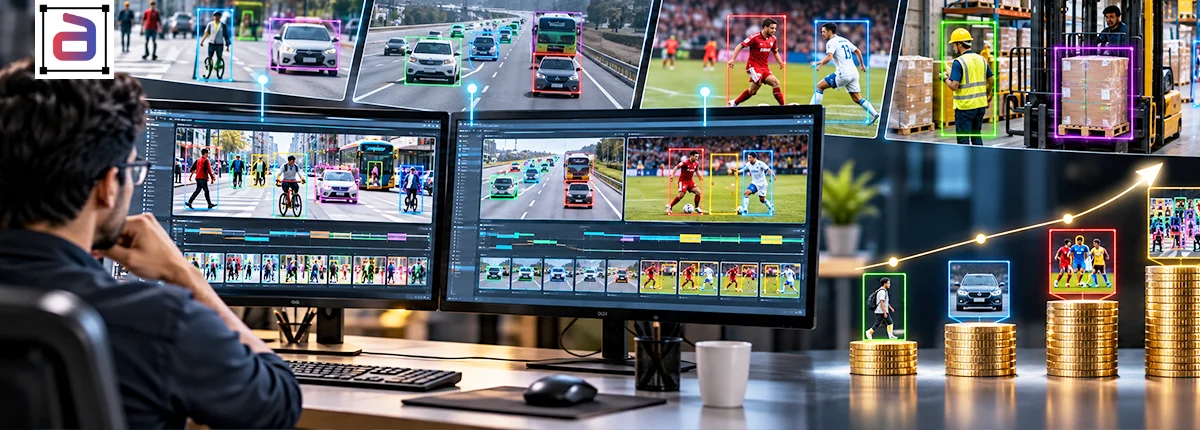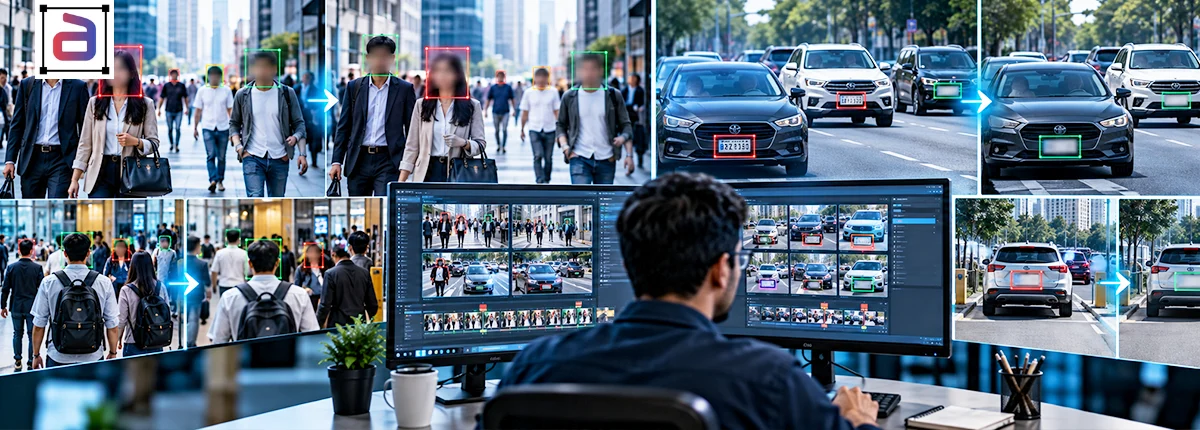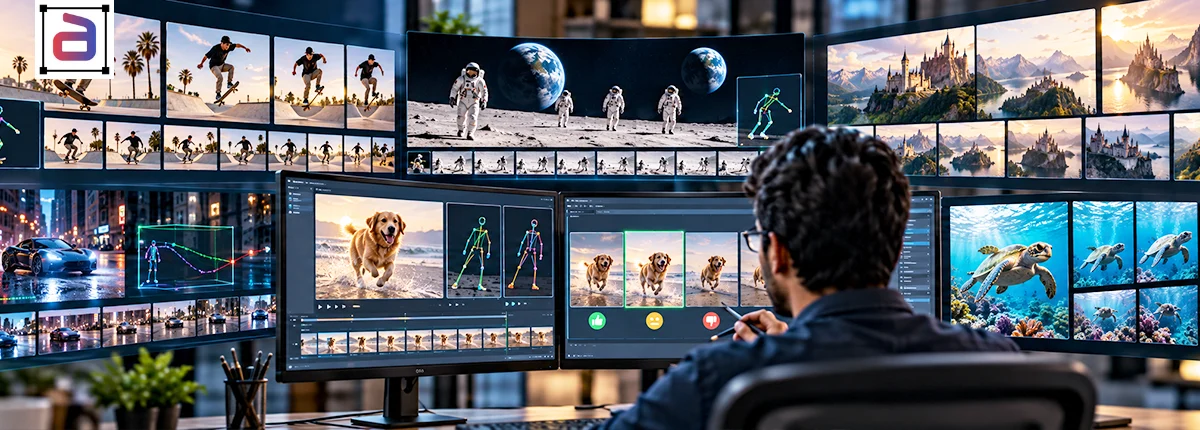
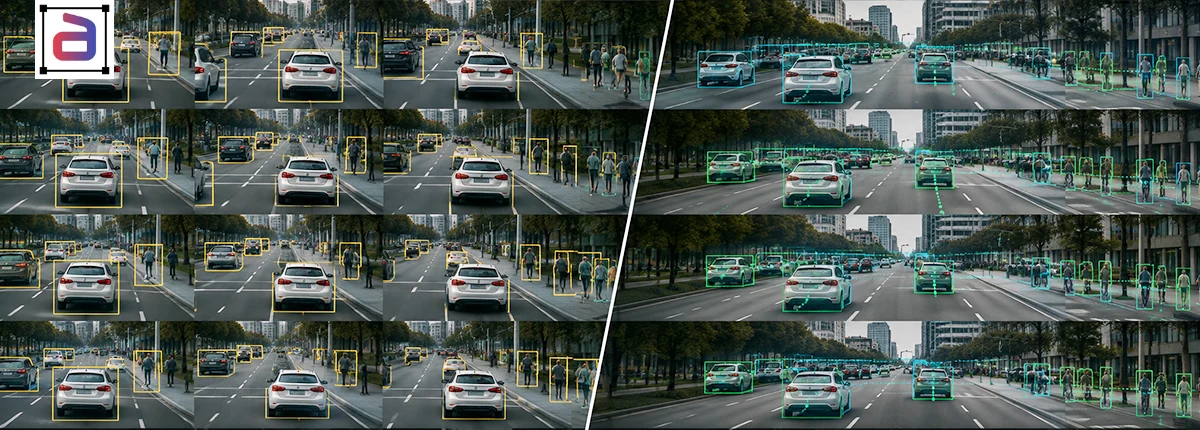
Video is one of the richest sources of training data for modern AI. It captures not only what objects look like, but also how they move, interact, appear, disappear, and change over time. That temporal context is essential for applications such as autonomous vehicles, robotics, intelligent surveillance, retail analytics, and activity recognition. But there is a practical challenge: how should thousands or millions of video frames be annotated without allowing either quality or turnaround time to suffer? Two approaches dominate the conversation: frame-by-frame annotation and interpolated video annotation. One prioritizes granular control, while the other uses automation to accelerate repetitive labeling. For organizations building production-grade AI systems, the real opportunity lies in knowing when to use each—and when to combine them. As the computer vision industry continues to scale, the principle is straightforward: speed matters, but inaccurate training data can cost far more than slow annotation.
Key Points
- Frame-by-Frame Annotation Maximizes Accuracy – Manual annotation of every frame provides greater precision for complex motion, occlusions, fast-moving objects, and safety-critical AI applications.
- Interpolation Improves Speed and Scalability – Keyframe-based interpolation reduces repetitive manual work and accelerates annotation for videos with predictable object movement.
- Hybrid Annotation Balances Quality and Turnaround – Combining interpolation with targeted frame-by-frame review allows teams to focus human effort on complex or high-risk frames while maintaining productivity.
- Annotera Enables Scalable Video Annotation – Annotera combines trained annotation specialists, intelligent annotation workflows, and quality assurance to deliver reliable video datasets for computer vision and AI applications.
What Is Frame-by-Frame Video Annotation?
Frame-by-frame annotation means labeling objects or events independently across individual frames. Annotators examine each frame and manually update bounding boxes, polygons, keypoints, classifications, or other labels according to what appears in the scene. Consider a pedestrian crossing a busy intersection. Their position, posture, scale, and visibility may change continuously. A frame-by-frame workflow allows the annotator to adjust the label whenever those characteristics change. This makes the method highly precise, particularly for difficult video sequences.
Why Choose Frame-by-Frame Annotation?
Frame-level annotation is especially useful when:
- Objects move unpredictably.
- Objects change shape or pose.
- Frequent occlusions occur.
- Multiple objects interact closely.
- Precise boundaries are essential.
- The application has stringent accuracy requirements.
The trade-off is productivity. Manually labeling every frame requires considerably more human effort, making it difficult to scale economically across very large datasets.
What Is Interpolated Video Annotation?
Interpolated annotation takes a more efficient approach. Instead of manually labeling every frame, annotators identify important keyframes and define the object’s position or shape at those points. Annotation software then generates labels for the frames between them.
For example:
- Frame 1: Vehicle manually labeled
- Frames 2–19: Intermediate labels generated through interpolation The annotator then reviews the generated sequence and corrects any frames where the predicted annotation does not accurately follow the object.
- Frame 20: Vehicle manually labeled
Research into efficient video annotation has demonstrated the value of combining human-drawn labels with automated interpolation to generate annotations across otherwise unlabeled frames. As one useful principle from annotation workflows puts it:
“Interpolation significantly reduces annotation time.”
The important qualification is that interpolation should not mean annotation without human oversight. Its effectiveness depends on the quality of keyframes, object motion, and subsequent validation.
Frame-by-Frame vs. Interpolated: Which Is Better?
There is no universal winner. The right method depends on the characteristics of the video and the AI model being trained.
| Factor | Frame-by-Frame | Interpolated |
|---|---|---|
| Annotation precision | Very high | High when motion is predictable |
| Turnaround time | Slower | Faster |
| Manual effort | High | Lower |
| Smooth motion | Effective but repetitive | Highly efficient |
| Sudden movement | Excellent | Requires additional keyframes |
| Occlusion | Strong | Requires human correction |
| Deformable objects | Strong | More challenging |
| Large-scale datasets | Expensive to scale | More scalable |
The key consideration is temporal complexity. A car moving smoothly along a highway may be easy to interpolate. A cyclist suddenly changing direction in crowded traffic is not.
When Frame-by-Frame Annotation Makes More Sense
Frame-by-frame annotation is the safer choice when even small errors can affect model performance. Autonomous driving provides a good example. A perception model may need to distinguish pedestrians, cyclists, vehicles, road barriers, and other objects under constantly changing conditions. A vehicle can accelerate, brake, turn, become partially occluded, or move behind another object within seconds. In such situations, relying exclusively on interpolation can create annotation drift. Frame-by-frame annotation is particularly appropriate for:
- Autonomous vehicle perception
- Complex traffic scenes
- Human pose and action analysis
- Fast-moving objects
- Irregular object trajectories
- Heavy occlusion
- Deformable objects
- Safety-sensitive applications
Annotera’s video annotation workflows support frame-level labeling and multi-object tracking, with quality processes designed to maintain consistency throughout video sequences.
When Interpolation Can Dramatically Improve Productivity
Interpolation becomes particularly valuable when object movement is smooth and predictable. Imagine thousands of hours of warehouse surveillance footage where forklifts travel along defined paths. Manually labeling every frame would consume substantial resources, even when the object changes position gradually. With interpolation, annotators can concentrate on meaningful events instead of repetitive drawing. Keyframes can be added when:
- An object changes direction.
- Its speed changes substantially.
- Another object causes occlusion.
- A new object enters the scene.
- The object changes shape or pose.
- The camera perspective changes.
This makes interpolation more than an automation shortcut. It becomes a resource-allocation strategy, directing human attention toward frames where it creates the most value. Annotera’s own video annotation guidance highlights keyframe interpolation as a way to reduce repetitive labeling while retaining human validation for difficult frames.
The Hybrid Model: Where Accuracy Meets Speed
For many enterprise AI projects, the strongest approach is neither purely manual nor purely automated. It is hybrid annotation.
A typical workflow looks like this:
- Identify keyframes Select frames representing important changes in object position, appearance, or context.
- Annotate keyframes manually Human annotators create accurate bounding boxes, polygons, keypoints, or other required labels.
- Interpolate intermediate frames The annotation platform generates labels between established keyframes.
- Perform human review Annotators inspect the sequence for drift, missed objects, boundary errors, and temporal inconsistencies.
- Correct difficult frames Frames affected by occlusion, rapid motion, or significant appearance changes receive direct manual annotation.
- Apply quality assurance The completed sequence passes through defined validation criteria before delivery. This approach can significantly reduce repetitive work while preserving human oversight where accuracy matters most.
Annotera uses human-in-the-loop workflows and multi-layer quality assurance to support production-grade datasets.
How Data Annotation Outsourcing Can Improve the Balance
Building an internal team capable of handling high-volume video annotation requires trained annotators, project managers, QA specialists, annotation technology, and ongoing workforce management. That is why data annotation outsourcing has become an attractive option for AI companies that need to scale without creating an extensive in-house operation. An experienced data annotation company can evaluate the dataset before production begins and determine which sequences are appropriate for interpolation and which require frame-level attention.
For organizations processing substantial video volumes, video annotation outsourcing can provide access to trained specialists, scalable production capacity, and established QA workflows. A specialized video annotation company can also adapt annotation protocols to different use cases, from autonomous driving and robotics to retail and security. Annotera combines dedicated annotation specialists, scalable delivery, and multi-layer quality assurance to support enterprise AI projects across video and other data modalities. For most large-scale computer vision programs, a carefully managed hybrid workflow provides the strongest balance.
Accuracy Should Drive the Workflow—not the Other Way Around
The biggest mistake is selecting an annotation method based solely on speed. A faster dataset is not necessarily a better dataset. If interpolation produces tracking drift or inconsistent object boundaries and those errors reach the training data, the resulting model may learn the wrong patterns. Instead, AI teams should establish an acceptable accuracy threshold first and then optimize the workflow around it.
“The goal isn’t to annotate every frame manually; it’s to apply human attention where it matters most.”
That principle captures the value of a well-designed hybrid workflow.
Why Annotera Is Built for Scalable Video Annotation
At Annotera, video annotation is designed around the realities of production AI—not simply the mechanics of drawing labels. Our workflows support frame-level annotation, multi-object tracking, bounding boxes, polygons, keypoints, classification, and other video labeling requirements. Projects are supported by trained annotation specialists and multi-layer quality controls designed to maintain consistency across sequences. Whether your project requires meticulous frame-by-frame labeling or a faster keyframe-and-interpolation workflow, the objective remains the same: deliver reliable training data without creating unnecessary annotation bottlenecks. For complex scenes, frame-level annotation provides the precision required to capture difficult visual events.
Conclusion: Choose Precision Strategically
Frame-by-frame annotation offers maximum control. Interpolation offers greater efficiency. Neither approach should automatically replace the other. For predictable motion, interpolation can accelerate production considerably. The future of efficient video annotation is therefore not simply manual versus automated. It is human expertise amplified by intelligent automation. Ready to scale your video datasets without compromising quality? Partner with Annotera to design a video annotation workflow tailored to your accuracy requirements, data complexity, and delivery timeline. Get in touch with Annotera today and turn raw video into production-ready AI training data.
A closely related read: Frame-by-Frame Video Annotation: When Manual Precision Still Beats Automation.