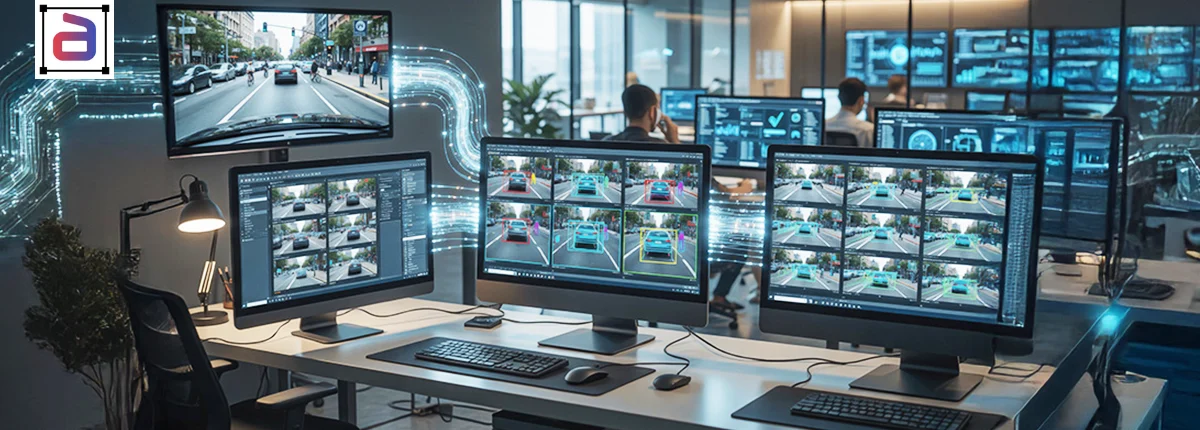
Every second, thousands of vehicles worldwide generate massive volumes of dashcam footage. Hidden within these videos are the insights that power autonomous vehicles, Advanced Driver Assistance Systems (ADAS), intelligent fleet management platforms, and next-generation transportation AI. Yet raw video alone does not create intelligent systems. Before machine learning models can understand road conditions, recognize pedestrians, track vehicles, or identify potential hazards, that footage must be transformed into structured, high-quality training data. This transformation is where video annotation workflow becomes mission-critical. According to industry analysts, autonomous vehicles can generate terabytes of sensor and video data every day. However, AI models can only learn from data that has been accurately labeled and quality-validated.
Poor annotation quality can lead to missed detections, inaccurate predictions, and unreliable model performance—risks that organizations developing safety-critical AI simply cannot afford. A well-defined video annotation workflow transforms raw dashcam footage into structured, AI-ready training data. From data preparation and labeling to quality assurance and dataset validation, each step plays a critical role in improving the accuracy, reliability, and performance of computer vision models.
At Annotera, we believe that high-performing AI starts with high-quality training data. As a trusted specialized video annotation company, we help organizations convert raw visual data into precise, scalable, and machine-learning-ready datasets that accelerate AI development and improve model accuracy. In this article, we’ll walk through the complete workflow that transforms raw dashcam footage into a production-ready labeled dataset.
Key Points
- Raw dashcam footage requires a structured annotation pipeline — clip extraction, tracking, temporal consistency checks — before becoming usable training data.
- Object continuity across frames is the hardest annotation challenge in dashcam datasets, not object detection within a single frame.
- Annotation quality at the frame level directly determines how models perform at highway speeds where milliseconds determine safety outcomes.
- Outsourcing dashcam annotation to specialized teams accelerates dataset development without sacrificing label consistency across large corpora.
Table of Contents
Why Dashcam Video Annotation Matters
Modern computer vision systems must understand not only what objects exist in a scene but also how they move, interact, and change over time. Unlike image datasets, video datasets provide temporal context that enables AI systems to make more informed decisions. Dashcam video annotation workflow provides the contextual data AI systems need to understand dynamic road environments. Moreover, it enables accurate object detection, tracking, and behavior analysis, thereby improving the performance, safety, and reliability of autonomous driving and ADAS applications. Dashcam video annotation provides the structured data needed to train computer vision models effectively. Moreover, by capturing object movements and road interactions over time, it enables more accurate detection, tracking, and decision-making in autonomous driving and ADAS systems.
For autonomous driving and intelligent transportation systems, video annotation enables models to:
- Detect vehicles, pedestrians, cyclists, and road obstacles
- Recognize traffic signs and traffic lights
- Understand lane boundaries and road markings
- Track object movement across frames
- Predict potential collision scenarios
- Improve situational awareness in complex environments
A study by McKinsey estimates that autonomous driving technologies could create hundreds of billions of dollars in economic value over the coming decade. However, these systems depend heavily on accurately labeled training datasets. This is why organizations increasingly rely on experienced data annotation outsourcing partners that can deliver annotation quality, scalability, and consistency across millions of video frames.
“Data is the food for AI.”— Andrew Ng, Founder of DeepLearning.AI
The Journey from Raw Footage to AI-Ready Dataset
Creating a high-quality dashcam dataset involves far more than drawing boxes around objects. It requires a structured workflow designed to maximize annotation accuracy while ensuring consistency across every frame. Transforming raw dashcam footage into an AI-ready dataset involves multiple structured steps. First, data is prepared and annotated; subsequently, rigorous quality checks and validation ensure the dataset is accurate, consistent, and optimized for machine learning model training.
Step 1: Capturing Real-World Dashcam Footage
The process begins with collecting diverse video data from vehicles operating in real-world environments. To build robust AI models, datasets must include:
- Urban traffic environments
- Highways and expressways
- Rural roads
- Daytime and nighttime conditions
- Rain, fog, and low-visibility scenarios
- Construction zones and detours
- Heavy pedestrian activity
The broader the environmental diversity, the better the model can generalize to unseen situations. At Annotera, we help clients structure data collection strategies that ensure comprehensive coverage of real-world driving conditions. Capturing diverse dashcam footage is the foundation of effective AI training. By recording various road conditions, weather scenarios, and traffic environments, organizations can create comprehensive datasets that, in turn, improve model accuracy, adaptability, and real-world performance.
Step 2: Data Preparation and Quality Screening
Not all footage is suitable for training AI systems. Before annotation begins, videos undergo rigorous screening to identify:
- Corrupted files
- Camera obstructions
- Motion blur
- Poor lighting
- Duplicate footage
- Recording anomalies
Removing low-quality data early helps reduce annotation costs while improving overall dataset quality. Before annotation begins, footage must undergo thorough preparation and quality screening. Consequently, removing corrupted, blurry, or duplicate files ensures cleaner datasets, while improving annotation efficiency and ultimately enhancing the accuracy and reliability of AI model training.
Step 3: Frame Selection and Sampling
A single hour of dashcam footage can contain over 100,000 individual frames. Annotating every frame may not always be necessary. Since video datasets contain thousands of frames, selecting the most relevant ones is essential. Therefore, strategic frame sampling reduces annotation effort while maintaining critical visual information, ultimately balancing project costs, efficiency, and machine learning model performance. Depending on project objectives, annotation teams may use:
- Key-frame annotation
- Interval-based sampling
- Continuous frame-by-frame annotation
- Event-driven frame selection
Choosing the right sampling strategy balances project timelines, budget requirements, and model performance goals.
Step 4: Developing Annotation Guidelines
Consistency is the foundation of successful AI training datasets. Clear annotation guidelines ensure consistency across every labeled frame. Moreover, they establish standardized rules for object classification, tracking, and edge cases, thereby reducing errors and improving the overall quality and reliability of AI training datasets.
Detailed annotation guidelines define:
- Object classes
- Occlusion handling rules
- Tracking protocols
- Lane marking definitions
- Edge-case treatment
- Quality acceptance criteria
Without clear standards, annotation inconsistencies can introduce noise into datasets and negatively impact model accuracy. As a leading video annotation company, Annotera develops project-specific annotation protocols that ensure every label aligns with client requirements.
Step 5: Annotating Objects and Events
This is where raw visual information becomes machine-readable intelligence. Once guidelines are established, annotators label objects and events using techniques such as bounding boxes, segmentation, and tracking. As a result, raw footage is converted into structured data that enables AI models to accurately interpret real-world scenarios.
Depending on project objectives, annotation methods may include:
- Bounding Box Annotation
- Polygon Annotation
- Semantic Segmentation
- Instance Segmentation
- Keypoint Annotation
- Multi-Object Tracking
For example, a vehicle entering a frame must maintain a consistent identity throughout its movement across subsequent frames. Accurate tracking enables AI models to understand object behavior and trajectory prediction.
“The best data is the data that represents the real world.”— Fei-Fei Li, Professor of Computer Science, Stanford University
High-quality annotation ensures that AI systems learn from reality—not assumptions.
Step 6: Multi-Level Quality Assurance
Annotation quality directly influences model performance. Multi-level quality assurance ensures annotation accuracy through systematic reviews and validation processes. Furthermore, by identifying inconsistencies and correcting errors early, organizations can maintain high-quality datasets that ultimately improve AI model performance, reliability, and real-world effectiveness.
At Annotera, every dataset undergoes multiple quality validation layers, including:
- Peer reviews
- Senior annotator audits
- Dedicated QA inspections
- Domain expert validation
Quality metrics often include:
- Annotation accuracy
- Tracking consistency
- Label completeness
- Inter-annotator agreement
- Edge-case coverage
This rigorous quality framework helps maintain dataset reliability at enterprise scale. Accurate video annotation workflow require rigorous quality assurance at every stage. Therefore, multi-level reviews, audits, and validation checks help identify inconsistencies early, ensuring dataset reliability and ultimately improving the performance and trustworthiness of AI models.
Step 7: Dataset Export and Formatting
Once annotations are validated, datasets are converted into machine-learning-compatible formats such as:
- COCO
- YOLO
- KITTI
- Pascal VOC
- TensorFlow Record
Additional metadata, tracking IDs, timestamps, and classification attributes are incorporated to support model training workflows. After quality validation, annotated data must be exported in machine-learning-compatible formats. Consequently, proper dataset formatting ensures seamless integration with training pipelines, while enabling AI models to efficiently process and learn from the labeled information.
Step 8: Continuous Improvement Through Model Feedback
The most successful AI programs view annotation as an ongoing process rather than a one-time activity. Once models are trained, performance insights reveal areas for improvement. Consequently, feedback from predictions and errors helps refine annotations, while continuously enhancing dataset quality and enabling AI systems to achieve greater accuracy over time.
After model training begins, performance metrics help identify:
- Missed detections
- Edge cases
- Rare traffic scenarios
- Environmental blind spots
These insights guide future annotation efforts, creating a continuous improvement cycle that strengthens model performance over time.
Why Organizations Choose Annotera
Building production-grade AI requires more than annotation capacity—it requires annotation expertise. As a trusted data annotation company, Annotera combines domain specialists, scalable workflows, advanced quality assurance processes, and flexible delivery models to support enterprise AI initiatives. Organizations choose Annotera for its combination of domain expertise, scalable workflows, and rigorous quality standards. Moreover, our dedicated annotation teams deliver accurate, consistent datasets, enabling businesses to accelerate AI development while reducing operational complexity and costs.
Our video annotation outsourcing services help organizations:
- Accelerate dataset creation
- Improve annotation consistency
- Reduce operational overhead
- Scale projects efficiently
- Maintain exceptional quality standards
Whether you’re developing autonomous vehicle systems, ADAS solutions, intelligent transportation platforms, or computer vision applications, Annotera delivers the precision and scalability required to build reliable AI.
Transform Your Dashcam Data into AI-Ready Intelligence
High-quality video annotation workflow is the bridge between raw footage and high-performing AI models. Every accurate label contributes to safer autonomous systems, smarter transportation networks, and more reliable computer vision applications. If you’re looking for a trusted partner for data annotation outsourcing or video annotation outsourcing, Annotera can help you accelerate development while maintaining the highest standards of quality and consistency.
Ready to Build Better AI Models?
Partner with Annotera’s expert annotation teams to transform complex dashcam footage into precise, machine-learning-ready datasets. Contact us today to discuss your project requirements and discover how our scalable video annotation solutions can help drive your AI initiatives forward.A closely related read: The Growing Role of Human-in-the-Loop Video Annotation in AI Surveillance Systems.