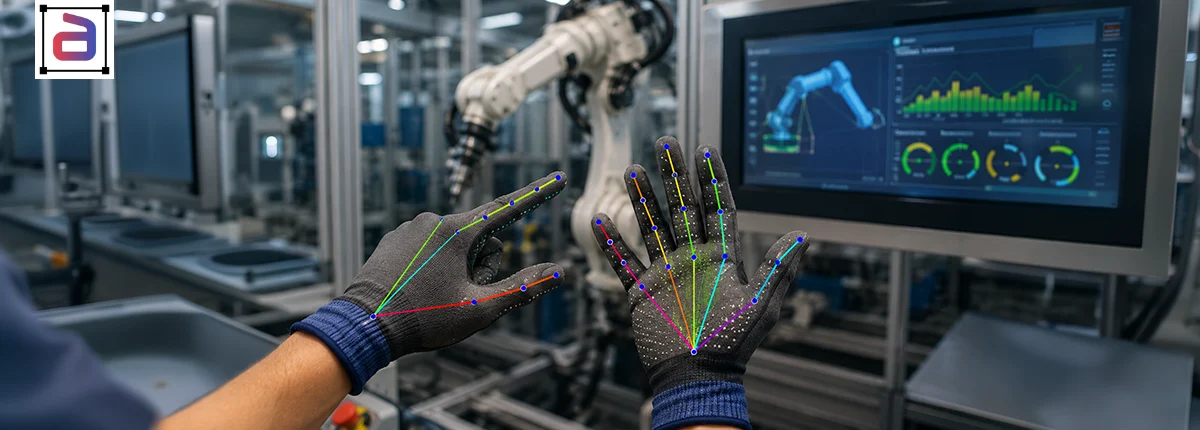
Industrial workplaces are entering a new era of human-machine interaction. Traditional keyboards, touchscreens, and handheld controllers no longer meet every operational need. Workers often wear protective equipment, handle heavy machinery, or operate in environments where conventional interfaces become impractical. As a result, glove-based interfaces have emerged as a promising solution. These systems rely heavily on keypoint annotation services to accurately capture hand and finger movements for machine learning applications. The success of intelligent glove-based systems depends on precise training data. High-quality keypoint annotation services enable AI models to identify finger joints, hand gestures, and complex movement patterns with remarkable accuracy.
Companies increasingly collaborate with an experienced image annotation company to create datasets that support industrial automation, worker safety, and productivity enhancement. As industrial AI adoption accelerates, many organizations turn to image annotation outsourcing providers to scale annotation projects efficiently. The demand for accurate hand tracking data continues to grow because manufacturers seek smarter ways to bridge human expertise and machine intelligence.
Key Points
- Industrial glove-based interfaces rely on precise keypoint annotation of every joint and fingertip to enable accurate hand gesture recognition.
- Annotation must account for glove deformation, finger occlusion, and variation in grip pressure across different hand sizes and glove types.
- High keypoint precision is essential in industrial settings where a misread gesture could trigger unintended machinery commands.
- Annotated hand-tracking datasets must cover the full range of industrial gestures, not just common consumer or household hand movements.
Table of Contents
Why Industrial Glove-Based Interfaces Depend on Keypoint Annotation Services
Hand and finger tracking technology has progressed significantly during the past decade. Modern industrial gloves often include sensors, cameras, and AI-powered recognition systems. These technologies transform natural hand movements into digital commands. However, AI models cannot understand gestures without extensive training. Every finger bend, pinch, grasp, and rotation must be labeled correctly. This process begins with detailed keypoint annotation. A keypoint annotation project identifies specific anatomical landmarks across the hand. Annotators mark joints, fingertips, knuckles, and wrist positions across thousands of images or video frames. The resulting dataset teaches AI systems how human hands move in real-world environments.
Industrial settings present additional challenges. Workers frequently wear protective gloves. Lighting conditions vary dramatically. Hands may hold tools, equipment, or components that partially block visibility. Therefore, annotation accuracy becomes a critical factor in system performance. Consider a technician operating heavy machinery while wearing augmented reality gloves. A slight tracking error may trigger an incorrect command. Such mistakes can reduce productivity or create safety concerns. Accurate keypoint annotation minimizes these risks.
As computer scientist and AI pioneer Geoffrey Hinton once noted, “The key to artificial intelligence has always been the representation.” His observation remains highly relevant for industrial gesture recognition systems.
The Growing Role of an Image Annotation Company in Industrial AI Development
Many organizations underestimate the complexity of hand tracking datasets. At first glance, annotating fingers appears straightforward. Reality tells a different story. Human hands contain more than twenty degrees of freedom. Each finger moves independently while interacting with surrounding objects. Industrial tasks introduce additional variability through gloves, tools, machinery, and environmental conditions. An experienced image annotation company develops workflows that address these challenges systematically. Specialized teams create annotation guidelines that ensure consistency across millions of data points. Consistency matters because AI models learn patterns from annotations. Even small labeling differences can reduce prediction accuracy.
High-performing industrial AI systems require reliable annotations across every frame. Several leading technology companies have demonstrated the importance of hand tracking. Meta Reality Labs has invested heavily in hand-tracking research for wearable computing systems. Their findings show that accurate finger tracking improves user interaction quality significantly. Industrial manufacturers now apply similar concepts within factories and production facilities. Smart gloves assist workers during assembly, maintenance, logistics, and quality inspections. These applications depend on trustworthy training data. The broader implication extends beyond convenience. Accurate hand tracking enables machines to interpret human expertise in real time. This capability creates opportunities for collaborative robotics, advanced training systems, and operational intelligence.
How Image Annotation Outsourcing Accelerates Industrial Innovation
The demand for industrial AI training data continues to outpace internal annotation capacity. Consequently, many enterprises adopt image annotation outsourcing strategies. Outsourcing provides access to specialized annotation teams, scalable workflows, and quality assurance processes. Instead of building large internal annotation departments, organizations can focus on AI development and deployment. This approach becomes especially valuable when projects require large volumes of annotated data. Industrial hand tracking models often need hundreds of thousands of labeled images. Video datasets may contain millions of frames. Through image annotation outsourcing, companies can accelerate project timelines while controlling costs.
Experienced providers also implement validation processes that improve dataset reliability. Yet outsourcing raises another important discussion. Should annotation simply focus on scale, or should it prioritize contextual understanding? Industrial hand tracking requires more than marking finger joints. Annotators must understand workplace environments, safety equipment, tool interactions, and operational workflows. Context improves annotation quality. For example, a maintenance worker gripping a wrench produces different hand poses than a warehouse employee scanning inventory.
Annotation teams must recognize these distinctions consistently. This requirement aligns closely with Google’s Experience, Expertise, Authoritativeness, and Trustworthiness principles. Data quality depends on domain knowledge, not merely annotation speed. The most successful annotation partnerships combine technical precision with industrial expertise. Organizations that recognize this relationship often achieve stronger machine learning outcomes. Image annotation outsourcing helps organizations scale AI training data production while maintaining quality and efficiency. Computer vision systems rely on accurately annotated datasets to recognize hand gestures, finger positions, and motion patterns in industrial environments.
Beyond Gesture Recognition: The Future of Human-Machine Collaboration
Industrial glove-based interfaces represent more than a technological upgrade. They signal a broader shift toward intuitive human-machine collaboration. Traditional interfaces require workers to adapt to machines. Gesture-based systems reverse this relationship. Machines learn to understand natural human behavior. This evolution creates significant opportunities across manufacturing, logistics, energy, aerospace, and healthcare sectors. AI-powered gloves can support worker training, reduce operational errors, and improve safety monitoring. Nevertheless, several challenges remain. Annotation teams must address edge cases, glove variations, occlusions, and cultural gesture differences.
Models must also perform reliably under changing environmental conditions. Interestingly, human hands remain one of the most difficult structures for computer vision systems to interpret accurately. As engineers often joke, “Teaching AI to understand hands is easy—until humans start moving them.” The humor reflects a genuine challenge. Human dexterity evolved over millions of years. Replicating that understanding through machine learning requires extraordinary amounts of annotated data. Therefore, keypoint annotation services will continue playing a foundational role in industrial AI development. Their importance will only increase as glove-based interfaces become more sophisticated.
Conclusion
Industrial glove-based interfaces are transforming how workers interact with machines. Their effectiveness depends on precise hand and finger tracking powered by high-quality keypoint annotation services. Organizations that partner with an experienced image annotation company gain access to specialized expertise, consistent labeling practices, and scalable data operations. Meanwhile, image annotation outsourcing enables faster development cycles without compromising quality. As industrial AI advances, the organizations that invest in accurate annotation today will build the intelligent, human-centered workplaces of tomorrow. The future of industrial innovation may not begin with machines alone. It may begin with teaching machines to understand the human hand. Transform industrial hand-tracking projects with Annotera’s expert keypoint annotation services. Our skilled teams deliver precise, scalable datasets that improve glove-based interface performance, accelerate AI development, and support safer, smarter human-machine interactions. Contact us today to discuss your requirements.
A closely related read: Training Humanoid Robots with Image Skeletal Data.
A closely related read: Skeletal vs. Keypoint: Choosing for Pose Estimation.