
Pose estimation is central to many computer vision applications, from human–computer interaction to motion analytics. However, selecting the right annotation approach often determines whether a model scales successfully or struggles with inconsistency. In this decision-making process, a clear skeletal annotation guide helps teams understand when skeletal representations outperform simple keypoints and when lighter approaches are sufficient. Learn more about skeletal annotation for fall detection in elderly care.
For data managers overseeing pose estimation pipelines, choosing between skeletal and keypoint annotation is as much a strategic decision as it is a technical one.
Table of Contents
Key Points
- Keypoint annotation captures discrete joint locations; skeletal annotation adds the structural connections between those joints — the choice determines whether AI learns positions or relationships.
- Pose estimation tasks that require joint angle calculation need skeletal annotation because angles cannot be computed from keypoints alone without the connectivity information that skeletal graphs provide.
- Keypoint annotation is the right choice when the AI task requires fast, lightweight inference: skeletal graphs add relational information at the cost of increased model and annotation complexity.
- Annotation programs should define the skeleton graph topology explicitly — which joints connect to which — before annotation begins, as post-hoc skeleton assembly from keypoint-only annotations is unreliable.
Table of Contents Learn more about video keypoint labels for movement recognition AI.
Understanding Keypoint Annotation
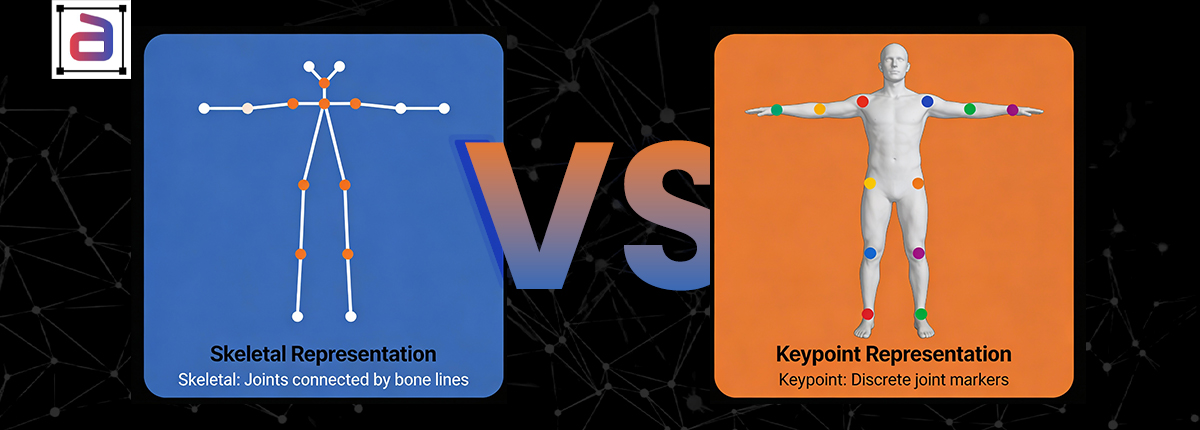
Keypoint annotation involves marking discrete points of interest on an object, such as joints, facial features, or landmarks. These points provide positional information but do not explicitly encode relationships between them.
As a result, keypoint-based models often require additional logic to infer structure, connectivity, and motion constraints.
What Skeletal Annotation Adds Beyond Keypoints
Skeletal annotation builds upon keypoints by explicitly connecting them into a hierarchical structure. Consequently, models receive both positional data and relational context.
Through this structure, skeletal annotation enables AI systems to learn joint dependencies, limb constraints, and coordinated motion patterns more effectively. While keypoints identify individual body joints, keypoint skeletal annotation services connect those points into a complete body structure. In elderly care AI, this enables more accurate fall detection, gait analysis, posture monitoring, and mobility assessment within smart care facilities.
Pose Estimation Accuracy and Stability Considerations
Keypoint-based approaches can perform well in simple or controlled scenarios. However, as pose complexity increases, missing or misaligned points can destabilize predictions.
By contrast, skeletal representations introduce redundancy and constraints, which improve robustness in the presence of occlusion or noise.
Choosing the Right Approach for Your Data Pipeline
Choosing the right approach for your data pipeline depends on factors such as data volume, processing speed, scalability, and integration needs. Evaluating modern architectures and best practices can help organizations design efficient pipelines that support reliable data processing and analytics-driven decision-making.
When Keypoints Are Sufficient
For lightweight applications or early-stage experiments, keypoint annotation offers faster turnaround and lower annotation cost.
When Skeletal Annotation Is the Better Choice
Complex movement analysis, biomechanics, robotics, and multi-joint coordination benefit significantly from skeletal annotation due to its structured nature.
Operational Implications for Data Managers
Annotation choice affects dataset size, review complexity, and long-term maintainability. Therefore, data managers must balance accuracy requirements against delivery timelines and budget constraints.
A skeletal annotation guide helps standardize decisions and reduce rework as datasets scale.
Managing Consistency Across Annotation Types
Switching between keypoint and skeletal approaches without clear governance introduces inconsistency. Consequently, documenting annotation standards and use-case alignment is critical.
With clear guidance, teams can maintain consistency even across mixed datasets.
How Annotera Supports Pose Estimation Strategy
Annotera provides a structured skeletal annotation guide, supported by trained annotation teams and quality-assurance workflows. Clients receive clear recommendations aligned to model goals and operational constraints.
As a result, data managers can make informed annotation choices without compromising data quality.
Conclusion
Choosing between skeletal and keypoint annotation is not about right or wrong. It is about fitness for purpose.
With a well-defined skeletal annotation guide, teams can align annotation strategy with pose estimation objectives and scale confidently.
Evaluating pose estimation strategies or managing large annotation pipelines? Partner with Annotera for expert guidance and skeletal annotation solutions built for accuracy and scale.
A closely related read: Skeletal Annotation for Fitness Apps and AI Trainers.